
Local artists find inspiration in French countryside Group of 20 spends two weeks along Normandy coast studying and sketching
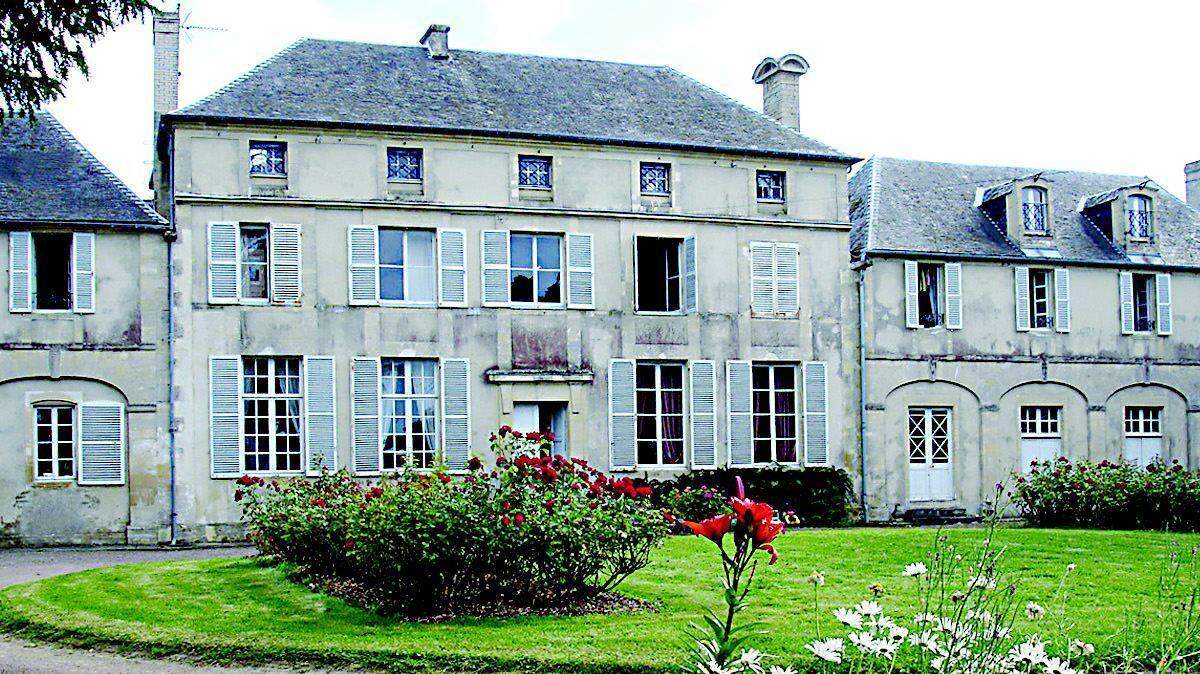
The mourning doves cooed as I opened the old shutters and gazed at the lipstick-red rose garden, the massive iron gates and the wheat field beyond. Gone was the frenzy of Paris, replaced by absolute stillness and daylight filtering through the fir trees.
Was this "Upstairs Downstairs" or perhaps Marie Antoinette's boudoir?
Ah yes, back to reality. Fitz and I were spending a week in an 18th-century French chateau in Normandy, close to the site where William the Conquerer launched his 1066 invasion of England, Claude Monet began his Impressionist style and thousands of American soldiers lost their lives in the D-Day invasions of World War II. A place of fiery history and natural beauty.
We were 20 Winthrop University art students, faculty and friends, dropped into the lush countryside of northwestern France to study how the masters did it, and have a go ourselves. We were a happy, compatible lot. Our expert teachers, Winthrop professors Seymour Simmons and Peg DeLamater, brought to life the drawing, painting and French art history that had swirled around Normandy for centuries.
The three-story chateau had thick stonewalls, the foundations of a 14th-century circular staircase and faint remains of the ox blood exterior. Called Chateau Rouge for that reason, its back garden was filled with small apple trees, evergreens, red and black currants and raspberries hugging the fence. Magnificent rose bushes sent their fragrance inside when the breakfast room doors were thrown open. Bees busily spread pollen throughout the garden. Our laundry drying on hedges became part of our own art exhibit!
"The back yard looked like an Impressionist painting," said Winthrop English professor Bill Naufftus, who tagged along with his wife, Ann, a student in the art course. "It was like "Le Dejeuner sur l'Herbe" with clothes on."
The two-week trip started with five days in Paris and ended with eight days in Meuvaines, the farm village of Chateau Rouge, walking distance to the ocean. Seymour, Peg and Seymour's French wife, Martine, planned the excursion, their third in six years, to excite students about the art in Paris museums. Then off to the relaxing countryside where we would step in the artists' shoes to paint on our own.
We took our granddaughter, Madeline FitzGerald, an art student at Rock Hill High, for the same reasons. She is tall and blonde and quickly noted there weren't many blonde French people. She bought a fashionable scarf and black cap and soon was on her way to becoming a Francophile.
"I wanted to blend in," said Madeline, who altered her hairstyle as well. She even mastered the Metro, but under our watch, we decided not to turn our Rock Hill girl loose in such a sumptuous city. Besides, it was more fun to be right there, sensing her awe as she cruised down the Seine, past the Louvre and Eiffel Tower and discovered her name on the Madeleine Church and Ste. Marie Madeleine statue.
"I felt very important, like I was a part of it," she said.
New foods were a challenge she relished, as she downed escargots, rabbit, mussels and even fried pigs ears.
"I felt accomplished," she said, "and not grossed out. "
The first morning in Paris, we stood at Notre Dame, surrounded by tourists and gypsies, one eye squinted, pencil in extended hand, measuring the historic cathedral. Seymour started us on the bell towers, having us measure from top to bottom to get the height and perspective right. Somehow my cathedral ran off the page and I decided instead to shoot pictures of the gothic church and its peering gargoyles.
Rather than just "expressing ourselves," Seymour's techniques were traditional: planning the design, studying the subject, methodical sketching and finally adding color. Starting at Notre Dame and continuing through the Louvre, Musee d'Orsay, Cluny, Ste. Chapelle, and Orangerie, our classes and museum trail led through the ancient world, medieval art, Impressionism, French art and everything in between. Once, Seymour used a shady spot in Tuileries Garden as a classroom, scooping water from a pond to mix with watercolor paint and bring his sketch to life. I began to understand and appreciate the time-consuming work that goes into painting, from such huge creations as Gericault's "The Raft of the Medusa," with its shipwrecked bodies, to da Vinci's surprisingly small "Mona Lisa," with all that blur around her smile. Now, I will prepare for museums and never drift past a painting without trying to analyze the artist's intent.
Jonatha Vare, of Winthrop's College of Education, expressed it best, "Now I know why people sit for hours in front of a painting."
Enroute to Meuvaines, we stopped at Giverny, Monet's long-time home on the Seine, to see his water lilies and breathtaking garden. The lilies were the subject of his famous floating Nympheas, which we had just seen in the newly renovated Orangerie Museum.
Jonatha looked at the lilies from all angles and asked, "Where did Monet sit?" We were thinking like artists.
We began our Normandy adventure by exploring our 10 comfy bedrooms and the living room's pink French provincial furniture. We shopped with Martine for fresh vegetables and discovered the 11th-century Saint Manvieu Church next door, with its Romanesque arches and yellow, lichen-covered roof, splayed like mustard on the tiles. I liked just sitting and looking at it.
Our hostess was Colette Deneubourg, a retired art teacher from Paris and friend of the Simmonses, whose family bought the rundown chateau in the 1970s to renovate for vacations.
We immediately felt the relaxation of the rolling wheat fields, high stonewalls popping with wildflowers and many choices of places to read or sketch. Madeline found a bicycle in the shed and threw off the regimentation of museums by breezing down narrow roads to draw or inspect the neat villages and seashore.
"I figured I could go further on a bike," she said.
One favorite pastime was helping Martine, our main chef, in the kitchen. We chopped vegetables for the ratatouille, prepared crust for the quiche, sliced fennel into the salad and tossed coriander seeds into cold, white rice. Her forte definitely was creative cooking. When Colette set the baronial table, she strew it with pink rose petals, adding to the ambiance of dinner. Usually the 20 of us ate about 10 , which seemed like 7 because the late sunsets.
After Seymour's daily breakfast room lectures, we headed, sketchbooks in hand, for sites that oozed French history: Caen, with its elegant abbeys and the remains of William the Conquerer's castle; the delightful fishing town of Honfleur, where Monet painted in the filtered light and moist air of the seaside, and Bayeux.
Peg educated us in advance, describing Bayeux's famous Middle Ages' tapestry, which isn't really a tapestry, she said, but an embroidery on linen stitched in silk and wool. Three-quarters of a football field long and 20 inches high, the tapestry's continuous narrative, with Viking ships and leggy men on horses, describes the Conquest of England by William. Its upper and lower borders reminded me of Fox News' running commentary -- 1,000 years later - portraying writhing soldiers, mythological animals and farmers plowing fields.
I was most impressed with the Normandy American Cemetery and Memorial at Omaha Beach. Its visitor center, chapel and Garden of the Missing helped us understand the sacrifice this generation experienced, but the endless rows of crosses and Stars of David, about 10,000 in all, were the ultimate reminder. Madeline did a rubbing of her great uncle's cross while I blocked raindrops with an umbrella. The rain cleared when we walked to the bluff, overlooked the sea and tried, on this pastoral day, to imagine the hysteria on June 6, 1944, as thousands of Americans plunged forward to free Europe.
The French narrative in an informative film said it best, "They gave their collective future to ensure ours." It's an area of France that all Americans should experience.
The final night soiree, where we taped our art to the wall for comments (including Fitz's sketches but minus my lopsided cathedral) demonstrated how much the students had learned in this stimulating setting. They had shot hundreds of photos, drawn endless churches and painted exquisite landscapes.
I'm sure they all agreed with a thank you note from Madeline: "Thank you for giving me France."
Google Chateau Rouge Meuvaines and you will find the listing with several photos. Be sure to click on "translate this" so it will be in English Or try the normandy-vacation-rentals.com website, click on Les Portes de l"ile de France, then click on "Special Offers" for Chateau Rouge.
By mail, write to Les Portes de l'Ile de France, 44, Chaussee Julius Caesar, F-95130 Le Plessis-Bouchard, France.
This story was originally published July 26, 2008 at 11:42 PM.