
What if you could hear a Picasso? New Charlotte museum exhibit expands inclusion
A 2020 survey on the museum-going experiences of blind adults found that while blind and low-vision adults are eager to engage with art, many still feel unwelcome in museums.
From unclear signage to a lack of sensory alternatives, the message, intended or not, is that these spaces weren’t built with their way of seeing in mind. That disconnect is exactly what artist Janet Biggs is working to undo.
Her new installation at the Bechtler Museum of Modern Art in uptown Charlotte, Biggs invites visitors to experience art not just with their eyes, but with their full bodies through sound, movement and presence. It’s called “Collection, Reframed: We Are Here, Beyond Vision.”
The exhibit opened in early July and runs through Sept. 22.
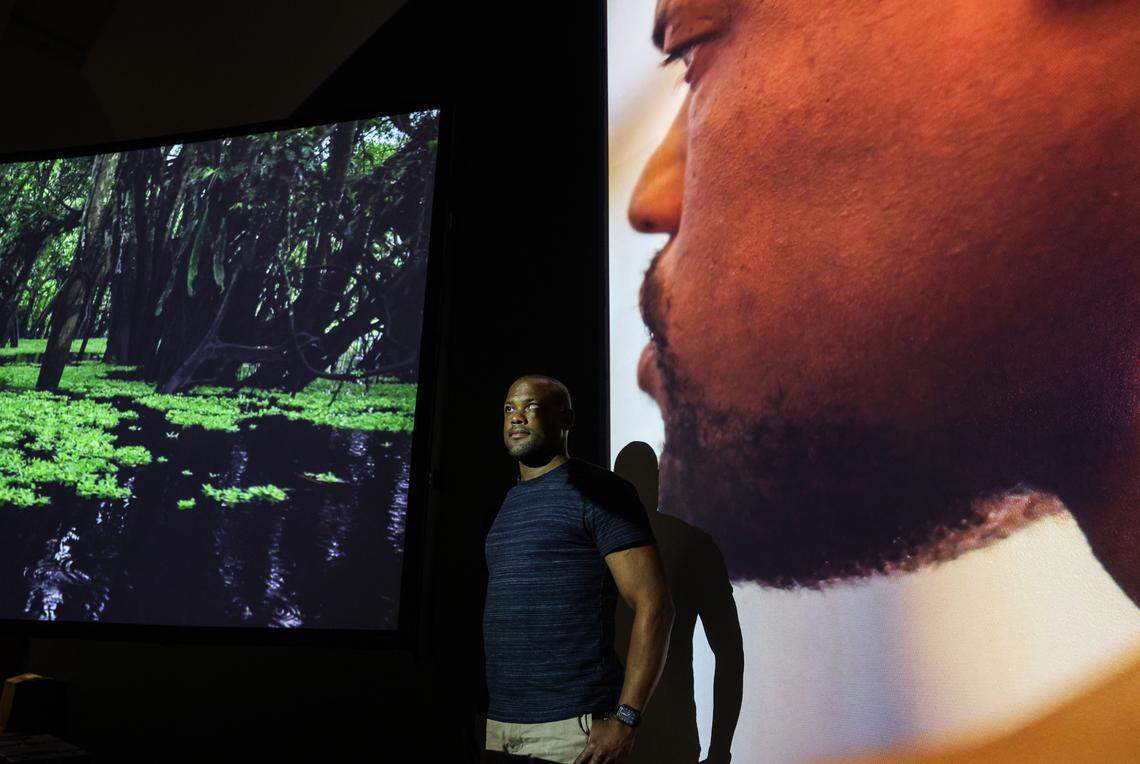
It’s a collaboration with Charlotte resident and UNC Charlotte grad Davian “DJ” Robinson, a visually impaired dancer and choreographer, Bechtler curator Katia Zavistovski and a multidisciplinary team from Virginia Tech and the University of Kansas.
The exhibit uses immersive video, spatial audio and something called “data sonification” to transform how we engage with visual art.
It brings together more than 60 paintings, sculptures and works on paper that explore the human body in all its complexity. It features some of the most visionary artists of the 20th century — including Edgar Degas, Alberto Giacometti, Henri Matisse and Andy Warhol.
Bechtler Executive Director Todd Smith said the “Collection, Reframed” summer series invites contemporary artists and creatives to engage with the museum’s holdings.
“We envision this series as a way to create fresh conversations around the works in our permanent collection, which includes some of the most respected modern artists of the 20th century,” Smith said in a statement.
In a moment where immersive art experiences are de rigueur, this show pushes experiential boundaries and allows us to wonder, what if we could hear a Picasso? Or, what if a dance could decode Degas?
The result echoes the late art critic John Berger, who opened his “Ways of Seeing” book by declaring, “Seeing comes before words.” Biggs takes that premise and flips it outward by challenging the dominance of sight itself and inviting visitors to not only see, but to listen, to feel and to move.
‘Defying the expected’
Robinson, who appears in several of the show’s six installations, was first contacted by Biggs in late 2023.
“This all just started as a beautiful conversation,” he said. “She’d seen my work and reached out through my website. I wasn’t even sure it was real at first.”
During their conversation, Biggs told Robinson about a 1987 ABC “Nightline” broadcast that featured conservative writer William F. Buckley and Jim Dickson, a blind sailor who had attempted a solo transatlantic voyage.
In the broadcast, Buckley suggested that Dickson couldn’t enjoy sailing because of his lack of sight and that his efforts went “against nature.” Dickson fired back, telling Buckley, “You are a lot more blind than I am because you can’t see what a person can do in my circumstances.”
That moment inspired Biggs’ vision, as a perceived constraint was recast as an opportunity for mobility. She saw Robinson as the perfect collaborative partner to execute this vision.
“Contra Naturam,” one of the installation’s feature pieces, gets its name from the Latin phrase that translates to “against nature.” But for Robinson, it’s less of a defiant proclamation than an expansive one.
“To me, ‘contra naturam’ is about defying the expected, what society thinks a body should or shouldn’t be able to do,” he said.
In the piece, Robinson’s choreography reimagines form and perception, bridging what he calls the “two-dimensional world of fine art” with the “three-dimensional space of lived experience.”
Through movement, he gives new shape to static forms.

Turning data into sound
One of the show’s innovative elements is its use of “data sonification,” or the process of translating data into sound.
That required taking hundreds of high-resolution photos of three artworks from the Bechtler’s permanent collection: a painting by Maja Godlewska titled “White” (2004), a bronze by Barbara Hepworth called “Garden Sculpture (Model for Meridian)“ (1958) and a tapestry by Pablo Picasso, “The Acrobat” (1968).
The data behind those photos is then converted into different sounds with varying in tone, pitch and rhythm. The resulting soundscapes are then spatialized, or moved around like a surround sound system, to create an immersive experience.
This lets patrons, including those who are blind or have low vision, to hear modern masterpieces.
“People always say visual art isn’t for blind folks,” Robinson said. “But if you just expand the medium, anyone can experience it. Accessibility is about imagination.”
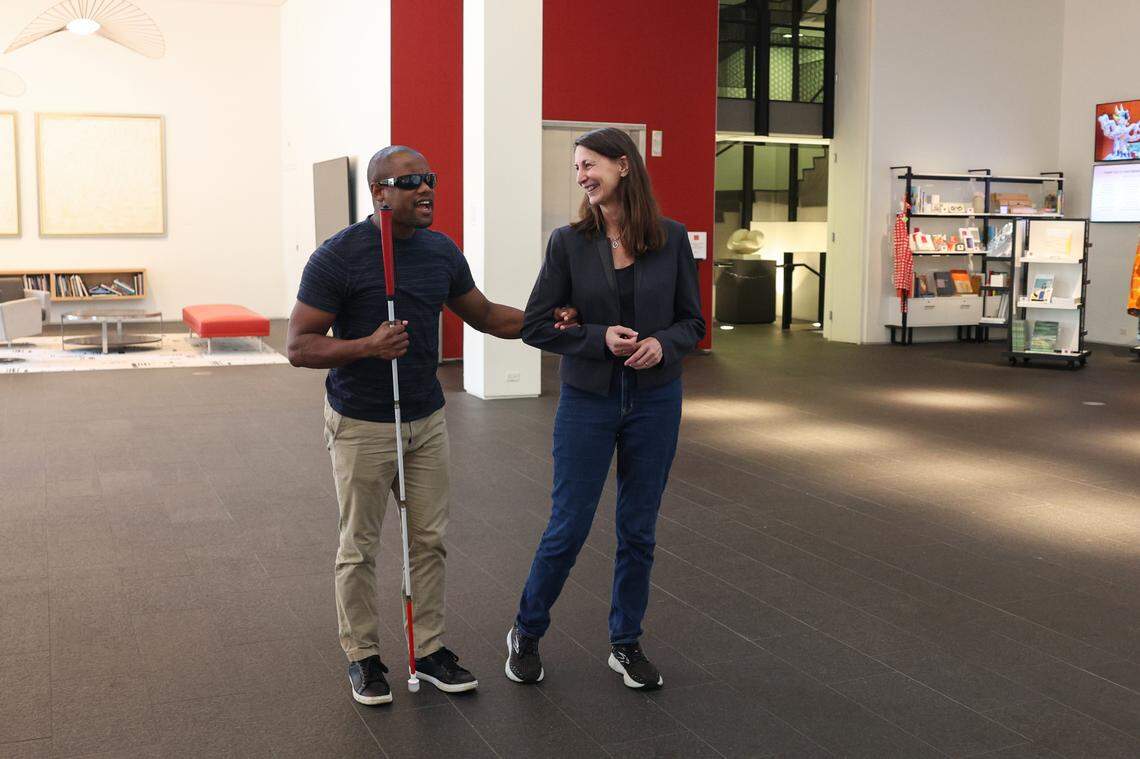
In “Bechtler Walk,” Robinson uses narration to explore the museum’s architecture and surrounding cityscape. The urban environment, he said, is both a challenge and a canvas.
“An urban space is always evolving, new sounds, new structures. It forces you to be alert, adaptive, alive,” he said. “But a performance stage? That’s a controlled risk. It’s like a safe container for experimentation.”
Robinson’s work invites viewers to confront their own assumptions, about vision, about disability, about what dance and art are “supposed” to look like.
Access as innovation
At its core, “We Are Here, Beyond Vision” is an exercise in accessibility as a creative strategy.
“People think access means doing the bare minimum,” Robinson said. “But when you lead with access, you unlock a whole new realm of artistic possibility. This show isn’t just about inclusion — it’s about reimagining the entire system.”
Robinson believes museums have a responsibility to question the traditional hierarchy of the senses.
“Why should sight be the default?” he asked. “Art is not just in the eye of the beholder. It’s in the body. In the ears. In the air.”
How museums can design for diversity and inclusion
Robinson’s vision for accessible art is not just theoretical.
When asked how museums can become more inclusive, he doesn’t hesitate: embed accessibility into design, not just programming. This could include tactile maps and spatial audio for visually impaired visitors, written or Braille descriptions layered into gallery labels and robust accessibility staffing.
And the audience is there. According to the Centers for Disease Control and Prevention, over 7 million adults in the U.S. live with a visual disability.
At the same time, a 2023 report from the Surgeon General found that more than half of American adults experience loneliness or social disconnection, a crisis that disproportionately affects people with disabilities.
Initiatives like the Bechtler’s new “Charlotte Art on Prescription” program are an important step in underscoring the symbiotic relationship between art and public health. Launched this spring in partnership with Novant Health, it allows physicians to refer patients to a year’s worth of arts programming and museum access as part of a holistic wellness plan.
For creatives like Robinson, it reaffirms his message that access is about belonging, and that the museum can be a site of healing, not exclusion. Many other museums are following suit by reconsidering their accessibility to all patrons, including the visually impaired.
For Robinson, “beauty isn’t just in the eye of the beholder,” as the cliché goes. “Beauty,” he said, “is in the one who first touches what has not yet been seen.”
Changing the frame
The experience of being both a creator and subject in the exhibit has left a mark on Robinson’s own artistic practice.
“This show gave me permission to dream differently,” he said. “To say no when someone tells me it’s impossible. To ask instead: Why not?”
What Robinson ultimately hopes visitors take away from the exhibition is a sense of curiosity and the courage to challenge their own limitations.
“If you can experience something that was once difficult to understand, then you’ve expanded your empathy,” he said. “Forget the status quo. Let’s jump to the impossible. Let’s reach for the stars.”
Want to go?
What: “Collection, Reframed: We Are Here, Beyond Vision”
Where: Bechtler Museum of Modern Art, 420 S. Tryon St., Charlotte
When: Now through Sept. 22
More info: bechtler.org
More arts coverage
Want to see more stories like this? Sign up here for our free, award-winning “Inside Charlotte Arts” newsletter: charlotteobserver.com/newsletters. And you can join our Facebook group, “Inside Charlotte Arts,” by going here: facebook.com/groups/insidecharlottearts.
This story was originally published July 16, 2025 at 10:35 AM with the headline "What if you could hear a Picasso? New Charlotte museum exhibit expands inclusion."