
Doolittle raid: Heroic tale well told
Two weeks after the attack on Pearl Harbor, President Franklin D. Roosevelt told his commanders that they must show the enemy the “real meaning of war” by bombing Japan.
That set in motion one of the most audacious attacks of World War II. Less than five months after the “day of infamy,” a fleet of 16 U.S warships, including two aircraft carriers, steamed 5,200 miles across the Pacific, retracing the course the Japanese had taken to Hawaii. Sixteen B25 Mitchell bombers, launched from the deck of the USS Hornet, flew unchallenged some 800 miles, arriving over Japan at midday and bombing Tokyo and other key industrial cities.
In his second book, “The War Below,” former Herald reporter James Scott recounted the story of America’s Pacific submarine fleet by describing the adventures of three subs, interspersing official accounts with personal details of the officers and crew, who severed the enemy’s supply lines. In “Target Tokyo: Jimmy Doolittle and the Raid that Avenged Pearl Harbor,” Scott’s most latest book, he brings his flair for storytelling and zest for research to describe in vivid details an event that boosted U.S. morale while it was still reeling from the surprise Japanese attack.
These days, the word “hero” is bestowed often and frequently without merit, but no other word better suits Lt. Col. James “Jimmy” Doolittle and his 79 fellow airmen. They volunteered for what was considered a suicide mission, flying into Japan to bomb several key targets. Aside from the fear of being shot down, the crews also worried if their bombers would have enough fuel to carry them into China, beyond the grasp of enemy troops.
With the exception of one plane, which landed in Russia, the bombers reached the mainland of China before their fuel ran out. The crews either bailed out or ditched along the coast. With the help of courageous Chinese farmers and militia, most of Doolittle’s team survived. Eight were captured and held in Japan’s notoriously inhumane prisons. Three were executed. One starved to death.
Relying on debriefing interviews, the raiders’ personal accounts and other sources, Scott has written a tale as gripping as a popular thriller. At one point, the fugitive airmen hid in a cave and listened as Japanese soldiers beat a Chinese priest who refused to betray them.
The surviving Doolittle raiders would become celebrities. Their Chinese protectors weren’t so fortunate.
Scott mined previously unpublished records of American missionaries in China to describe life inside Japan’s occupation, during which an estimated 250,000 Chinese would be executed; women and girls raped; villages and cities reduced to rubble; water supplies poisoned.
Perhaps no one could have anticipated the extent of Japan’s wrath, but Scott proves that U.S. leaders believed the Chinese would pay a high price for the raid on Tokyo. U.S. official kept Generalissimo Chiang Kai-shek, the Chinese military leader, in the dark about the impending raid.
The need for secrecy, while understandable, also hampered rescue efforts and undermined the White House’s credibility.
Prior to the departure of the task force, only seven people were fully briefed on the Doolittle mission, Scott writes. Radios had been removed from the bombers in order to reduce weight and to maintain silence. Unfortunately, once the B-25s lifted off the Hornet, it would be weeks before anyone knew the full story.
The war would be long over before the extent of damage inflicted by the Doolittle attack would be known. Many of those details are revealed for the first time in Scott’s narrative, which is the first book to make use of Japanese records. At the time, Japan downplayed the attack and spread the lie that nine planes had been shot down. On its part, the White House bungled the public relations campaign by withholding facts from the public, including that several men had been captured.
Doolittle, who was promoted to brigadier general and awarded the Medal of Honor, never forgot his fellow raiders. For many years until his death in 1993 at age 96, he presided over an annual reunion.
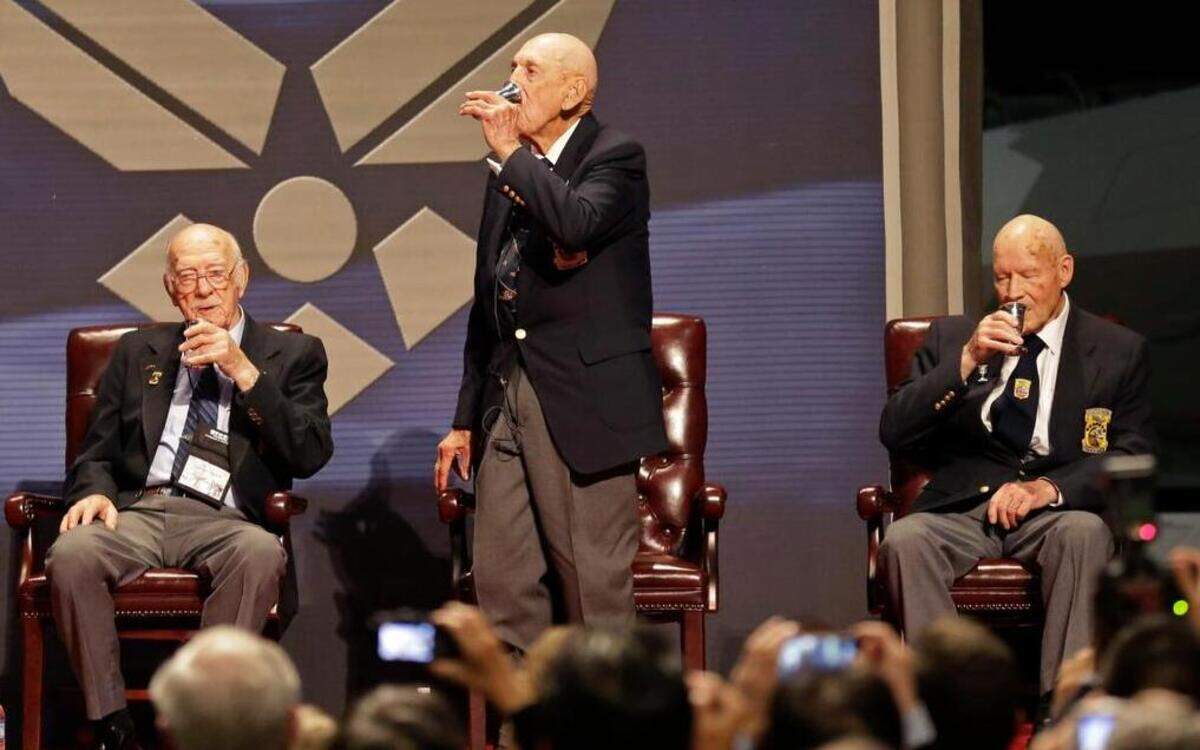
In November 2013, Scott attended the final such gathering at the National Air Force Museum in Dayton, Ohio. He was present when three surviving raiders, each in his 90s, toasted their comrades with an 1896 bottle of cognac donated by Doolittle.
It was a fitting end to a great story.
Plumb is a former editor of The Herald.
“Target Tokyo: Jimmy Doolittle and the Raid That Avenged Pearl Harbor”
By James Scott
W.W. Norton and Co.
672 pgs., $35.
This story was originally published April 17, 2015 at 11:22 PM with the headline "Doolittle raid: Heroic tale well told."