
NC flight attendants learn self-defense, as reports of unruly passengers rise by 300%
Minutes away from Charlotte Douglas International Airport recently, three flight attendants found themselves throwing elbows and using a drink cart as a barricade.
But they weren’t 35,000 feet in the air.
Instead, the Charlotte-based attendants were on the ground taking a self-defense class in a replica plane interior at the Federal Air Marshal Service’s Charlotte field office.
Reports of unruly passengers on planes have nearly quadrupled compared to last year’s tally — but the problem is nothing new. It’s always been part of the job although it’s “definitely getting worse,” American Airlines flight attendant Courtney McDonald told the Observer.
Many of those incidents are fueled by alcohol or anger at COVID-19 mask mandates, Federal Air Marshal Service officials said.
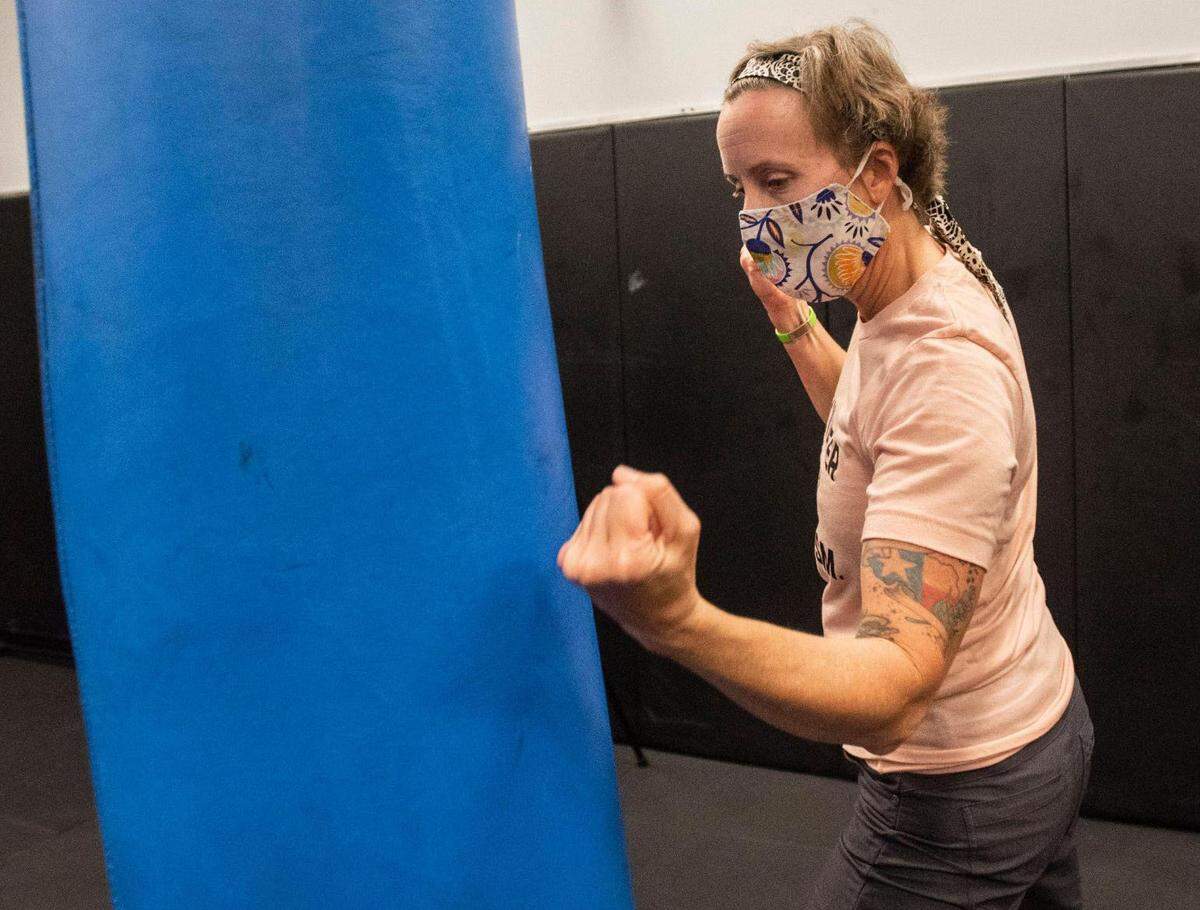
So last Wednesday, McDonald and two other flight attendants learned how to deal with unruly — and potentially violent — passengers. This included self-defense strategies like eye-gouging, palm heel strikes and hammer fist strikes.
De-escalation is the main tool that flight attendants use to deal with unruly passengers, McDonald said. But she said all flight attendants should be prepared to deal with a situation that turns violent.
“Our entire job is preparing for the worst-case scenario,” she said.
The Federal Air Marshal Service teaches a self-defense class for crew members once a month at the agency’s Charlotte field office.
The Federal Air Marshal Service, a law enforcement organization under the Transportation Security Administration, was drastically expanded after 9/11.
The details of that day were top of mind for instructors of the class, both operational air marshals who fly undercover. The instructors asked not to be identified to preserve their undercover status.
“That’s the day the world stopped,” one instructor said. “There’s a reason every one of us quit our jobs and became federal air marshals.”
And that’s why the agency started the crew member self-defense program.
Unruly passengers
The Federal Aviation Administration has reported a nearly 300% increase in investigations into unruly passengers so far this year compared to all of last year.
And the organization has received reports of more than 3,800 incidents involving unruly passengers. More than 2,800 of those involved mask complaints, according to the FAA.
The agency also has issued more than $1 million in fines to unruly passengers this year. The fines are part of the agency’s zero tolerance push against unruly passenger behavior. In previous years, the FAA had dealt with unruly passengers with warnings, counseling and fines.
But FAA Administrator Steve Dickson signed an order in mid-January ordering the agency to address cases with legal enforcement action instead of warnings or counseling.
“We’ve seen a disturbing increase in incidents where airline passengers have disrupted flights with threatening or violent behavior,” Dickson said in a January video in a news release. This dangerous behavior can distract, disrupt and threaten crew member safety functions. And as a former airline captain, it’s extremely concerning to me.”
Hostility for ‘no good reason’
Some of the disruptive incidents stem from anger at mask policies, Charlotte-based flight attendants at the self-defense training said.
Other incidents are alcohol-fueled.
American Airlines flight attendant Lynn Knuth has been a flight attendant for 20 years.
She said she’s been on leave for 1 1/2 years due to the pandemic, but will return to work in November. That’s why she wanted to take the training.
All of the flight attendants at the training said they have dealt with unruly passengers.
Devin McLendon has been a flight attendant with PSA Airlines, a subsidiary of American Airlines, for 2 1/2 years. He hasn’t needed to remove passengers from the plane for mask-related incidents, but has reported people who later were put on the no-fly list.
On one of Knuth’s flights, a naked man ran down the jetway to the aircraft, she said. And McDonald said she was cursed at after asking a woman on a flight to use headphones. “It’s just hostility toward each other for no good reason,” McDonald said.
Trouble with passengers
The Air Marshal instructor has seen an increase in unruly passengers on his flights too.
“People are very resistant towards authority and they take out their aggression on whatever figure is standing before them,” he said.
The Federal Air Marshal Services has taught the flight crew self-defense program since 2004, assistant supervisory Air Marshal in charge John Montero said. Air marshals teach about 3,000 flight crew members self-defense each year at 20 locations across the U.S.
A number of problems contribute to the huge spike in problem passengers, he said.
“You’re coming out of a year and a half worth of pandemic, people have been locked down,” Montero said. “There’s a lot of stress, anxiety and politicization of the problem.
“…I think those things all converge in that environment, and there’s nowhere else to go with 35,000 feet (in the air). You’re stuck in a tube and the flight attendants tend to bear the brunt of some of that unruly passenger behavior.”
Training exercises for flight attendants
In their class, Knuth, McDonald and McLendon learned how to react to a range of situations, “all the way from a crying baby, to a Level Four actual attempted breach of the flight deck door,” the instructor said.
The International Civil Aviation Organization has defined four levels of unruly passengers.
Level One: verbally disruptive behavior, Level Two: physically abusive behavior; Level Three: life-threatening behavior, and Level Four: attempted or actual breach of the flight crew compartment.
Much of the training took place in the Charlotte field office’s mat room, complete with three punching bags, a Body Opponent Bag (a realistic mannequin punching bag) and a mock-up airplane interior with five rows of foam training mat airplane seats (including foam folding tray tables).
Instructors walked the flight attendants through a proper fighting stance: feet shoulder-width apart, knees slightly bent and hands at chest level or higher.
And everyone got a chance to test out the punching bags with a number of moves including palm heel strikes, elbow strikes and hammer fist strikes.
At the end of the class, Knuth, McDonald and McLendon were tested on their training in a simulation room, with airplane seats, aisles, drink carts, overhead compartments and even a model airplane bathroom.
Each had to fight off a punching bag mannequin, barricade the aisle with a drink cart and signal to the pilot that the plane would need to be diverted. The entire exercise lasted a few minutes per person.
It’s all part of being ready for any situation, their instructor told them.
McDonald said the training should be a necessity for all flight crew — and really anyone.
“Everyone who interacts with other people should go through a de-escalation class,” she said. “And in our job, we have to protect the aircraft and protect all the people on the aircraft.”
This story was originally published August 23, 2021 at 6:30 AM with the headline "NC flight attendants learn self-defense, as reports of unruly passengers rise by 300%."
.jpg)