American Airlines ‘close to capacity’ at Charlotte airport in challenging economy
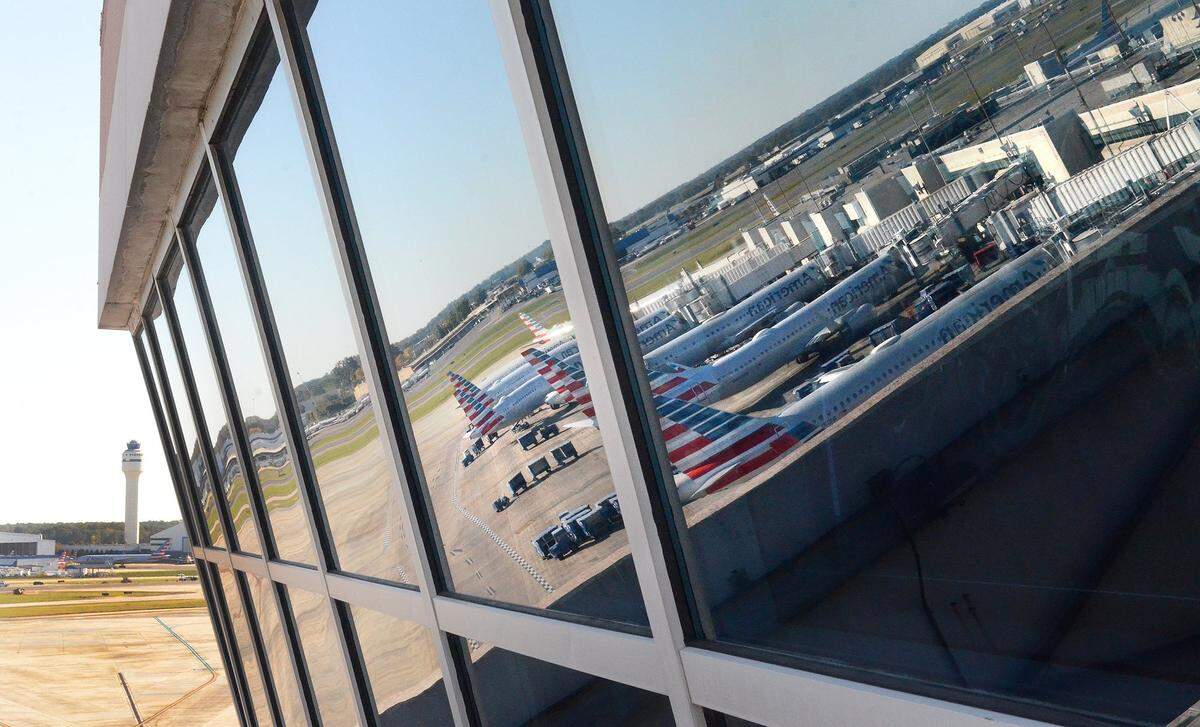
While American Airlines will continue to dominate the runways in Charlotte, the company is close to capacity at CLT, airline officials said during their first-quarter earnings call.
The airline also acknowledged it is operating in a challenging economic environment.
American Airline’s strategy for Charlotte is to maintain a significant presence at Charlotte Douglas International Airport, Vice Chair Steve Johnson stated during American’s earnings conference call on Thursday. “It’s a very efficient, very geographically well-placed hub,” Johnson said, “very low cost for purposes of connecting.”
“We’re just not in a position, at least right now, to grow it any further,” he said.
The airline did not respond to a request from The Charlotte Observer for additional details about its Charlotte operations.
Charlotte Douglas is the second largest hub for the Fort Worth, Texas-based company, which accounts for about 90% of all flights out of the airport. Overall, American Airlines offers thousands of daily flights to more than 350 destinations in more than 60 countries.
Here are other takeaways from the 2025 first-quarter financial report and earnings call.
American pulls its full-year outlook
American Airlines withdrew its 2025 full-year forecast because of economic uncertainty.
“Uncertainty is what we’re living with now. It is something I know that the country wants to move beyond, and I know that everybody is working to that end,” said Robert Isom, CEO, American Airlines:
The company’s first-quarter revenue was $12.6 billion, the same as the first quarter from last year.
The airline said it is planning to provide a full-year update when the outlook becomes clearer.
DC crash continues to reverberate
Isom acknowledged the deadly Jan. 29 crash involving American Eagle Flight 5342.
The flight from Wichita, Kansas, collided with an Army Black Hawk helicopter over the Potomac River in Washington, D.C. No one survived. A total of 67 people died in the collision — 60 passengers, four Charlotte-based crew members on the commercial plane and three people on the military chopper.
Isom paid tribute to everyone who died in the incident. American is supporting families through an outreach office established within a week of the crash.
“Thank you to our team members who helped in the immediate response to the accident, those who kept the operation running while caring for our customers and to our care team members who supported the families,” Isom said.
On the financial side, according to American’s estimates, the crash reduced the company’s first-quarter revenue by $200 million. American is working with federal authorities to make the country’s aviation system safer going forward.
Keeping an eye on airplane tariffs
American Airline expressed concern about the potential impact of tariffs on aircraft costs. Isom emphasized the importance of maintaining a zero-tariff policy for civil aviation.
He added that aircrafts are already costly. And increased costs from tariffs is a burden the company wants to avoid, Isom emphasized.
“And I’ll tell you, it’s not something that I would expect our customers to welcome,” Isom said about costs being passed on to them. “So we’ve got to work on this.”
American doesn’t have any near-term deliveries. But the company may have deliveries at the end of the year that would potentially be subject to tariffs on planes that are built in Europe, Isom added.
He stated that since 1979, the aviation industry has operated under a zero-for-zero tariff regime, meaning no tariffs on imports or purchases.
“That’s worked very well for civil aviation, and by that I mean everything from aircraft engines and into parts as well,” Isom said. “That framework has led to an industry, a sector that has produced the largest level of exports, the largest level of surplus of any industry. And so I know that that’s where we want to end up.”
This story was originally published April 25, 2025 at 5:48 AM with the headline "American Airlines ‘close to capacity’ at Charlotte airport in challenging economy."