
Best of the weekend: Capturing baby's first wiggle
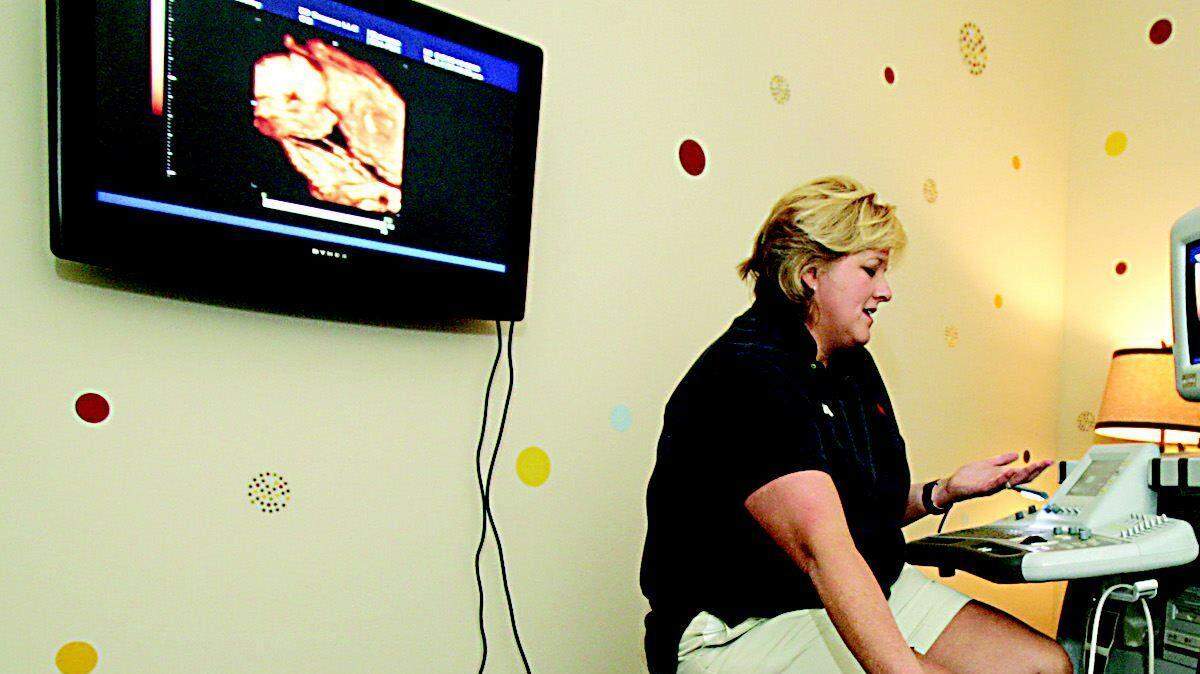
Suzanne Pressley, 22 weeks pregnant with her second child, recently saw her unborn daughter in 3D and 4D -- a type of ultrasound imaging that lets parents-to-be see a lifelike, three-dimensional view of their baby with movement.
"Mommy! Mommy! The baby went like this!" Pressley's breathless 7-year-old daughter Joi An Holmes said, shaking her hand back and forth to mimic her unborn sister's movements.
"Watch!" Pressley said to Joi An, pointing at the screen."I'm making a movie for you," added Pamela Manley of Tega Cay, co-owner of 3D Dreams in Fort Mill's Baxter Village and the sonographer who performed Pressley's ultrasound.
Over the past three years, elective prenatal 3D/4D imaging centers such as 3D Dreams have grown in popularity, said Randy Koenig, vice president of an online directory for pregnant mothers looking for a 3D/4D ultrasound facility.
Koenig said the number of centers in the United States, Canada and England has tripled since 2005. In South Carolina, there are about nine elective 3D/4D ultrasound clinics.
"It is such a booming industry," he said.
But despite the popularity of 3D/4D ultrasounds among expectant moms and their families, many medical experts do not support the non-medical use of ultrasound technology.
Although no adverse biological effects have been confirmed from the use of ultrasound, the U.S. Food and Drug Administration, American Institute of Ultrasound in Medicine and the Society for Maternal Fetal Medicine recommend that ultrasound should be used only when the patient's physician indicates that it will provide a medical benefit to the patient.
Kevin McCarthy, a spokesman for Charlotte's Carolinas Medical Center, which offers specialized medical care for expectant mothers, said the primary purpose of an ultrasound is to diagnose potential problems. He said non-physician supervised 3D/4D ultrasounds should not substitute for ultrasounds performed by an obstetrician.
"There is no harm that would come to someone by having the 3D ultrasound," McCarthy said. However, "if you are just doing it as a prenatal family portrait, you might consider that ultrasound is used as a diagnostic tool. If it is only used for a picture, it might not be read to spot real problems."
Dr. John Allbert, a maternal-fetal specialist in Charlotte, said it is difficult for the untrained eye to interpret a 2D ultrasound, so he occasionally uses 3D ultrasound to give parents a visual of something of interest or concern.
But Allbert recommends using ultrasound only for a medical reason.
"Ultrasound has been well-tested, and there is no evidence of it causing harm to fetuses," he said. "That doesn't mean that there isn't the potential."
'A different twist'
Although the elective use of the 3D/4D ultrasound isn't generally supported by the medical community, that has not affected its popularity among expectant mothers and families.
Unlike the diagnostic two-dimensional ultrasound that's commonly performed on expectant women in a doctor's office, the 3D ultrasound can show the baby's surface area in a golden hue, giving parents a more life-like image of their child. The 4D component of the ultrasound shows the baby's movement.
The 3D image of a fetus is captured on keepsake prints, CD-ROMs and DVDs for a cost of $80 to $250, depending on what memorabilia parents choose.
The elective 3D/4D ultrasound is not performed for a medical purpose.
"It's a different twist," Manley said. "Here I'm interested in showing you for fun. The patient enjoys this. It's like a bonding thing."
Manley and her partner, Jamie McFadden of Tega Cay, are registered diagnostic medical sonographers. They work day jobs in a hospital and perform 3D/4D prenatal ultrasounds at the center by appointment, usually evenings and weekends.
The center, which opened in mid-July, offers prenatal massage. Manley and McFadden said they recommend that their clients check with their doctor before having an elective ultrasound.
Like a movie
Suzanne Pressley, who lives in Indian Trail, N.C., had a routine diagnostic ultrasound at her obstetrician's office in July. She brought her husband and daughter to 3D Dreams so they all could see of her unborn daughter in 3D.
Pressley, 33, and a registered nurse, stretched out on a red cushioned lounge chair that was low to the floor. Her husband, Rodney Pressley, 41, and her daughter were by her side.
The room was dimly lit by the orange glow of a table-top lamp. Soft jazz played in the background. A 30-inch flat-screen monitor mounted on the wall in front of Pressley displayed a moving 3D image of her unborn daughter -- like a movie.
"Having the screen is wonderful," Suzanne Pressley said. "You don't have to break your neck looking."
"She is beautiful," said Manley, watching the screen while holding the probe against Pressley's bulging abdomen.
"Mommy, she is going like this," Joi An said, demonstrating her unborn sister's hand-against-cheek movement.
"She's kicking," Rodney Pressley said.
The monitor displayed the image of the baby, arms and legs flexed. She kicked her legs and moved her head back and forth.
"Are you feeling that?" Manley asked.
"I've been feeling a lot of movement today," Suzanne Pressley said. "I feel some right now."
"Look at her face, Joi An," Suzanne Pressley said.
Manley froze the baby's image on the screen -- the unborn child's mouth was open and her tiny fist was balled against it.
It will be one of the color pictures Manley will print out for the Pressleys' photo album. They also get a CD and DVD of the session, which Rodney Pressley has promised to show his daughters, Brice and Halie Pressley, who were not able to attend the appointment.
The best time to have a 3D ultrasound is between 18 and 34 weeks of pregnancy, Manley said.
"You can tell the sex around 18 weeks, and if they are interested in great face shots, those come slightly later."
Having the elective ultrasound was a happy experience, Pressley said, and she is amazed that she can see what her baby looks like before she is born.
"Most of the people who I know who had this type of 3D/4D ultrasound done around 26 to 32 weeks, their babies looked just like what they see at that stage when they are born.
"You can put their newborn and ultrasound photos next to each other and can see it is so accurate -- and surreal."
This story was originally published September 6, 2008 at 11:58 PM with the headline "Best of the weekend: Capturing baby's first wiggle."