
Blue Angels to retool training in wake of '07 S.C. crash
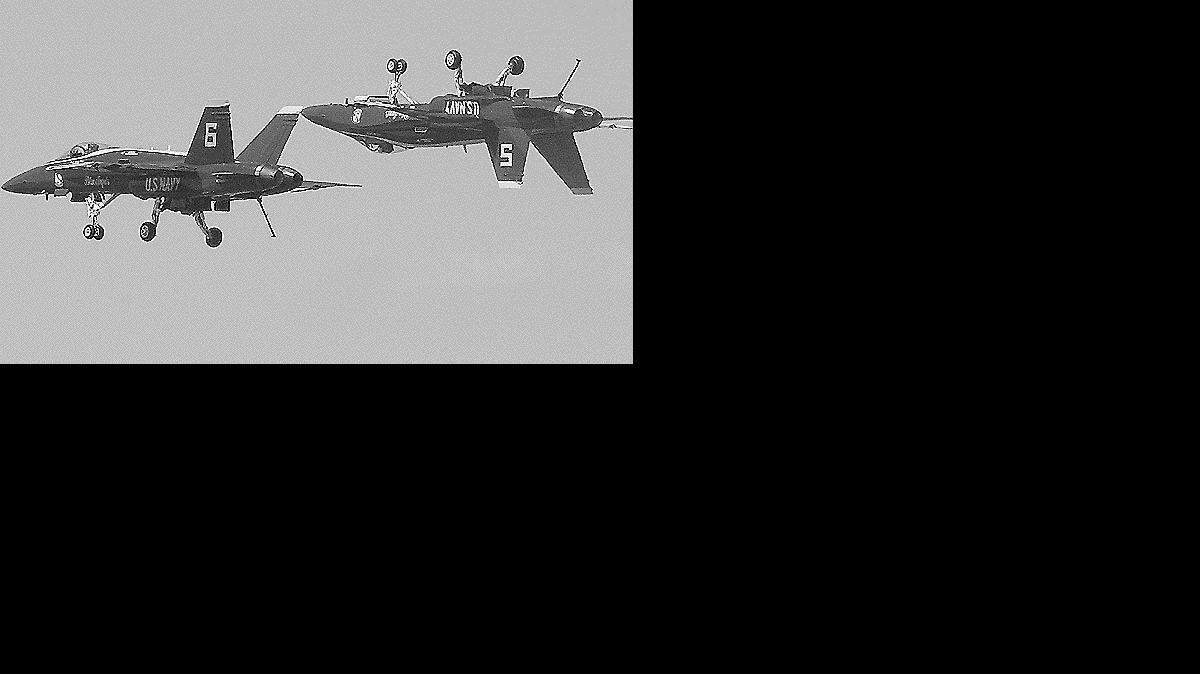
BEAUFORT -- The Navy hopes changes in the way Blue Angels train will help prevent crashes such as the one that killed Lt. Cmdr. Kevin Davis in Burton two years ago.
Instituted in December, the new G-Tolerance Training Program is designed to help Blue Angel pilots withstand the physical and mental rigors of performing aerial maneuvers that can multiply normal gravitational forces.
Effects caused by those forces are believed to have caused the April 2007 crash that killed Davis.
In the last maneuver of the Blue Angels' performance at the 2007 Beaufort Air Show at the Marine Corps Air Station, Davis was trailing the other pilots and accelerated to more than 425 mph. Investigators said the sudden force caused him to lose awareness of his speed and altitude.
Davis' F/A-18 Hornet clipped several trees before crashing in a wooded neighborhood near the intersection of Shanklin and Pine Grove roads. The pilot was killed, eight people were injured and dozens of homes were damaged in the crash.
The Navy hopes the new physical training program will reduce the incidence of "G-LOC," when a pilot loses consciousness because of excessive gravitational forces.
Unlike Navy and Marine pilots, Blue Angel pilots are not required to wear G-suits. The suits use a compressed air and bladder system to restrict the amount of blood flowing from a pilot's brain, preventing blackouts, said Lt. Brett Dawson, spokesman for the Chief of Naval Air Training in Corpus Christi, Texas.
However, the suits are not conducive to the type of flying done by the team, Dawson said.
"Those guys are flying 18 inches apart, and their arms and legs and hands are extremely close to that stick during those maneuvers; and if that suit inflates or deflates, it can move the stick," he said. "When we're flying 18 inches apart, we don't want that stick to move."
The Blue Angels annually submit a waiver to the Secretary of the Navy to exempt them from wearing G-suits, which are standard issue for Marine and Navy pilots. This year's waiver is making its way through the chain of command, Dawson said.
Naval investigators do not believe a G-suit would have prevented Davis' crash because he was experiencing G forces exceeding the suit's capacity to prevent disorientation. New requirements are designed to train pilots' bodies to perform functions under high force that a G-suit would perform at lower forces.
"What we've done is mandated additional centrifuge training for the pilots and increased their physical fitness and their physical readiness," Dawson said.
Under the new rules, pilots must complete centrifuge training annually at Naval Air Station Lemoore in California, where they are strapped to a rotating arm that creates gravitational forces four to seven times greater than normal. Naval and Marine aviators typically undergo the training once every four years.
"You can become so disoriented when you're flying, and you think up is down and left is right," said Dawson, who has undergone the centrifuge training.
"The training really helps your body get used to what those Gs feel like, so you don't become as disoriented."
The Navy also increased exercise requirements for Blue Angel pilots, particularly those aimed at strengthening the lower body.
A combination of squat-type exercises, leg curls, leg extensions and calf raises help pilots improve their G-tolerance, according to a memo from Naval Air Training Chief of Staff James Crabbe. When pulling Gs, blood in the body flows downward, away from the brain, causing a pilot to black out. By flexing his leg muscles, the pilot forces blood into the upper part of his body.
The squadron will perform at Marine Corps Air Station Beaufort in May as part of its air show, held biennially in Beaufort. The performance, the team's first in Beaufort since the crash, is expected to draw hundreds of -thousands of spectators to the base.
This story was originally published January 6, 2009 at 12:46 AM.