
Catawba Indian culture explored in two new Lancaster exhibits
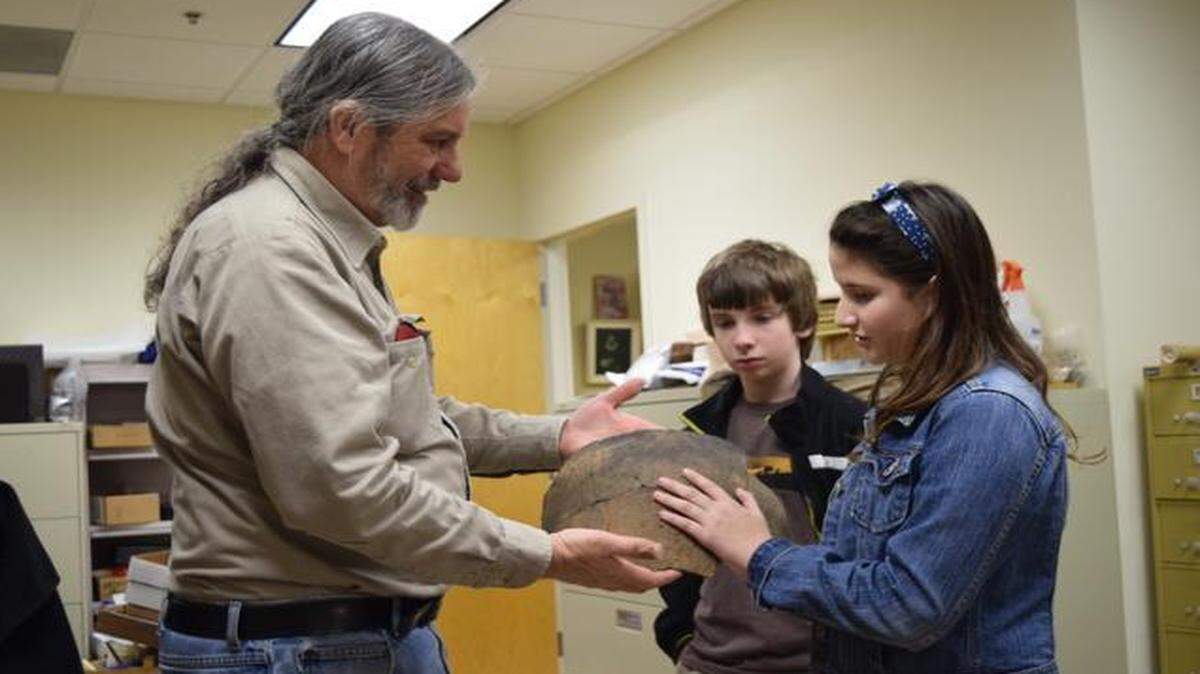
Late 20th century photos of the Catawba Indians and native languages are the two new exhibits at the University of South Carolina’s Native American Studies Center in downtown Lancaster.
The exhibits open during the center’s 10th annual Native American Studies Week that ends Friday, focusing on the rich history and cultural traditions of South Carolina’s indigenous people. About 7,000 visitors come to the center each year, officials say.
“We bring awareness to people that Native Americans still live here,” said Chris Judge, an archaeologist, University of South Carolina professor and the center’s assistant director.
The center, a mix of history and art housed in a renovated Main Street department store building, is working to preserve the past while honoring the current 47,000 natives who call South Carolina home. It boasts the largest collection of Catawba Indian pottery in the world.
Windows in the rear of the center allow visitors to view artifacts, some fresh from an archaeological dig, and the floor of the building resembles a riverbed.
‘A life study’
In the center’s North Gallery, photographs show a changing Catawba Indian tribe, which was thought extinct after tribal termination policy was passed by the federal government in 1959.
The still-photo documentary, called “The Renaissance of The Catawba Indians,” by Catherine Bauknight, a Lancaster native, follows the tribe through its land claim and federal recognition in the 1990s. The 23-image exhibit has been on display at the U.S. Capitol in Washington, D.C.
Bauknight, who lives in Pasadena, Calif., is coming home to be honored at a reception Wednesday before talking about her documentary work on Friday.
From an early age, she was drawn to the Catawba Indian culture and learned through the years that many people thought the tribe was extinct.
She met Monty Hawk Branham and Anna Branham, Catawba Indian potters, during a photojournalism assignment and made arrangements to visit the tribe’s York County reservation east of Rock Hill to refute the claims that the tribe no longer existed.
“The goal was to prove to the world that they are here and alive, and they are successful with their pottery and their culture,” said Bauknight, who over the three-year project witnessed storytelling, drumming, dancing and ancient rituals.
She shared silence with a medicine man, watched the making of homemade pottery and arrows, and saw the joy of children playing in a stream off the Catawba River.
“From that point on, I knew I had to go on to learn more about other indigenous people,” said Bauknight, whose documentary work includes native cultures of Peru and Hawaii. “It’s become a life study.”
2,800 members
A few of her photos show the transition from run-down trailers to new homes after the land claim settlement of 1993 that gave the Catawba Indians federal recognition and $50 million for economic development, education, social services and land purchases.
Bauknight has since been interested in capturing cultures and social change through her photography. The Catawba Indians were appreciative, she said, to have her there, and her work has successfully shown there is a lot to learn from others.
“It’s a culture that is ancient and has wisdom from the past that should be transferred to the future,” she said. “They know how to take care of the earth and each other for generations. We should all learn from them.”
Today, there are more than 2,800 enrolled members of the Catawba Indian Nation, according to the tribe.
For Beckee Garris, 67, the Lancaster center feels like home. She greets visitors with the Catawba greeting “tanake,” pronounced tah-nak-keh, and educates people about her tribe. Her great-grandfather was Catawba Indian Chief Samuel Taylor Blue, who led the tribe from 1928 to 1939 and again in 1956.
“This has created a mecca for people to come and learn about native culture,” said Garris, who is working on a degree in Native American Studies through the university.
From working at the center, Garris has a renewed interest in making pottery and studying the Catawba Indian language that is still spoken by some.
400-page dictionary
With the help of Claudia Heinemann-Priest, an instructor of native American literature, the Catawbas have a 400-page dictionary of their language. Priest has been working on the Catawba Indian language since 1995 and is the curator of the new “Native Southeastern Languages” exhibit at the center.
She designed the exhibit to show the diversity of native languages spoken before the arrival of Europeans. In the Southeast, about 40 languages from at least seven language families were spoken.
“At some point there were upwards of 10,000 people who spoke a type of Catawba language,” said Priest, who hopes visitors will be able to help her refine the standardized language that is being taught once again.
Garris also is promoting the revival of the Catawba language, which was considered dormant in 1962. It bothers her that school children are taught very little about her tribe.
“There is nothing in books to teach them, except for two little paragraphs,” Garris said. “We are a vital part of history.”
Free-of-charge, the Native American Studies Center is open from 10 a.m. to 5 p.m. Tuesday through Saturdays with extended hours on Thursdays to 7 p.m. For information, visit usclancaster.sc.edu/NAS.
Remaining Native American Studies Week events
Wednesday
4 to 6 p.m. – Exhibit opening reception and gallery talks by Catherine Bauknight and Claudia Heinemann Priest. NASC Gallery.
Thursday
7 p.m. – “The Lawson Trek: A New Voyage to Carolina.” Lecture by Scott Huler, author from Raleigh, N.C. Bundy Auditorium, Bradley Building, USC-L main campus.
Friday
9 a.m. – “Photography and Collecting History.” Lecture/Workshop by Catherine Bauknight, photojournalist and documentary filmmaker. Room 106, NASC.
This story was originally published March 24, 2015 at 8:16 PM with the headline "Catawba Indian culture explored in two new Lancaster exhibits."