3 ways The Exchange will change downtown Rock Hill, and when to expect it.
The Exchange will change the look and feel of downtown Rock Hill. It could in some ways serve as a model for still more development.
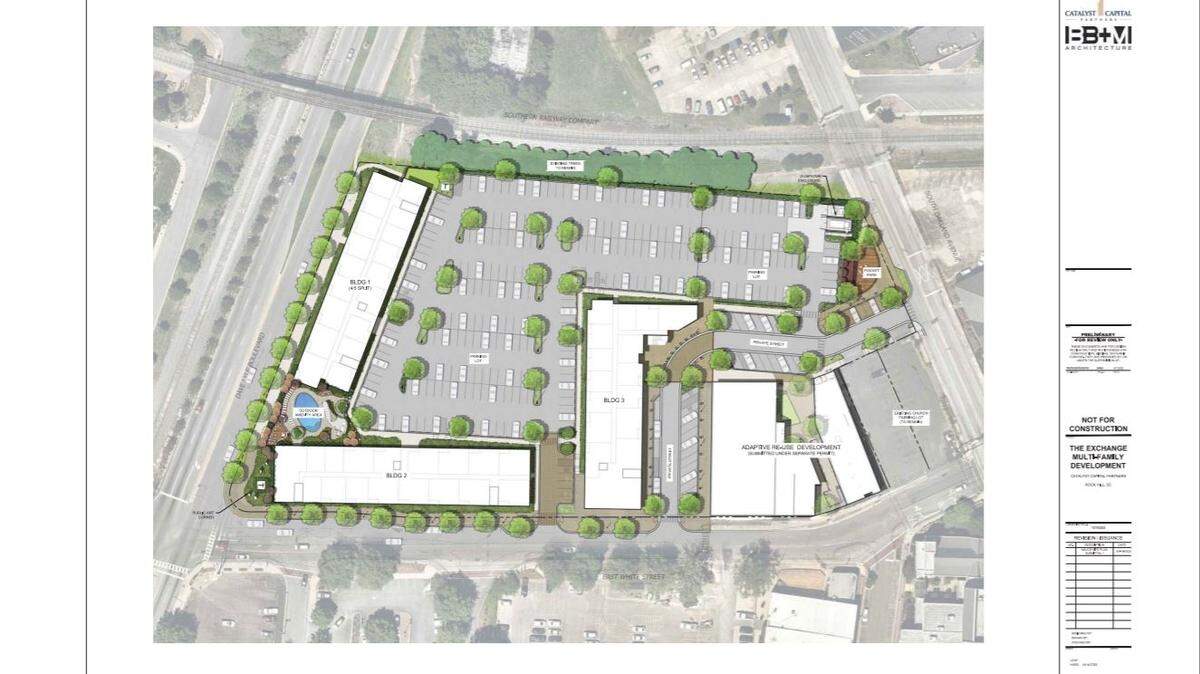
Rock Hill City Council gave initial approval earlier this week to a development agreement for the former Good Motor Company and surrounding sites. Catalyst Capital Partners has plans for the six acres bounded by Dave Lyle Boulevard, White Street, Oakland Avenue and the downtown railroad track. Only an Episcopal church parking lot in that entire area isn’t part of The Exchange.
“Excuse me if I smile a lot here,” city economic and urban development director Stephen Turner told council Monday. “I’m so happy that we’re talking about this tonight, and we’re going to get this one done.”
The Exchange is a sign of growth already here, and also of growth coming. Here’s how:
Apartments, restaurant, retail
The most obvious change to downtown Rock Hill comes with the redevelopment plan itself. The Exchange will have 229 apartments and 25,000 square feet of retail, restaurant or office space. Private investment will be at least $40 million.
“This is really a high-amenity project,” Turner said. “They have a pool area. They’re going to have a leasing and co-work area that fronts onto White Street. There’ll be a fitness club, fitness center. And then a rooftop amenity area on one of the buildings.”
A driveway from Oakland to White will be the focal point. A walkway will connect White to a courtyard area. A pocket park will come along Oakland.
The city has several requirements listed in the agreement. The city is responsible for sidewalk improvements along Dave Lyle, White and Oakland. A landing area of pedestrian improvements at the corner of Dave Lyle and White, too, are part of about $600,000 in city investment. About a third of that amount is streetscape improvement along Dave Lyle.
The developer will return later to ask for facade improvement grants and growth management incentives from the city at combined $635,000.
“That is not committed in this agreement today,” Turner said.
Some of the city investment could be returned. The developer will apply for textile mill redevelopment tax credits.
“If the developer is successful in getting the textile tax credits, those costs will either be reimbursed to the city or voided,” Turner said. “So we are very hopeful that they get those.”
Within a week of Monday’s meeting, sides reached agreement on what to do with the caboose on the property. The developer will take ownership and relocate it.
Affordable housing
While it won’t solve the issue of affordable housing in Rock Hill, The Exchange could set a standard. At least 10 affordable housing units will be included, with residences priced at no more than 80% of the area median income.
Multiple council members referenced recent conversation about a 10% requirement for new apartment developments, asking if The Exchange might provide more.
“We sat there and we went through a presentation and had someone to come in and consult us about having these developers to offer 10% toward affordable housing with it not being much of a cost burden to them, and I just see that we’re deterring away from what we originally said that we would do,” said Councilwoman Nikita Jackson.
Jackson said she is concerned that allowing less than 10% might make it more difficult to get more units from future developers.
“In my opinion we need to adhere to that, because we do know that we in the City of Rock Hill do have an affordable housing crisis,” she said.
Turner said the 10% requirement has been discussed, but never put into any set of city requirements.
“Staff has only had arm-twisting available to us right now,” he said. “There is no formal policy by the city council. We’ve certainly talked about 10%, but city council has not adopted a real policy that we can stand behind try to enforce.”
A workshop at the next council meeting will continue that conversation. Even without a formal requirement, Turner said The Exchange is a step on the path toward more affordable housing.
“Just with some persuasion and arm-twisting, this is the first time a developer has ever come in to city council and said we’re willing to provide affordable units,” he said. “So the discussions that you’ve been having, even though they have been informal to this point — they’re not written down anywhere — it’s having an effect.”
A special provision in the development agreement states the city and developer will continue negotiation on additional affordable housing units. It’s also stated that later city decisions on that $500,000 growth management incentive will be tied to efforts to support city affordable housing goals.
“When the growth management incentive application comes to you,” Turner told council Monday, “that’s the point that discussion of additional units needs to take place.”
Opportunity Zones
Among tax changes under President Donald Trump was the creation of opportunity zones. Those zones give incentives for redevelopment of lower income areas. Downtown parts of Rock Hill, Chester and Lancaster qualify.
“The Exchange will be one of the first major redevelopment projects in Rock Hill to use the opportunity zone financing,” Turner said. “We’ve been talking about this opportunity zone financing for quite a while, and this is one of the first projects that we’re seeing now that is actually taking advantage of that important legislation.”
Last fall when Turner updated Rock Hill economic development leaders on more than $1 billion in recent, ongoing or coming downtown Rock Hill redevelopment, he attributed the wave of activity to opportunity zones. Redevelopment of textile facilities, the former Herald site and other downtown sites rely on the incentives.
“It’s a great location that’s going to pull in a lot of development that’s underway or about to be underway” Reno said of The Exchange. “We’re really excited about what this project means.”
Construction at The Exchange could begin mid- to late third quarter of this year.