Winthrop University furloughs over 800 workers to save $3 million. Here are details
The Winthrop Board of Trustees approved a furlough plan Tuesday that will affect nearly all faculty and staff and save the university approximately $3 million.
The furloughs are an unfortunate milestone in a tumultuous period for Winthrop and other public universities. Winthrop is the fourth South Carolina public university to announce furloughs this year, joining South Carolina, Coastal Carolina and Clemson, which released its furlough plan Monday.
The furlough plan passed without opposition. It comes after housing and dining revenues alone have been reduced by 35% as a result of the two-week delay in bringing students to campus, and the decision to ask students not to return to campus after Thanksgiving break, because of coronavirus concerns, the plan says.
Winthrop interim president George Hynd told The Herald that the university had “about a $6 million budget gap between our anticipated revenues and our expenses, and we needed to figure out a way to close that gap.”
Winthrop’s regular employee count at the time of furlough implementation, which begins Sept. 1 and lasts through June 30, is approximately 810. All of the employees will have to take unpaid days off, unless if they are:
▪ Adjunct instructional faculty hired on a course-by-course basis.
▪ Employees in positions that specifically require South Carolina Criminal Justice Academy certification, such as a law enforcement officer.
▪ Employees in externally funded positions “if the terms of the funding prohibit the employees from participating in a mandatory furlough” or if the furlough plan violates the terms of the funding agreement.
▪ Employees holding H-1B Visa status.
▪ Student employees.
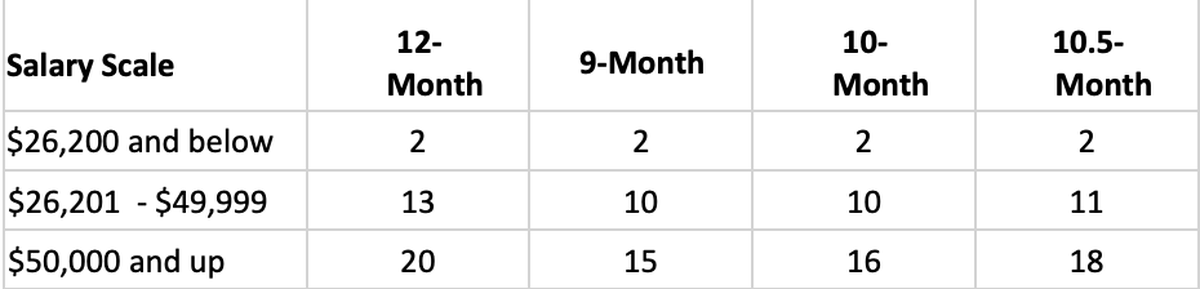
Employees who will earn $26,200 or less in fiscal year 2020-21 will be required to take two furlough days. Workers who earn $26,201-$49,999 will have to take 10-13 furlough days. And those who are paid $50,000 or more will have to take 15-20 days.
The number of days each employee has to take also depends on how many months out of the year they work at Winthrop — 9 months, 10 months, 10.5 months or 12-months.
The university also has instituted other measures to address its budgeting concerns for fiscal year 2020-21, including cutting its men’s and women’s tennis programs in June, putting in place a hiring freeze and allowing only essential travel.
The last time Winthrop instituted a furlough plan was in 2008, during the Great Recession.
Timing of Winthrop furloughs
Before the furloughs can be implemented, the Division of State Human Resources must approve Winthrop’s plan.
The amount of time to review and approve a plan varies based on a number of factors, including the complexity of the plan, Kelly Coakley, a spokesperson for the DSHR, wrote in a statement to The Herald.
“Generally, most plans are approved in 7-10 days,” Coakley wrote.
Winthrop’s plan states that employees will “be notified of the mandatory furlough in a campus-wide email notification at least seven days before it goes into effect.”
Justin Oates, the vice president for finance and business affairs at Winthrop, told The Herald that the university wasn’t bound to any state-enforced timeline for implementing the furloughs.
“If you delay the decision, you’re just making it tougher to meet the requirements to take 20 days during a fiscal year,” Oates said after the meeting, adding, “If you start it on Oct. 1, Nov. 1, it means that they have to take 20 days in a shorter period.”
According to the plan, salaried staff, administrators and academic employees — whose primary responsibilities do not include teaching — must take their furlough days in five consecutive full-day increments within the same work week.
Conversely, salaried professors and hourly staff employees may take their furlough days in either consecutive increments or intermittently.
In an FAQ that Winthrop sent out along with its furlough plan, the university made clear that retirement benefits “will not be negatively impacted” by the furlough.
2 takeaways from Hynd
▪ After the meeting, Hynd noted the strengths of implementing a furlough plan over the strengths of other cost-cutting measures, like layoffs, early retirement plans or voluntary separation plans.
“The downside is that everybody who is furloughed for whatever days they’re furloughed, they’re not receiving any income on that day,” he told The Herald, adding, “The advantage is: No. 1 (employees) keep their jobs, and No. 2, their benefits continue even during the days that they’re not being paid. So they maintain their benefits, of course the main one being their health insurance and retirement.”
▪ Hynd also drew a compelling comparison between the housing market crash over a decade ago and the pandemic.
“For many years before the collapse of the housing market and all of the unsecured loans and the credit that had been given, people were ringing alarm bells before that, and people didn’t pay attention to that,” he said. “Then the Great Recession hit. People lost their jobs, lost their houses. They lost their retirements. It was a terrible period of time.
“Here, (it’s a) different situation, but 13 years later, we have COVID-19, and people have been ringing alarm bells about a pandemic eventually hitting us. And did we prepare adequately? Apparently, we did not. And so when the pandemic hit, we were unprepared to deal with the expense and the impact on society.
“So a lack of preparation and responsiveness to the alarm bells that were being rung, I think, characterizes both of these periods of time, unfortunately.”
This story was originally published August 25, 2020 at 4:52 PM.
.jpeg)