The Geminids meteor shower peaks Sunday night. Here’s how to (possibly) see it.
One of the last major meteor showers of 2020 will take over the sky Sunday night, but those in the Carolinas may not have the best view of it.
The Geminids, known as one of the “strongest” and “most dependable” annual meteor showers, have been active since Dec. 4 and will continue through Dec. 17. But the shower is set to peak Sunday night into Monday morning, according to the American Meteor Society.
Typically, more than 100 meteors per hour dart through the sky, but this year, NASA reports that 120 meteors per hour are expected during the Geminids. AMS predicts the shower could produce as many as 150 meteors per hour visible in very dark areas.
The Geminids, which peak during mid-December each year, originated from 3200 Phaethon, considered to be either an asteroid or an extinct comet, according to AMS.
When Earth passes each year through the meteroids, or trails of dust, left by 3200 Phaethon, the dust burns in the atmosphere. That results in the meteor shower, NASA said in a blog post earlier this month.
People in central and southwestern United States will have the best view of this year’s show, leaving most of the Carolinas in the “poor” viewing conditions range, according to AccuWeather’s visibility map. Slivers of the states’ eastern borders will have “fair” conditions.
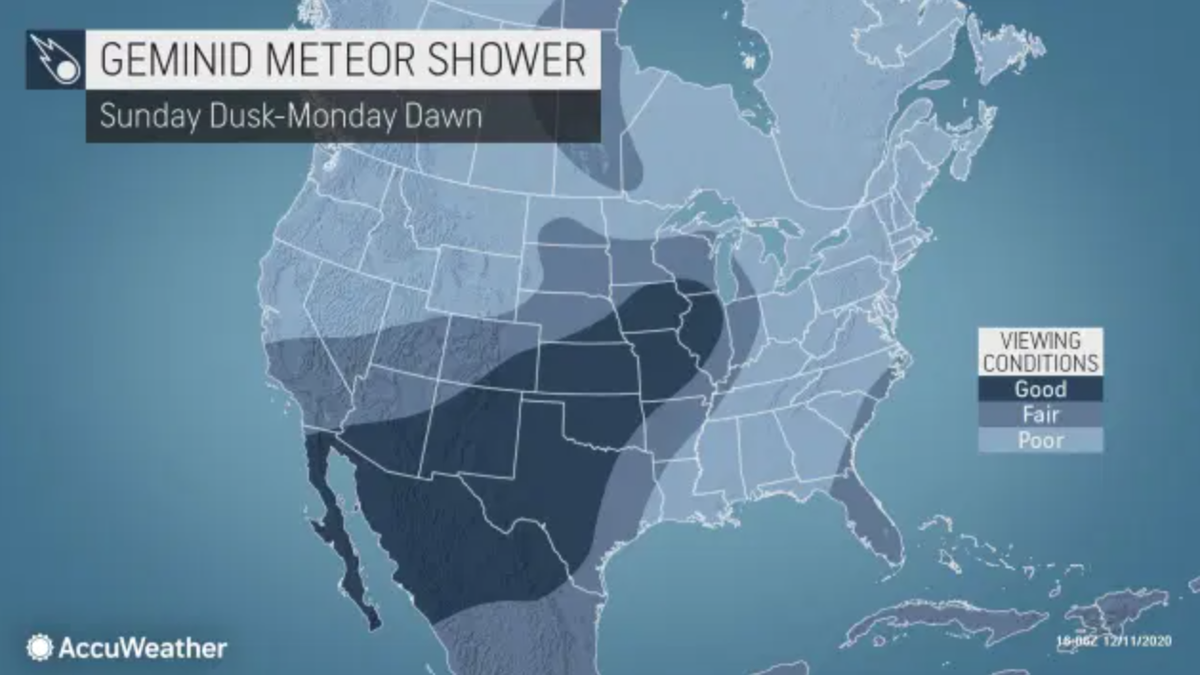
Clouds may also prove to be an inconvenience for some viewers Sunday night across the eastern United States, according to AccuWeather. Charlotte is expected to see cloudy skies Sunday night, the National Weather Service says, but clear skies on Monday night.
The best time to watch the shower will be around 2 a.m., but viewers can start spotting meteors as early as 9 p.m., according to NASA.
Light pollution can reduce the number of meteors visible, so AMS suggested viewers travel to a dark area, such as a nearby park, for better views.
“Lie flat on your back with your feet facing south and look up, taking in as much of the sky as possible,” NASA said on its website. “After about 30 minutes in the dark, your eyes will adapt and you will begin to see meteors. Be patient — the show will last until dawn, so you have plenty of time to catch a glimpse.”
NASA will broadcast the Geminids live on its NASA Meteor Watch Facebook page starting at 9 p.m. Monday. Due to expected rain and clouds Sunday night, the space agency moved the show to Monday.
“We likely won’t see quite as many meteors as we would at peak, but if the skies stay clear it should still be a great night for meteor-spotting,” NASA wrote on its Facebook page.
After the Geminids, there will be two not-so-major meteor showers in 2020 — the Ursids on Dec. 21-22, followed by the Quadrantids on Jan. 2-3. But the next major shower will not got on display until the Lyrids in late April, according to AccuWeather.