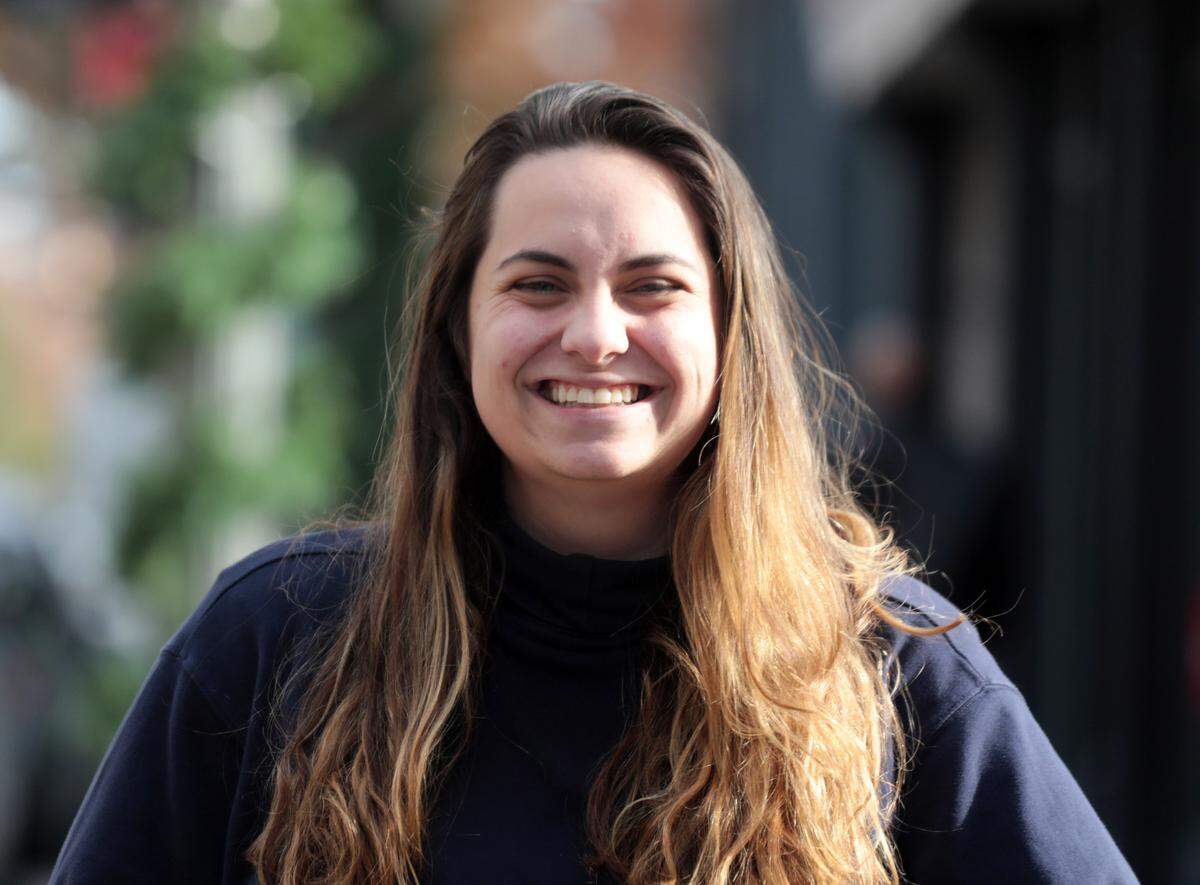
A Catawba man gets grant to teach tribe’s language
On a winter morning, DeLessin “Roo” George-Warren looks over the grey-blue rapids of the Catawba River, named for the only federally recognized indigenous tribe in the state of South Carolina.
He surveys the Catawba Indian Reservation land where his ancestors lived. It’s a place he left as a youth, thinking he would never return.
The reservation is on the edge of Rock Hill, SC., a small piece of what once belonged to the Catawbas.
George-Warren left in 2010 and went to the nation’s capital. He wanted to change the world. Now, he’s back, realizing that change begins here.
As a federally recognized tribe -- the Catawbas fought for and won that recognition in 1993 -- The reservation is an independent sovereign government.
“We can move in ways that other governments aren’t always able to move,” George-Warren says. “I grew up with that ethos of service towards the community, which a lot of Catawbas have, as part of our traditional values.”
As George-Warren speaks, it’s clear he could have succeeded anywhere.
Most recently, he was granted the Alfred Landecker Democracy Fellowship, an award given to 30 young people of diverse backgrounds to conduct innovative social change. He was given $12,200, plus a $6,000 project budget.
He’ll use the money to support other Natives -- computer coders, artists, and creators. He’s also using the grant to develop an app and a website that will teach and preserve the Catawba language.
He taught himself how to computer code. He learned how to sing opera. He studied theater. He graduated from Vanderbilt and won fellowships that took him to Columbia University and Copenhagen.
But in 2017, he chose to come home.
Comfortable with who he is
He says it took most of his 29 years to fully embrace his identity, to understand what his tribe means to him.
He’s the grandson of the late Buck George, an assistant chief to the Catawbas. George-Warren grew up immersed in the Catawba culture. He had light skin and could pass for white. And sometimes he stayed quiet about his identity.
When he did mention his heritage, he was told he didn’t “look Native American.” He said he remembers wanting to ask them: “What does a Native American look like?”
He remembers being asked by a classmate if he lived in a tee pee. “He had been to my house,” George-Warren says, and laughs.
“Being a numerical minority means, for me, and I know, for a lot of other Native Americans, a lot of other Catawba kids, it’s just like an exercise, being raised in the school system and having to constantly fight misconceptions,” he said. “I remember when I was in kindergarten you were doing that thing where you cut out pieces of paper and making like a deer skin, the headdress thing. I just remember being like, ‘what is this?’ I was thinking of my grandfather’s sports jackets, you know, that he wore to the counseling center.”
George-Warren has had a hard time moving past stereotypes of Native Americans, which exist in America even today.
He says he also identifies as queer. He feels safe with his sexuality in LGBTQ spaces. But he didn’t always feel safe about his race.
“I was ... constantly astonished by how many people wore like headdresses for Halloween, or when they were doing drag,” he said, “Or calling me Pocahontas when I said I was Catawba.”
In his travels, George-Warren says he began to feel invisible. So he came home in 2017, where his identity would never be questioned.
“My tribe knows who I am,” he says, shrugging.
When he enters a room, every Catawba knows him, remembers him as a child -- even if he doesn’t remember their names.
And now, he’s on a mission to preserve the language and history.
He remembers his family coming to dance at a school assembly. At first, he said he tried to disappear in the crowd. Then his aunt called him up to dance. “I just remember feeling proud,” he said. Proving that he belonged.
Working to ensure culture isn’t erased
Teaching the Catawba language, he says, is part of reclaiming the tribe’s identity. The Encyclopedia Britannica has deemed the language “extinct.”
To learn the language, George-Warren says, is to ensure the culture of the Catawbas won’t be further erased.
Part of his mission, he says, is to spread an idea that has lead him through his life — there is no single way to be Native American.
Light-skinned, donning a beanie and sporting electric blue nail polish, he doesn’t look like a stereotype.
George-Warren says he encounters people who’ve never met a Native American. He travels to schools and gives presentations on the history of the Catawbas.
He shows children there is no one way that Native Americans look or act. And he says he still fights for the memory of the Catawbas, teaching students that indigenous people were here before Christopher Columbus.
He’s also been involved in the tribe’s response to the COVID-19 pandemic.
George-Warren has helped organize the distribution of sanitary products to the tribe’s members. He’s assisting with the building of a new senior center and the procurement of agricultural land for the tribe.
He’ll get involved wherever his tribe needs him.
“The he only thing that motivates me is curiosity,” George-Warren said. “So what I’ve tried to do is constantly align my curiosity with things that will benefit my community.”
As he walks the trail behind the Catawba Indian Nation Cultural Center, Warren’s gaze wanders from time to time, lingering on the trees and plants. Long ago, he says, the Catawbas had words for each tree and flower. But that has been lost.
“The land misses hearing the language,” George-Warren likes to say, calling on a quote by Robin Wall Kimmerer’s “Braiding Sweetgrass.”
Always moving from one thing to the next, George-Warren seems to exhale here. He says he has no plans to leave.
This story was originally published January 4, 2021 at 12:00 AM.