
Q&A: Why longtime Fort Mill principal Dee Christopher is ‘hopeful’ amid coronavirus
Catawba Ridge High School principal Dee Christopher has seen a lot.
He’s been an educator for the past 30 years. He was the principal at Fort Mill High School for 12 of them, before the other two area high schools sprouted. He, like others in the Tri-County, has been a leader and a parent amid the kinds of emergency scenarios educators long remember.
Now comes the introduction of remote-learning in schools because of the novel coronavirus.
In a phone interview with Herald reporter Alex Zietlow on Tuesday, the 2015 Principal of the Year weighed in on a range of topics — from how the pandemic has uniquely affected his line of work, to how it may affect the future of education.
Each answer was laced with optimism.
“If this had to slow us down to be reminded that the most important thing in our lives is the relationships we have with one another,” he said, “that’ll be something positive that comes out of this.”
This interview was conducted before the announcement that South Carolina schools are closed for the rest of the year. Answers have been edited for clarity and brevity.
Finding the positives amid coronavirus
Zietlow: Does this situation compare to anything else you’ve faced?
Christopher: It’s obviously unprecedented. When you have an event, an emergency event — like an ice storm, or a snow storm, or a tornado or a hurricane or whatever — there’s kind of a rhythm for it. You’re going to be out of school for a couple of days. You’re going to close down beforehand. Those kinds of things.
This is so out of the ordinary, even for that. I think everybody is just doing the very best that they can do.
And you know, I thought about that: This is something that has affected us the most as a country, as a world, since probably World War II. And at that time, everybody couldn’t help then. But every single person could do their part in the quote/unquote ‘war’ against the coronavirus.
It doesn’t matter who you are because everybody can stay home. Everybody can cover up and do their part. I think that’s unique. I asked our students early on. I’ve done some videos for them, just some short little videos. But I asked them to really see the good in humanity during this time. And we have just seen some really cool things happening all over our county, our state, our nation, our world. I’m just amazed at how people have responded.
Zietlow: What are some of those cool, awesome, inspiring things you’ve seen?
Christopher: Well, since I’m a school person, I’ll talk a little bit about schools and even faith-based organizations that are helping. But kids doing things like making masks for folks who are maybe not doing as well. Maybe they’re out of a job now, things like that...
So students at our schools, as well as the faith-based community, (have helped). We got a local church in Fort Mill that’s taking care of a number of families from our school district. This has really affected some of the folks who are food insecure, maybe unemployed and things of that nature. We have a lot of people in our community for those who are in need.
‘We couldn’t have done this 10 years ago’
Zietlow: I can’t help but think that those who work in education are seeing their jobs change the most of any jobs because of coronavirus, considering the transition to E-Learning and the associated challenges. Do you think that’s accurate?
Christopher: When I started teaching, I didn’t have a computer in my classroom. I don’t know if we had a computer in the school that I worked in. ...
There’s been such a growth in technology that we couldn’t have done this 10 years ago, I don’t think. Especially not on such a mass scale, where almost every school in America is able to get online and do their schoolwork. ...
Our teachers, not just in our school, but in our school district, in our state, in our country, they’re not our front-line heroes, but they’re keeping some normalcy for a large population of our country. And I think the world of what our teachers are doing.
A lot of our teachers have moved from very direct instruction to a different form of instruction almost seamlessly. It hasn’t been perfect; I wouldn’t say that. But they jumped right in.
Being a principal and a parent
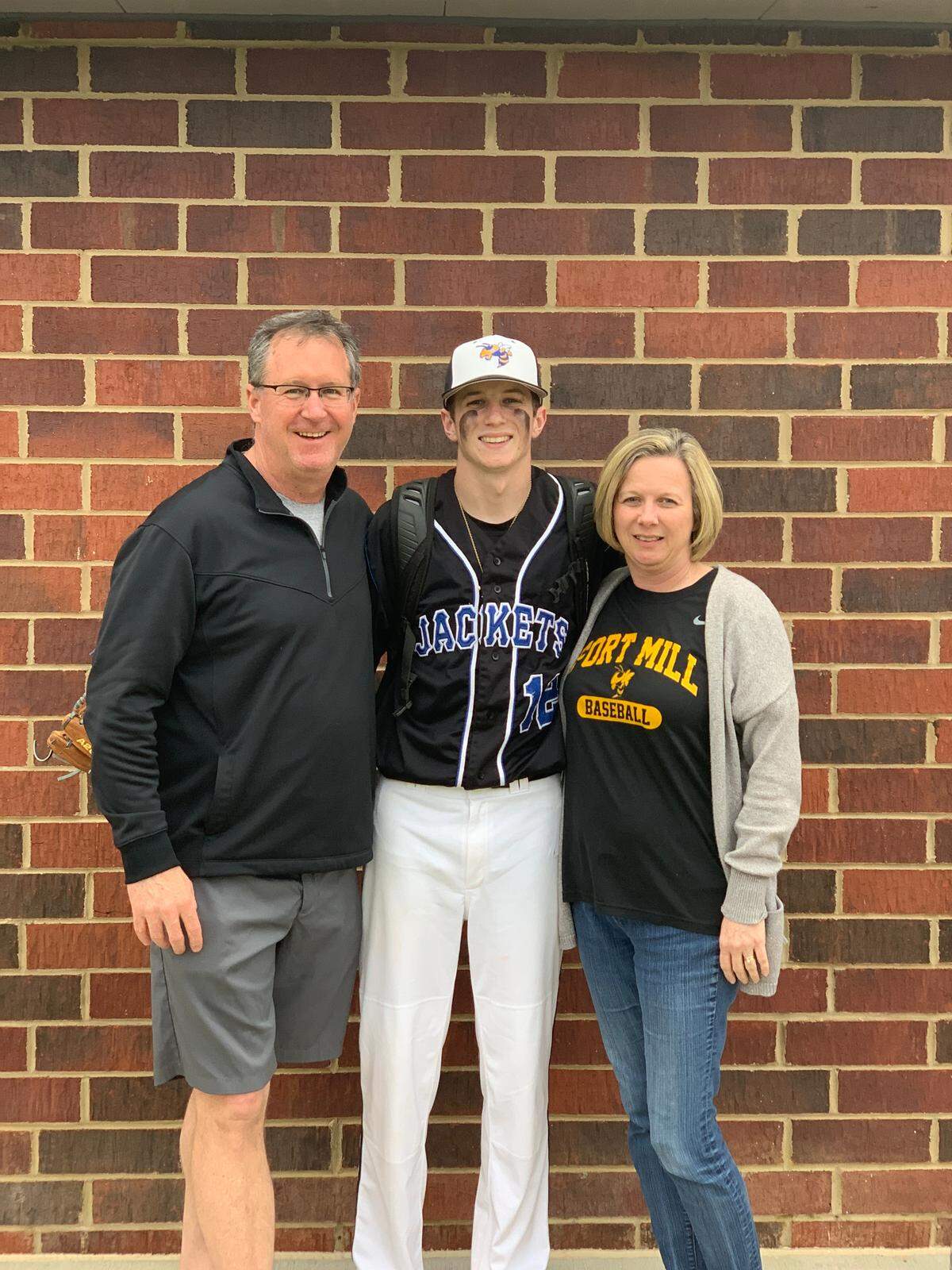
Zietlow: Catawba Ridge High School has 875 students. You’re used to managing a boatload of people in a building and being ultimately responsible. Now, you still are a principal, but you’re also in your own house with your kids, including one who’s a senior at Fort Mill High and who’s seeing his baseball season truncated.
Can you take me through what it’s been like for you as a parent?
Christopher: Well, we’ve got five in our family. I’ve got a 25-year-old daughter, who’s a school teacher in Jacksonville, North Carolina. Her husband is a Marine and he’s deployed right now. She’s been home some during this time. I’ve got a 21-year-old junior in college at home as well. And then our 18-year-old son.
Just so you know, he played varsity football, varsity basketball and varsity baseball. If somehow you were just to say baseball, it would bother him. (Laughs.) He’s a three-sport athlete, which is kind of odd nowadays, but he’s proud of that. ...
As far as he’s concerned, he turned 18 on March 1. He’s a senior in high school. He’s done well in school. We’ve never had to look over his shoulder a whole lot.
So it’s been really like having four or five adults in our house, all doing their own work...
It’s been a bigger challenge for (my son) with the social aspect of it, you know, being on teams, but also being a senior in high school. I mean, we all remember what it’s like being a senior in high school. That’s pretty difficult on our 17- and 18-year-olds that aren’t getting to see their friends and hang out and be seniors in high school. They’re having to do something really different.
Zietlow: What is something that you’ve learned? What is something that only this weird circumstance could’ve have taught you?
Christopher: You know, I’ve thought about that a little bit...
The thing that I would say, that I’ve always said, is I’ve been positive. Amid a pandemic, I just think there’s a lot of hope in humanity and in who we are as mothers and fathers, brothers and sisters, neighbors. I just think there’s a lot of hope for the future even amid something so unique and unprecedented.
I’m hopeful about the future. I’m older than I used to be, and I’ve always worked with teenagers for my entire career. I believe in what our teenagers have to offer. And I always have. But this has been a reminder that the world isn’t hopeless. We have a hope for something even bigger.
And if this had to slow us down to be reminded that the most important thing in our lives is the relationships we have with one another, that’ll be something positive that comes out of this.
I love the fact that I’ve gotten the chance to spend more time with my adult children, which I would not have gotten otherwise. I don’t like a pandemic, but that’s a positive portion of this.
Coronavirus implications on future of education
Zietlow: Do you think this will be a sort of game-changing moment in education?
Christopher: It’s going to show all of us, educators as well, that, ‘Hey, we can do this.’
I’ll be honest with you. We can make some mistakes and fail as educators in instruction sometimes. That makes us human like our students. But it also pushes us to continue to grow, to meet the needs of our students.
In terms of this taking over what education looks like? I just don’t see it. I don’t mind choice for students and families; I think students need to be in the environment where they excel the most. So we’re going to have some students who say, ‘I just want to do this all the time.’ But we’re going to have some students who say, ‘There’s no chance. I need a teacher.’ ...
We’re going to be better at using technology than we’ve ever been because of this. And our students are going to be more used to it than ever before.
But I don’t think it will fully change the paradigm of Brick and Mortar schools, where most of our students receive their education.
Zietlow: Is there a final thought?
Christopher: The only thing that I would say is, because I have a senior at home, those are the students who are missing out on the most. Not only are they missing out on education and instruction, they’re missing out on a lot of those senior rites of passage, if you will, that I always talk about in my graduation speeches with students.
High school graduation is one of those rites of passage. And the look and feel of that could be very different for our students. It’s already caused it to be very different for our students.
But I also don’t want to miss an opportunity (to say): Our students are going to be OK — in Fort Mill and across the country.
Our teachers are going to do things in the fall. They’re not going to catch them up necessarily with everything they may have missed, but our teachers are going to work really really hard to have our students ready for whatever their next step is.
And I’m talking about elementary, middle and high school teachers. They’re going to have them prepared.
This story was originally published April 23, 2020 at 11:36 AM.
.jpeg)