
‘Our district looks racist.’ A close look at what Rock Hill school rezoning would mean.
The debate over how — and whether — the Rock Hill school district should rezone elementary school students continues to intensify as parents and school officials examine the proposed options.
“We know it’s hard,” Rock Hill Superintendent Bill Cook told the Rock Hill Schools Board of Trustees and other participants when he introduced the topic at a Monday board meeting. “Choices are wonderful except for when they’re difficult to make.”
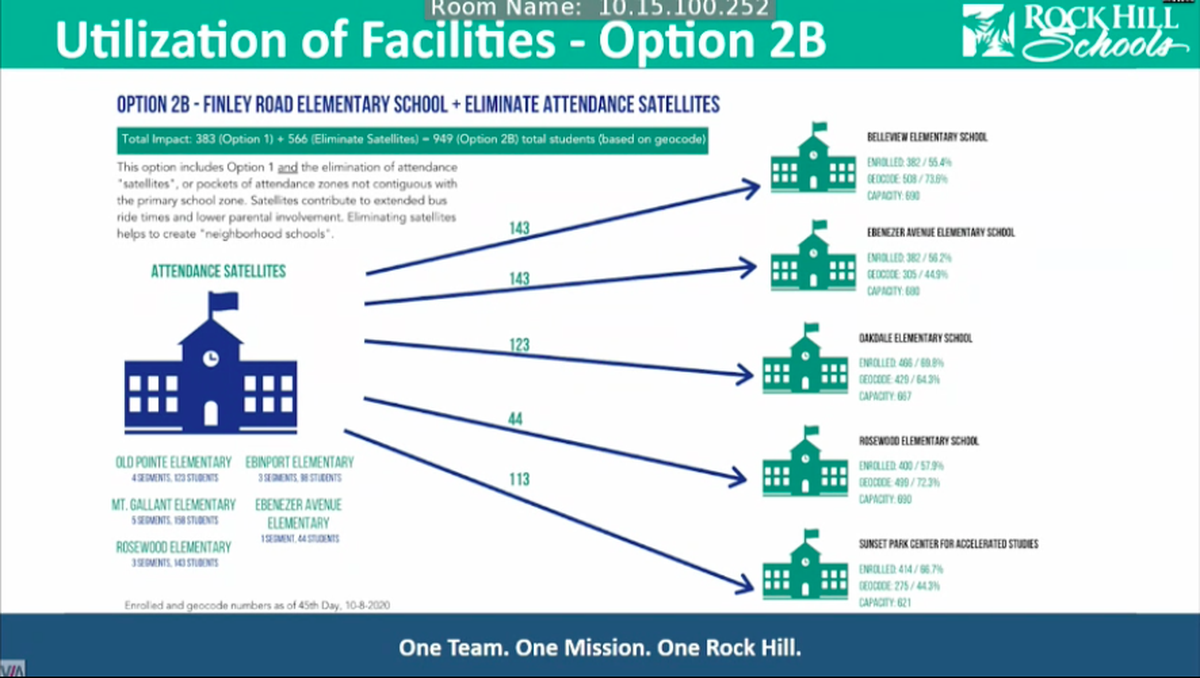
Two weeks ago, the district began considering three rezoning plans to explore how it could more efficiently use its elementary school facilities. One of the three rezoning proposals would close two functioning elementary schools — Finley Road Elementary and Rosewood Elementary — and displace more than 1,300 students. (Per the board’s request, the district later fleshed out two more options. Each would move more than 3,800 elementary school students.)
The board solicited feedback from School Improvement Councils (a committee made up of parents and educators representing each school), staff and community members across the district. Community members expressed an array of concerns: that the proposed rezoning comes at a bad time; that closing schools should only be considered as a last resort; and that the proposed plans may have unintended consequences.
Rezoning would go into effect for the 2021-22 school year. Cook is pushing for a decision next month.
This change has been an idea within the district for years, Cook told The Herald after Monday’s meeting.
Racial balance is a goal
Apostle Norma Gray, president of the Rock Hill NAACP, sat through much of Monday’s three-hour meeting. Before she left, she told The Herald she doesn’t like any of the board’s proposed plans, but she also recognizes that action must be taken to reverse the current state of segregation in Rock Hill’s elementary schools.
“Bottom line, our district looks racist,” Gray told The Herald.
Gray had children who went to Belleview Elementary. She — like the two parents who advocated for saving Finley Road to the board on Monday — doesn’t take joy in the prospects of any schools closing, or of families having their routines upended.
But she also said rezoning is “going to happen because it needs to happen,” adding that better integrating schools would improve the children’s learning environment and benefit the future of Rock Hill.
Cook acknowledged to The Herald after the meeting that the district currently has “significant” racial imbalances. The rezoning options, he said, present a way the district can better promote its goal.
“We are trying to get that message (out) that we are currently imbalanced,” Cook said, “and we’re trying to get better at creating that balance.”
District spokesperson Mychal Frost later confirmed to The Herald that one of the goals of rezoning is to make the racial composition of the elementary schools proportionately reflect the racial composition of the surrounding community. (According to U.S. Census data, Rock Hill has three main races/ethnicities in its population: 54% white, 39% Black and 6% Latino.)
That goal is tricky.
The district is not legally allowed to use racial quotas as a factor in reassignment. Also, the district offers parents opportunities to send their children to schools other than those assigned based on their address. There are “choice” programs — programs like “STEAM” at Oakdale Elementary and “Arts Integration” at Northside Elementary. So there’s no way to be absolutely certain what the racial makeup of each school would be post-rezoning.
Also, some community members are cautious about accepting plans that shape boundaries (like multiple proposed plans do) to create “neighborhood schools,” a term that historically has been associated with segregation.
“One of my major concerns is, ‘Are we looking and being careful so that we will not end up segregating some schools?’” board member Mildred Douglas said at Monday’s meeting. Her question was met with applause from the 10 community members who stayed in the audience for the meeting’s entirety.
Cook told The Herald that limiting bus ride times and balancing school capacities and demographics is all achievable through rezoning.
Under capacity schools
The clearest argument for rezoning from the Rock Hill school district is simple: Not enough elementary school students are in the district to justify having 17 elementary school buildings.
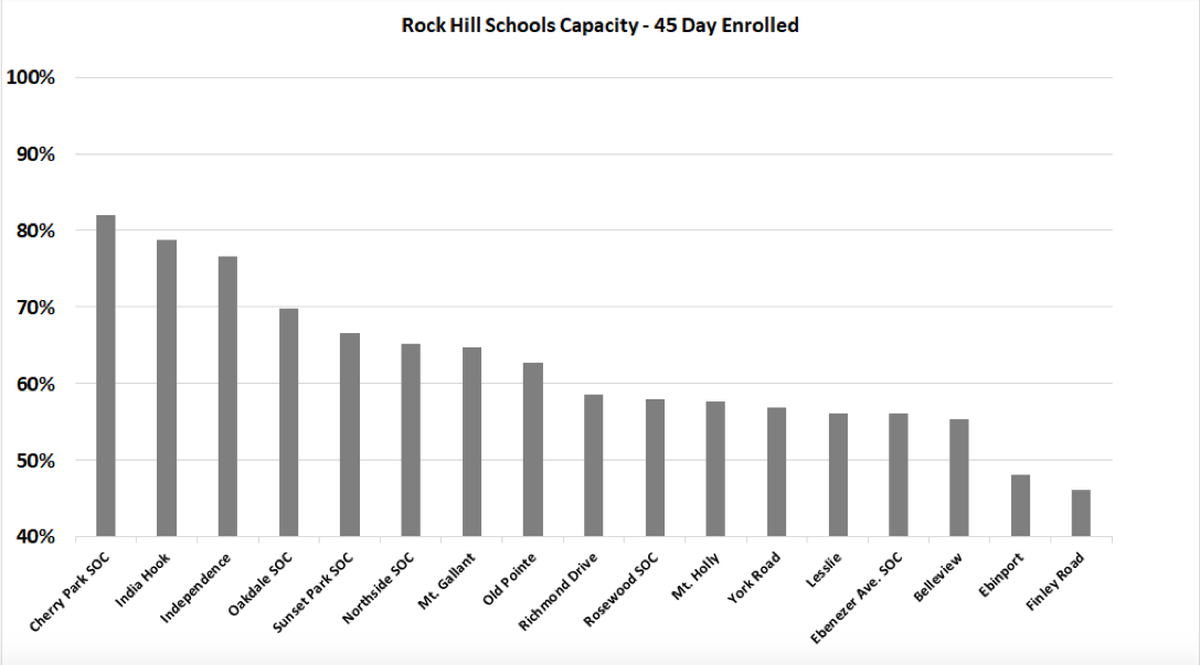
Data presented to the board Monday show that 14 of the district’s 17 elementary schools are currently at 70% or below in capacity, and nine are 65% or below. The school district has a set target of 75% capacity, Frost said.
Nine of the district’s school buildings, also, were constructed 60 or more years ago.
This, paired with the fact that Rock Hill has seen overall population changes and community shifts over the past decade, gives more reason for the board to consider rezoning, Cook said.
“Rock Hill has changed,” Cook told The Herald. “The district has built new schools. There are charter schools, private schools. So it’s just that things have changed…”
He added that by addressing the population shifts, the board could better use its classroom space and reallocate resources to expand academic programs (perhaps repurposing a current elementary school into a centralized pre-kindergarten facility).
“It’s hard to narrow it down to one thing,” Cook said. “But at the end of the day, we want to provide the very best education for every child in the district.
“We have a lot of schools that are under-utilized in their capacity; we have a lot of schools that are aging facilities. So what are we trying to do? We’re trying to provide equity to children. We’re also, through this process, trying to provide balance as best as can be allowed for.”
Why decide now?
Many who provided feedback to the board also argued that the district should not make a rezoning decision ahead of what will likely be another transitional school year in 2021-22.
In a written statement submitted to the board, Kim Crean of Cherry Park Elementary’s School Improvement Council asked, “Why is this an immediate focus during the pandemic?”
In another written statement, the School Improvement Council at Ebinport Elementary expressed concern that next year would “not be an ideal time to introduce more change in life” for students and teachers as the pandemic has “introduced additional trauma and risk factors — especially among our at-risk students — making them less resilient to change.”
The council also noted that some members called the timing “ideal for change,” a chance to make a hard but necessary transition before students return to a new normal environment.
Board member Patrice Cherry asked Cook if the rezoning decision could be postponed, arguing that perhaps the effects of the pandemic and recent changes in population haven’t yet been fully realized.
Cook said not rezoning is an option, but he added reasons that changing now is appealing.
“One of the components that has guided us to this point is that this has been a continuous, ongoing issue: We have not seen the (population) growth that gets us to the full utilization in our buildings,” Cook said.
He added that some of the older buildings cost a lot of money to maintain, an issue made more urgent now because the district’s funding is limited. (The district indefinitely postponed its $294.8 million bond referendum in March that would’ve helped pay for safety and security projects and updates to facilities.)
“We recognize that no time is a good time to transition and shift students,” Cook said. “I would say that buildings don’t define a teaching and learning process. The relationships between the teachers, the administrators and the people who work in those buildings are really what guide and determine the impact on our children.”
Other details to know
▪ Board member Brent Faulkenberry clarified that the rezoning proposal is not a costs-cutting initiative. He said “every dollar that is saved will go into another classroom, into another school, into your children.”
▪ Cook said, no matter the plan selected, he would “strongly advocate” for the students to be “Grandfathered” into the elementary school they currently attend. He said the board would need to determine which grades would be included.
▪ Cook said a final decision on this will need to be made next month — at either the Feb. 8 or Feb. 22 board meetings. That would provide time for families and the district to make necessary preparations ahead of the 2021-22 school year.
This story was originally published January 29, 2021 at 7:00 AM.
.jpeg)