How to find, support and keep teachers critical for York County school superintendents
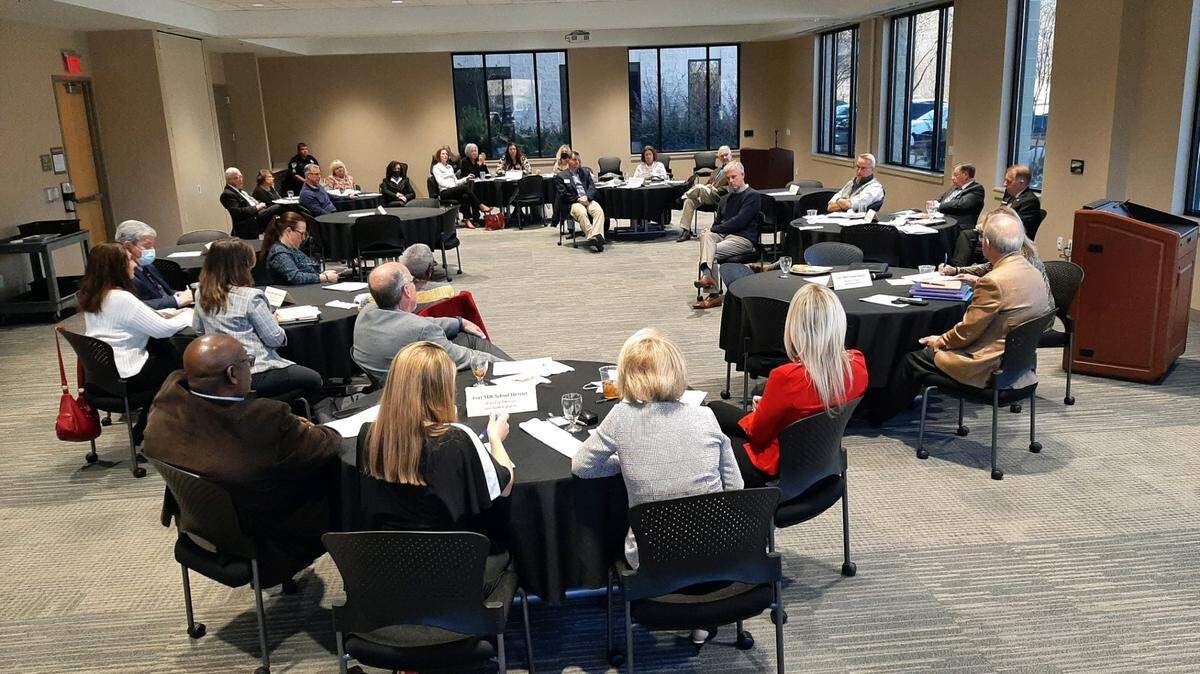
Editor’s note: Superintendents and board members from the York, Clover, Rock Hill and Fort Mill schools met Jan. 7 in Fort Mill. This series of articles will explore common issues that face them, including teacher shortages, COVID funding, state funding and impact fees.
Public schools in York County need teachers. Teachers to serve bigger cities and towns, and teachers to help students catch up from lost classroom time. Teachers, district officials say, who could become yet harder to find.
York, Clover, Rock Hill and Fort Mill school board members and superintendents gathered Friday in Fort Mill. Collectively they asked state legislators in attendance to fund state teacher salaries at or above the national average. Districts asked for additional staff to give teachers planning time during their days. They asked for expanded certification options, funding for new “grow your own” programs and higher summer pay.
The idea of a teacher shortage in South Carolina isn’t new. It is widening.
The State newspaper reported earlier this school year that teacher vacancies in South Carolina are up 50%. It’s the biggest vacancy gap in at least 20 years, the paper reported.
In growing areas like Fort Mill and Lake Wylie, the need for new teachers is constant. Superintendent Sheila Quinn with the Clover School District gets 300 to 350 new students each year.
“That means we’re always adding teachers,” she said.
Even York with its relatively stable population in recent years could face similar challenges. Superintendent Kelly Coxe said 18 new developments approved in York could add 2,000 homes.
Nationwide and locally, there aren’t as many qualified teaching candidates. The reasons range from insufficient pay to work load to politicization of education, educators said Friday.
“We’re all trying to hire (from) the same reduced-pot number,” said Chuck Epps, Fort Mill School District superintendent.
COVID impact
When COVID-19 hit, emergency federal money paid for teacher, interventionist, speech pathologist, counselor and mental health assistant positions. When federal money dries up, it will be up to districts to figure out how, or whether, to keep those employees.
“We’re challenged on the general fund budget because we’re adding teachers,” Epps said.
Those challenges come at a time when state-funded programs for career specialists, nurses, reading coaches, security officers and 4K instructors already aren’t fully funded. It would take another $3.4 million from the state just to fully fund them in Fort Mill, according to that district. Rock Hill would need $3 million, Clover $2.6 million and York $1.5 million, according to those districts.
Mental health professionals are another concern. District officials on Friday shared similar stories. More students than ever need mental health services, they said. The Rock Hill district has 140 student referrals a week.
“That is a deep need that we have in our district,” said Terri Smith, chief of business services for the Rock Hill district.
Coxe asked legislators to lift, in part or whole, several years-old bans on policies that once allowed districts to apply for Medicaid funding for mental health treatment.
Teaching teachers
COVID kept students out of classrooms for months. It hamstrung teachers charged with educating those students.
Quinn said districts have to plan for new college graduates who come in as teachers.
“We feel like we’re really going to have to support them for several years,” Quinn said.
Those students had an interrupted college experience due to COVID. Many of them took final years courses virtually, at a time when student teachers typically spend time in schools.
“Learning to teach children has to be done face to face,” Quinn said.
School districts want to offer competitive positions for teachers and staff. The additional staff needed to make sure teachers get planning time during the day would cost about $500,000 in Fort Mill alone, said board chairwoman Kristy Spears. School districts want the same hourly pay for teachers during the summer, key to learning loss recovery from COVID for students.
Quinn’s district gave daily rates last summer as a way to get more of its own teachers with students who need help. Paying lower rates, as was done historically, won’t cut it for teachers.
“They’re exhausted,” Quinn said. “They want to go home and rest.”
School districts also want room for creativity. The Clover district spent $80,000 for its own special education masters program. The district paid for 15 teachers to attend Winthrop University for certification.
Summer instruction is key. Students need time and access to teachers to catch up from time out of classrooms, said Rock Hill interim superintendent John Jones. There is an undeniable educational gap brought on by COVID.
“The gap is becoming deeper,” Jones said. “It is becoming wider.”
Getting teachers to commit summer time is tricky when there are other online or tutoring options that may pay well.
“It’s more competitive now,” Jones said.
Despite size and geographic differences in the four York County districts, teacher recruitment and retention is one of several areas discussed Friday where districts find common ground.
“These are the big, low-hanging fruit that affects all of us,” Epps said.