‘Large’ predator — with hundreds of teeth — pulled from the depths. It’s a new species

Thousands of feet underwater, a “large” predator prowled off the coast of New Zealand. Maybe the pregnant sea creature was searching for a snack to sink its nearly 200 teeth into, or perhaps it was looking for a spot to deposit one of its three eggs.
Instead, something caught the rough-textured animal and pulled it to the surface. It turned out to be a new species.
Scientists were surveying the depths of the western Pacific Ocean when they encountered the “large” and unfamiliar-looking shark, according to a study published March 28 in the peer-reviewed journal Fishes. The surveys caught several of these sharks between 1985 and 2019.
Taking a closer look at the ocean animals, researchers realized they’d discovered a new species: Dichichthys satoi, or the roughback bristle shark.
Roughback bristle sharks are considered “large,” reaching about 3 feet, 5 inches in length, the study said. These sharks have “firm” bodies covered in “large” spike-like structures that create a rough texture. Their “large” mouths have about 200 teeth that are constantly visible.
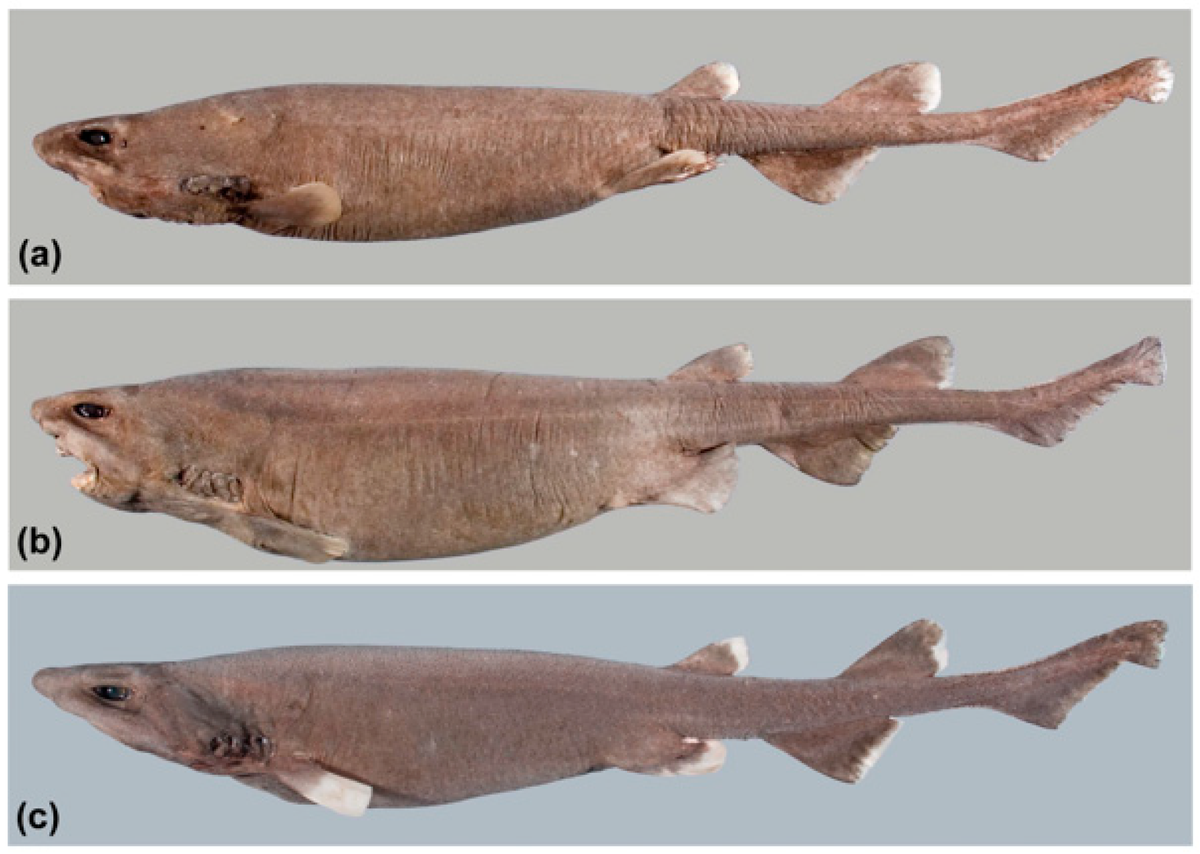
Photos show the brownish-gray coloring of several roughback bristle sharks. Their fins have white edges that vary in thickness, the study said.
Several female roughback bristle sharks were found pregnant with three eggs, researchers said. These eggs were “golden brown” in color and in “banana shaped” cases. Female sharks likely deposit their egg cases before the embryo has fully developed.
When researchers analyzed the stomach contents of one shark, they found a fish and the “beaks of two octopus.” The remnants indicate that roughback bristle sharks are predators.
Roughback bristle sharks live at depths between 2,200 feet and 3,900 feet, the study said. So far, the new species has only been found off the western coast of New Zealand’s North Island.
Researchers said they named the new species after Keiichi Sato, a researcher at the Okinawa Churaumi Aquarium, whose “extensive work” on “deepwater catsharks has been crucial for the field.”
The new species was identified by its size, coloring, body shape, texture, teeth, egg cases and DNA, the study said.
The research team included William White, Andrew Stewart, Helen O’Neill and Gavin Naylor. The team also identified a new family of sharks: Dichichthyidae, or bristle sharks.
This story was originally published April 2, 2024 at 2:13 PM with the headline "‘Large’ predator — with hundreds of teeth — pulled from the depths. It’s a new species."