‘Toothless’ predator — millions of years old — found as new species in Brazil. See it

In southern Brazil, the now-lush rainforest environment once was a vast desert.
Under the beating sun, massive shadows would pass overhead before fearsome predators cascade from the sky and attack.
More than 100 million years ago, this Caiuá Desert was ruled by these prehistoric flying animals — with no teeth.
“The Tapejaridae are a clade of Cretaceous toothless pterosaurs easily recognized by their short, downturned rostra (or beak) and peculiar premaxillary (on the front of the head) crests,” according to a study published June 10 in the journal Historical Biology.
Pterosaurs existed across the globe, particularly when the planet’s land masses were predominantly connected.
In 2014, a massive assemblage of bones belonging to these ancient species was discovered in the Paraná State of Brazil, according to the study, and hundreds of specimens have been identified in multiple layers of the ground.
The site came to be known as the “Pterosaur Graveyard,” with pterosaurs of slightly varying shapes and sizes found to have died in the same place.
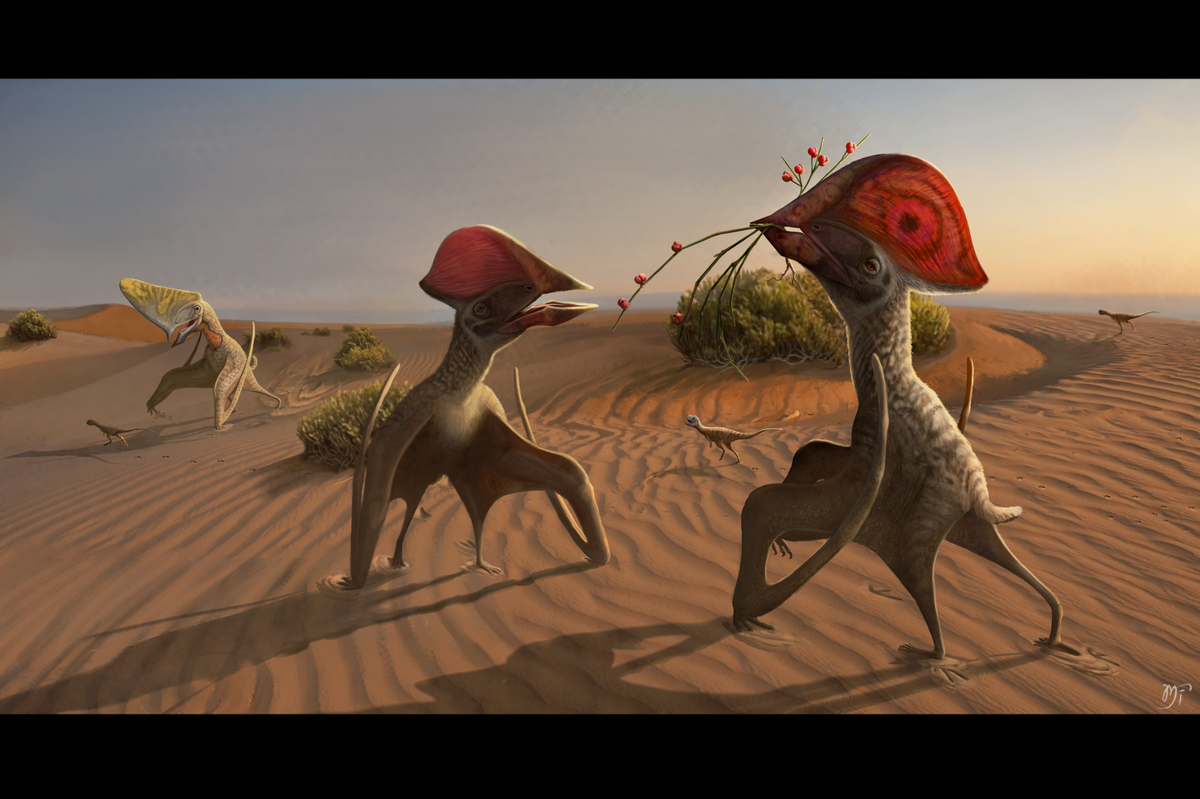
Now, researchers believe some of this variation shouldn’t be attributed to general differences among animals of the same species, but two species that may have been coexisting.
Rodrigo Pêgas, a paleontologist from São Paulo University, compared the fossilized bones of multiple specimens and uncovered key differences.
Pêgas found only some of the fossil remains have a palatal ridge, a structure inside the mouth, as well as differences in the hard palate, they wrote in a post on X, formerly known as Twitter.
Some specimens also had a much steeper angle of their rostrum, the hard beak-like shape of the face.
Pêgas notes that some slight differences are to be expected among the same species, just as humans don’t all come in the same height, weight and bone structure.
But, they argue, the differences are significant enough to suggest the presence of a new species.
Excavations of other pterosaur bones around the world have found that “multiple, closely related pterosaur species” used to coexist more commonly than previously thought, according to the study.
Pêgas named the new species Torukjara bandeirae, after Brazilian paleontologist Kamila Bandeira, who was the first to notice taxonomic differences in the tapejarid pterosaurs and suggested Pêgas look into it further, according to the study.
Pterosaurs ranged from terrors of the sea to desert predators, and previous research at the Caiuá Desert site shows this species often stayed around desert oases hidden in the dunes, Smithsonian Magazine reported in 2014.
Paraná State is in southeastern Brazil, between the Atlantic Ocean and Paraguay.
This story was originally published June 13, 2024 at 1:02 PM with the headline "‘Toothless’ predator — millions of years old — found as new species in Brazil. See it."