Rock Hill approves its new elections map. See if you need to vote in delayed races
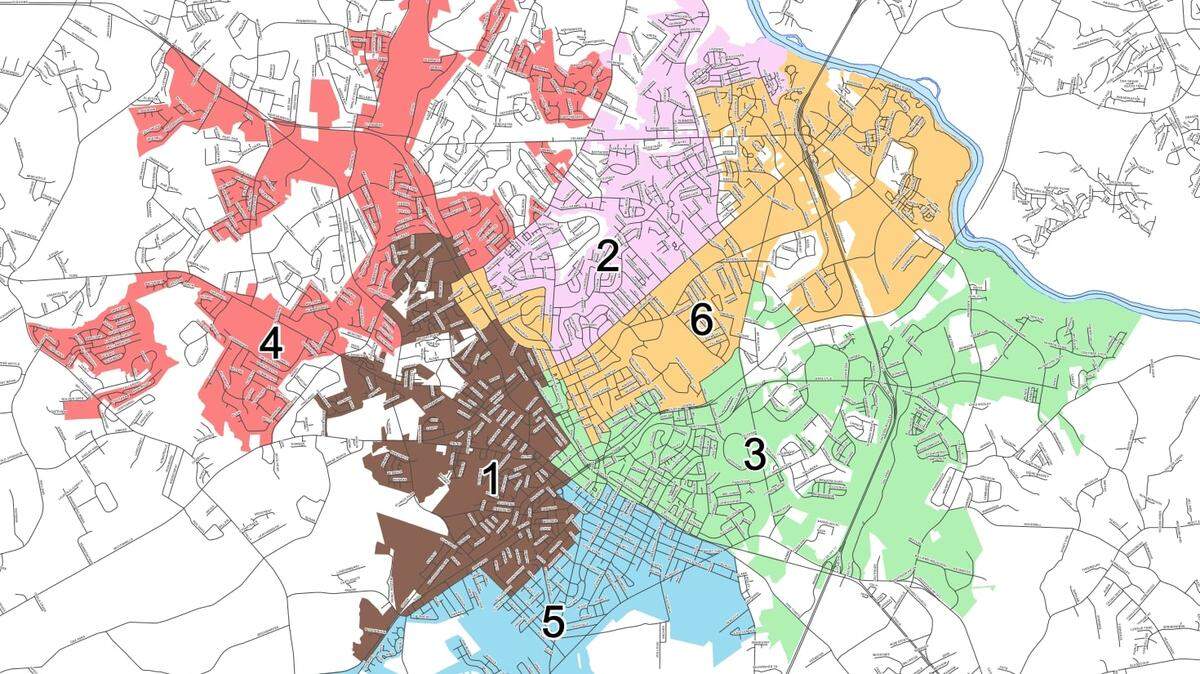
Hundreds of Rock Hill residents may need to vote in new wards, some sooner than others, after the city finalized a redistricted elections map this week.
On Monday, Rock Hill City Council voted 6-1 to adopt a new ward map based on 2020 census data. Council voted several months ago to delay elections for Wards 4, 5 and 6 until city officials were able to redraw its six voting districts, which is required every 10 years based on updated U.S. Census Bureau information.
The city held its mayoral race as scheduled in October. Now, Rock Hill will hold the three ward races on Feb. 8. Candidate filing for the three seats opened Wednesday.
Councilwoman Nikita Jackson, who represents Ward 5 and is up for reelection, voted Monday against second reading of the ordinance. Last month, council voted unanimously on first reading. However, city officials corrected the map Monday to include a parcel of land that was annexed into Rock Hill in August.
The parcel, along the intersection of Fire Tower Road and Interstate 77, was delegated to Ward 3. However, Jackson said the parcel, which will be developed as part of the Southside Redevelopment Plan, touches part of Ward 5 and the city would benefit from keeping that area together.
“We’re actually going to be splitting that road in order to move that to Ward 3 if you look at the way that it is on the map,” she said. “Why do we split an area straight down the middle? That gets confusing for people.”
Delayed races and representation
Pandemic-related delays slowed the census bureau’s release of the 2020 data and municipalities did not receive the necessary redistricting information until late August. At that time, Rock Hill officials said the later date would not allow the city enough time for the redistricting process.
The U.S. Constitution requires voting districts to be equal in population. City officials anticipated the six wards would need to be redrawn because of significant population growth during the last 10 years.
Over the last decade, Rock Hill’s population grew to over 74,400 people. As a result, officials aimed to include roughly 12,400 residents per ward. When Rock Hill redrew its map in 2010, the city’s wards each had roughly 11,000 people, according to the city.
Based on the city’s new map, Ward 4, which includes the airport and the northwestern part of the city, has the highest population with 12,537 people. Ward 5, which includes East Main Street and the southern part of the city, has the next-highest with 12,517 people. Ward 1, which includes the Boyd Hill area, has the smallest population with 12,233 people.
Rock Hill’s wards must also comply with the 1965 Voting Rights Act, which ensures redistricting plans do not discriminate on the basis of race, color or membership in a language minority group.
Rock Hill’s population is made up of about 49% whites and 39% Blacks, according to the latest census numbers. The city worked to ensure the new map represents the population, Steven Gibson, deputy city manger, said.
Ward 5, which is made up of about 66% Blacks, has the highest minority population, based on the city’s map. Ward 1, represented by councilman Derrick Lindsay, is made up of about 60% Blacks, according to the map.
“We were able to make sure we are not diluting a minority’s voting strength in the new plan that is being considered,” Gibson said.
Changes to city’s map
Gibson said the city’s map did not undergo “too many changes.” City officials needed to add more residents to Wards 1 and 2 to balance out the populations, he said.
The main changes in the new redistricting map are:
▪ Ward 1 was short by roughly 1,300 people, Gibson said. Officials moved a section of the Steeplechase area in Ward 4 to Ward 1. Officials also designated part of Ward 5 along Moore, Johnston, Green streets and Jefferson and Carolina avenues to Ward 1.
▪ Ward 2, which needed about 150 people, gained parts of Ward 6 along India Hook and Cherry roads between Charlotte Avenue and McDow Drive.
▪ A multi-family area in the city’s downtown between Main and White streets and Elizabeth Lane was moved from Ward 5 to Ward 3, Gibson said.
▪ As a result, Ward 5 gained a chunk of land on the city’s southern border between Blackmon and Porter roads to include Flint, Black and Main streets.
City officials worked to avoid splitting voting precincts, prioritized keeping communities of interest together and attempted to maintain consistency among constituents, Gibson said.
“Part of redistricting, we move people from ward to ward so that we have that level, that deviation that is as low as possible,” Gibson said. “We only moved about another 360 folks beyond that, so that’s a great measure for consistency.”
New election timeline
Candidates for Wards 4, 5 and 6 have until 5 p.m. Dec. 10 to file at the county elections office in York.
Councilman John Black represents Ward 4. He filed Wednesday morning to run for reelection.
Jackson represents Ward 5. She said she plans to run for reelection.
Councilman Jim Reno represents Ward 6.
Candidates must be registered to vote and have lived in the ward for at least 30 days before the election, according to the elections office.
Rock Hill residents must be registered 30 days prior to election day to vote. A runoff will be held on Feb. 22, if needed.
This story was originally published November 11, 2021 at 6:00 AM.