
SC superintendent hopefuls spar over book bans, vouchers and school funding in lone debate
In a state superintendent race where candidate qualifications, or the lack thereof, has been a focal point the past seven months, the issue was conspicuously absent from Wednesday night’s debate between candidates Ellen Weaver and Lisa Ellis.
Neither the candidates nor the moderators mentioned Weaver’s controversial pursuit of a master’s degree, which state law requires the superintendent of education must possess, focusing instead on issues ranging from book bans to school consolidation.
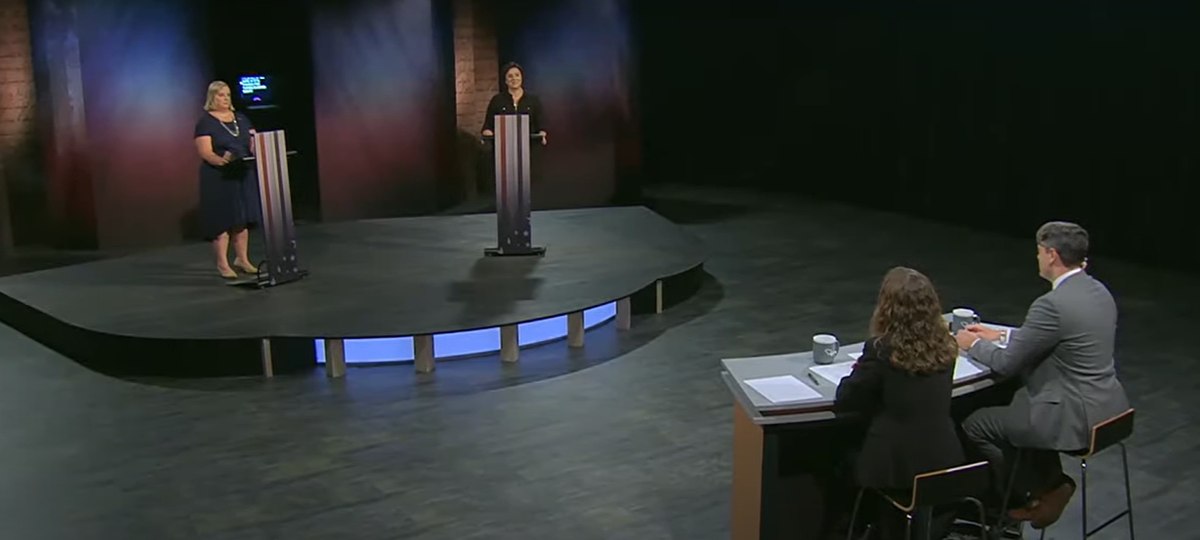
The one-hour debate, moderated by South Carolina ETV’s Gavin Jackson and the Charleston Post and Courier’s Seanna Adcox, centered largely on policy and highlighted some of the key differences between the candidates.
It was the only debate held between the candidates ahead of Election Day Tuesday.
Weaver, a conservative think tank president with no classroom experience, touted her leadership skills, political connections and ability to get things done. She announced last month, roughly six months after starting an online master’s in educational leadership at Bob Jones University, that she’d completed her degree requirements.
“This job is all about executive leadership,” she said in response to a question about her qualifications for the job. “While I greatly value the expertise and calling of our teachers in the classroom, this is a management role of a multibillion-dollar state agency with over 1,000 employees.”
Ellis, a Richland 2 student activities director and founder of grassroots teachers group SC for Ed, stressed her experience in the classroom and the need for the state’s top schools official to understand what’s really happening “down in the trenches.”
“What I have seen through my 22-year experience in the classroom is the fact that what’s happening at the policy level is not helping students and teachers down in the trenches, or in the classrooms,” she said. “And so I believe that the teacher voice, understanding what is really going on in schools and how best to fix that, needs to come up to the policy level.”
Ellis, who has continued teaching full-time while criss-crossing the state speaking to voters, seeks to become the first Democrat elected to statewide office in South Carolina since 2006, when former state Superintendent Jim Rex defeated his Republican opponent by fewer than 500 votes.
The 47-year-old political novice, who opposes private school choice and efforts to censor classroom discussions about hot-button cultural topics, has made raising teacher and staff pay, increasing state education funding and improving school working conditions the central tenets of her campaign.
Weaver, a Republican political insider who has raised record amounts of cash from leaders of the national school choice movement and South Carolina’s business community, would usher in a more conservative brand of education reform that emphasizes school choice, promotes greater parental involvement in curriculum design and disavows lessons that center race, gender and sexuality to “indoctrinate” students.
The candidates are running to replace Superintendent Molly Spearman, a moderate Republican who declined to seek reelection. Spearman, a former music teacher who served four terms in the South Carolina House and two terms as state superintendent, recently endorsed Weaver, after backing her opponent Kathy Maness in the GOP primary.
Teacher pay, school vouchers, politicization of education
Both Ellis and Weaver agree that teacher salaries need to increase, but differ in how they would finance pay hikes.
Ellis said during Wednesday’s debate that the state should fund higher teacher salaries through its annual spending plan.
The state does not lack for teachers, she said. It simply needs to raise pay and improve working conditions so disaffected educators return to the classroom.
But the General Assembly has been short-changing schools since the 2008 financial crisis, Ellis said, and won’t be able to lure the best and brightest teacher candidates away from higher paying private sector jobs without paying them competitive salaries.
“Over the last four years, we’ve had enough budget surplus to be able to solve that problem, and yet the General Assembly has chosen not to,” she said. “If we want to retain and recruit teachers that are great and really there for our students, we have to stop looking at the way that we’ve always done it and look at how we move forward.”
Weaver called it a “myth” that schools were underfunded and said people pushing that narrative would rather throw more money at the problem than figure out how to spend existing funds more wisely.
“There is so much money that is currently in our education system, and I’d like to see us make efficient use of the money that we already have in the system before we just start throwing money at problems,” she said.
Weaver said she supports raising teacher salaries to the national average, but wants to pay for it by finding savings in the existing education budget.
“In the conversations that I’ve had with teachers across this state, they tell me about books that are sitting in closets that have been unopened, technology that’s not being used,” she said. “We know that there is so much waste and inefficiency within the system.”
Weaver said as superintendent she’d order a “top-to-bottom” audit of the Department of Education to better understand how money is currently being spent and where the agency can find savings that can be returned to classrooms.
The candidates also clashed Wednesday over private school choice, an issue that has significant support in the Republican-led General Assembly and could become a reality in the years ahead.
Weaver, whose Palmetto Promise Institute has led the push in South Carolina to redirect taxpayer dollars to private and religious schools, called school choice “the great civil rights issue of our time,” and said she would implement any private school choice option the General Assembly approves.
“I want children to be in the environment where they can learn best,” Weaver said. “And too often many families face income limitations because of their ZIP code and just because of their family circumstances. I want every child to be able to get into the education environment that is right for them.”
Ellis, who opposes any efforts to give taxpayer money to private schools, asserted that parents in South Carolina already have education choice and said the state would sacrifice transparency and accountability if it diverted money to private institutions that aren’t held to public school standards.
“If you are not a public school in South Carolina, you can choose who comes through your doors,” she said. “When the superintendent of education is tasked with educating all students in South Carolina, we need to make sure that we are protecting our public schools and using all the available funds that we have.”
The candidates also come down on different sides of the national debate over parents’ rights and school censorship, specifically as it relates to so-called critical race theory and book bans.
Weaver wants to give parents the ability to fight against the “pernicious” ideology of critical race theory and to report what she said were “pornographic” books in school libraries, an issue that in recent months has become a hot topic in school districts across the state.
In Beaufort County, for example, school administrators pulled nearly 100 books from library shelves after parents complained they contained “adult-rated content,” and the Lexington-Richland 5 school district recently removed from its libraries a children’s book that touches on Black American history and identity.
Greenville County Council this week also considered, but ultimately rejected removing LGBTQ-themed books from the children’s sections of its 12 locations after the county GOP raised concerns that children might be “indoctrinated” by their contents.
Much like the debate over critical race theory, supporters of book bans argue that schools are exposing young children to topics like race, gender and sexuality that some parents feel are inappropriate.
Weaver clarified that she didn’t support removing literary classics such as “To Kill a Mockingbird” or “Catcher in the Rye,” but rather the “crassly inappropriate pornographic materials” that she said had been found in school libraries.
“These are things that parents have the right to decide and a school should never come between a parent and a child in these critical decisions,” she said.
Ellis responded that teachers were not attempting to indoctrinate students by pushing critical race theory or assigning books about race, gender and sexuality. She said people attempting to put an end to such practices were “chasing ghosts” rather than addressing the real issues students are dealing with.
“That is one of those issues that has become an issue that has never really been an issue,” Ellis said.
By removing books from school libraries and sanitizing the curriculum, politicians would be denying students a “whole education,” she said.
“We want to prepare (students) for the world that will exist,” Ellis said. “And that world is a beautiful, diverse world, and we need to make sure that we’re giving them all of the perspectives so they can make their own decisions about what they believe and follow that through.”
The candidates also diverge when it comes to the politicization of education more generally.
Weaver said she would support a legislative push to make school board races partisan because “there should be truth in advertising when people go to vote,” while Ellis wants politics out of education entirely.
Only two counties in South Carolina currently have partisan school board races, but as education issues have become increasingly politicized in recent years, support for partisan contests has grown.
Proponents say requiring candidates to align with political parties allows voters to more easily identify where they stand on certain charged issues, while critics fear injecting politics into school board races will sow division and hurt racial minorities.
Ellis argued Wednesday that even the state superintendent race should be nonpartisan.
“Politics has no place in education,” she said. “When you start making it more about party than about what is in the best interest of students, students lose.”
This story was originally published November 2, 2022 at 9:57 PM with the headline "SC superintendent hopefuls spar over book bans, vouchers and school funding in lone debate."