‘Rock Hill has something’: Why so many Democratic presidential hopefuls visit this city
Joe Sestak was lost. The Democratic presidential candidate, who had finished an interview at Sub Station II, carried a book under his arm and briskly walked across Cherry Road to Winthrop University where his event earlier this month was supposed to start in 10 minutes.
The former Congressman and three-star admiral didn’t have a team. No security. No press secretary. He drove himself in a teal Prius to Rock Hill and would travel to Charlotte, then Orangeburg later that day.
As he walked, he chatted about his reason for holding an event at Winthrop.
“I am a big believer in the youth of America,” he said. “I love the youth because they’re not burdened with experience. They’re willing to look at things differently.”
He paused, looked around and walked up to a student.
“Excuse me,” he said. The student smiled. She wore leggings and a sweatshirt.
“Where is Macfeat House?”
“It’s right over there,” she said. She pointed to one of the multiple brick buildings. “Just keep walking that way. It’s behind this building.”
She didn’t recognize Sestak.
“Thank you,” Sestak said. He smiled, and continued his brisk walk and conversation.
He rushed into the small house, introduced himself to Winthrop president Daniel F. Mahony and talked with administrators. Then, he rounded the corner.
The chairs were empty. One student, with the Winthrop College Democrats, stood in the room. Sestak didn’t break his smile.
In recent months, Rock Hill voters have seen 11 Democratic presidential candidates campaign in this area.
The front-runners — former Vice President Joe Biden, Sen. Elizabeth Warren and Sen. Bernie Sanders — drew crowds in the high hundreds.
Rock Hill has become a destination for candidates in South Carolina, which is the fourth state to hold its Democratic primary for the 2020 presidential election. And even hopefuls, such as Sestak — who hasn’t been able to break above 1% in national polls — know this area is critical.
‘Eyes on the city’
Rock Hill’s candidate frenzy started in March, when then front-runner, former U.S. Rep. Beto O’Rourke, who withdrew from the presidential race in November, met with supporters at Amelie’s cafe downtown.
The visits quickly ramped up. U.S. Sen. Cory Booker and South Bend, Ind., Mayor Pete Buttigieg both stopped in Rock Hill the following day.
Then, U.S. Rep. Eric Swalwell, who withdrew from the race in July, and U.S. Sen. Kamala Harris campaigned in April.
In June, Sanders spoke at Clinton College. Biden visited in August. California billionaire Tom Steyer, Sanders — again — and Warren made stops in September. Buttigieg returned in October. Self-help author Marianne Williamson visited a downtown yoga studio. And then, Sestak.
“Even if you look back 10 years ago, 12 years ago, we’ve never seen nothing like this,” Nikita Jackson, Rock Hill city councilwoman, said. “Never. And I’m just going on 10, 12 years ago.”
Jackson said Rock Hill’s growth draws candidates.
“I think nationwide, everybody has their eyes on the city of Rock Hill because of all the economic growth and development that is coming,” she said. “And with the influx of economic growth and development, it has the potential to bring a lot of people here.”
But Rock Hill didn’t become a key campaign spot overnight.
John Holder, executive committeeman for the York County Democratic Party, said the city was put on the map four years ago when Winthrop hosted the nationally-televised MSNBC presidential forum with Hillary Clinton, Sanders and former Maryland Gov. Martin O’Malley, and when almost all the Republican candidates, including President Donald Trump, visited the campus during the 2016 election cycle.
“The current group of candidates noticed that and are taking advantage of it this time,” Holder said.
Katarina Moyon, director of Winthrop’s John C. West Forum on Politics and Policy, has worked with the forum since 2012, and said the city’s political influence has been in the works for a number of years. She said Winthrop invites all Democratic, Republican and third-party presidential candidates to visit.
“Even since 2008, in each recent election cycle, we’ve had more and more candidates coming through Rock Hill specifically,” she said. “And I think that some of the reasons for that are the growth in York County, and also the perception that some of the voters are persuadable.”
She said more people moving to York County are interested in national level campaigns.
“The Democratic Party is canvassing our state because they’re looking for support in the South and we’re the first in the South presidential primary,” she said. “And so, they’re looking for supporters in our area of which there are more to choose from now than there used to be.”
And because of the city’s location, candidates can pick up Charlotte-based media coverage, attracting a potential large North Carolina audience, Moyon said. Also, North Carolina will host its Democratic primary race the week after South Carolina’s.
“When I speak with our police here on campus — when we have major candidates — lots of the license plates are North Carolina license plates,” Moyon said. “Lots of candidates choose to come to this area because they’re hitting two states at once. And the other state is a purple state, not a blue state or a red state, so they really see that as an opportunity to touch that population as well.”
‘Focus on the African-American vote’
Five of the 11 candidates who have visited Rock Hill, including the three front-runners, held events at Clinton College, a historically black university. That’s new this election cycle, Moyon said.
“I don’t know if any candidates came in the past to Clinton College,” she said. “And so for Warren and Biden to both early on choose to go to Clinton College, I would say that interest in Rock Hill has expanded.”
And, Jackson said, by going to the college, the candidates are targeting African Americans — a key pocket of critical voters in South Carolina. Black voters are expected to make up two-thirds of the electorate in the state’s presidential primary.
“Everybody has the spotlight on the HBCU’s,” Jackson said. “I tell people I haven’t been in politics for a long time, but I guess I’ve been doing a lot of the ground work and, with that being said, a lot of people are putting focus on the African-American vote because getting African Americans to come out and vote does have a significant effect on how an election can go.”
Campaigning at Winthrop also allows candidates to target young black voters, Moyon said. She said more than 30% of the student body is African-American.
“And that very closely aligns with the demography of our state,” she said. “So, what they’re getting here is a little bubble of what the state looks like...They’re trying to target that exact population and by coming here, they’re able to do that.”
Biden, who drew a crowd of nearly 300 at Clinton, continues to maintain his commanding lead among black voters in South Carolina, according to a recent Monmouth University poll.
“I’ve spent a fair amount of time on HBCU’s across the country and I think this is a good place and a good forum to speak about what concerns me,” Biden said in an interview with The Herald after his event at Clinton. “It wasn’t unique to Clinton College, but it’s a place that has a forum where I feel comfortable. I always feel comfortable on college campuses.”
Warren, who has had difficulty gaining black voters’ support, saw over 600 people at her Clinton event. Her campaign handed out signs that read “African Americans With Warren,” but a majority of the crowd was white.
“For me, it’s about the chance to build a grassroots movement,” Warren said in an interview with The Herald. “I decided I was not going to spend my time behind closed doors with bazillionaires and corporate executives, and that meant I would get a lot more time to do town halls.”
Buttigieg, who is gay and married, also has struggled to gain support among black voters. His campaign conducted focus groups with several uncommitted African-American voters in South Carolina and found that Buttigieg’s sexuality is an issue.
Buttigieg acknowledged that fact after a worship service at an A.M.E Zion Church in Rock Hill, as he stood across the street in a parking lot behind the Gourmet Soul restaurant.
He recognized that some at the church, which does not allow same-sex marriage, may see his sexuality as a problem, but he insisted they would look past that once they learned about him and his policies — just as voters did in South Bend, Ind.
“I think as long as I can convey to voters here and across the country what my presidency would mean to their everyday lives, then a lot of the other stuff will fall away,” he told reporters.
‘Not coming just by happen-chance’
More candidates are going beyond the colleges this election season, Moyon said.
“When Pete Buttigieg came, that was definitely a city effort,” she said. “They put the event together. Their logisticians worked on that whole thing. But we worked closely with them on making sure that we had some students there.”
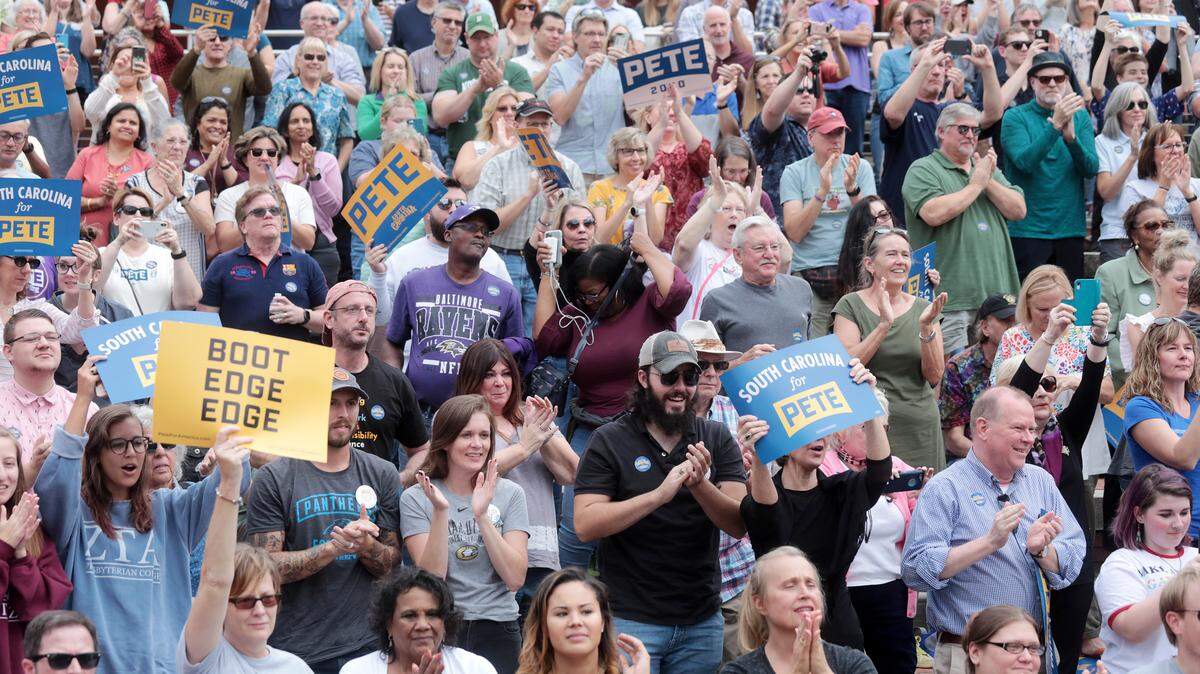
Buttigieg’s second town hall in October saw the largest turnout with over 1,700 people crammed in and around the Old Town Amphitheater — some people sat in the trees to see him.
Later that day, Buttigieg met with Catawba Indian Nation leaders, and the following day, he went to the A.M.E Zion Church, completed a walking tour with veterans of The Wall That Heals — a traveling replica of the Vietnam Veterans Memorial in Washington, D.C., participated in a canvassing event downtown and led a round table discussion with local faith leaders.
He was the first candidate to spend two days in Rock Hill.
“One thing that we’ve found is that there’s still an awful lot of voters in South Carolina who don’t feel like they’ve been able to form an opinion about us at all,” Buttigieg said in an interview with The Herald. “It’s just I’m so new on the national scene. And that means we have to do the quantity work of getting to know people.”
Other candidates held events around the city.
Before his event at Amelie’s, O’Rourke walked through the now-closed Five and Dine restaurant, where 10 black men were arrested in 1961 for sitting at a segregated McCrory’s lunch counter. Booker spoke at Platinum Cuts Barbershop and at Freedom Temple. Swalwell gathered a crowd at McHale’s on Main Street. Williamson sat with supporters at Synergy Yoga.
“From what I’ve learned being on city council, these things that’s happening here, and the people that are coming here, are not coming just by happen-chance, if that’s a word,” Jackson said. “They’re coming because Rock Hill has something.”
‘An important question’
Sestak, who wore a bomber jacket, spoke for about 45 minutes. He took questions from the two administrators in the room — Moyon and Judy Longshaw, Winthrop spokeswoman. He discussed his plan for national security, healthcare and gun control.
“Don’t forget about college debt,” Longshaw said at the end of his talk.
“Yes,” Sestak said. “With pleasure. Am I keeping you? What time is it?”
“It’s 12:45,” Longshaw said.
“I’ll have to leave to get up to Charlotte soon, if that’s OK.”
“I’m supposed to leave by a quarter of.” Sestak laughed. “But this is an important question.”
And he started to lay out his plan.
This story was originally published November 15, 2019 at 3:22 PM.