
NC has $25 million to buy flood-damaged homes, and a strategy for spending it
George and Jacqueline Lacy left their home at the end of Park Street by boat during Hurricane Matthew, fleeing as water rose to an eventual six feet.
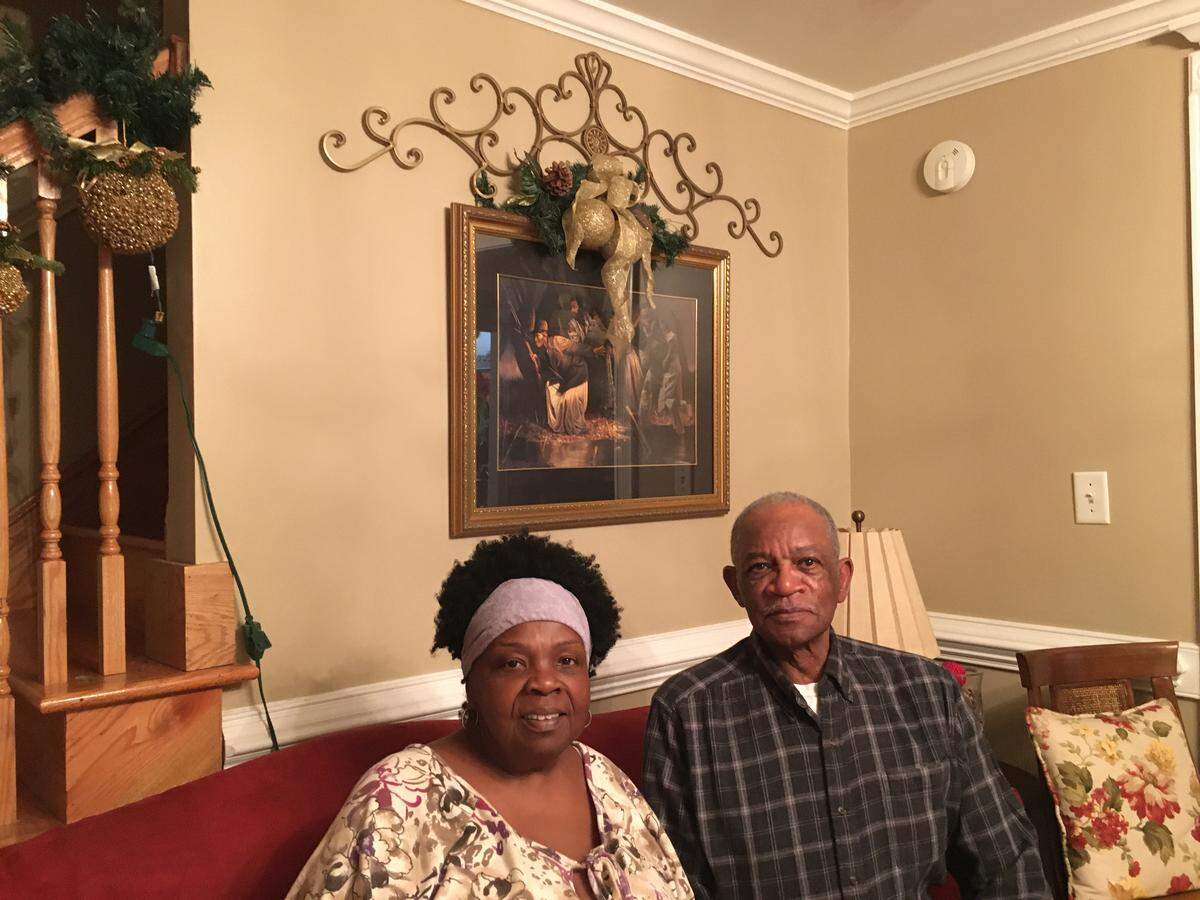
Sitting in her living room more than three years later, after a two-foot flood from Hurricane Florence forced her to rebuild again, Jacqueline Lacy was adamant that she will not leave the home. The land has been in Jacqueline Lacy’s family for decades, and the couple built the house there in 2004.
“I do understand that we might and we probably will have another flood. We just might. I just pray and hope we don’t, but I’ve already called the company about lifting it,” Jacqueline Lacy said. As Jacqueline talked, George Lacy moved around the house, turning on Christmas lights and plugging in the strands draped over a tree that stood prominently in the middle of the living room.
The Lacys’ Park Street home is in the middle of a South Lumberton neighborhood that state officials have designated as a buyout zone, one of the areas where they’re trying to concentrate disaster relief dollars to move the most at-risk residents out of harm’s way. State officials used data including flood zones, ReBuild NC applications, repetitive loss properties and properties acquired through the Hazard Mitigation Grant Program to figure out where buying homes out would be most effective.
North Carolina’s buyout program is overseen by the N.C. Office of Recovery and Resiliency (NCORR), which has dedicated $25 million of a HUD Matthew relief package to the effort.
Laura Hogshead, NCORR’s chief operating officer, said, “When we were considering how to use that $25 million for buyouts, we want to get the biggest impact that we can, we want to get the biggest bang for the buck that we can, and we want to get people out of harm’s way.”
Ultimately, they settled on 13 zones for Hurricane Matthew and are working on nine preliminary zones for 2018’s Hurricane Florence, all of which are in federally designated “most impacted and distressed” areas for Matthew and anticipated areas for Florence. The Matthew zones include four in Edgecombe County, including two in Princeville; three in Lumberton, including the Lacys’ neighborhood; three in Wayne County; two in Columbus County; and one in South Fayetteville.
Community meetings about the NCORR-identified buyout zones could take place in early 2020, Hogshead said, with people beginning the process and ideally moving in the summer so as to not disrupt the school year.
Buyout strategy
Hogshead and other state recovery officials expect the demand for buyouts will far outpace the $25 million. According to NCORR’s calculations, the state will need between $148.3 million and $162.4 million to meet the demand from Matthew and Florence.
The buyout fund could receive a significant boost if the U.S. Department of Housing and Urban Development (HUD) signs off on the state’s action plan for Community Development Block Grant-Mitigation funds, which includes an additional $109.2 million for the program. Some environmental groups have criticized that proposed approach, though, noting that Community Development Block Grant-Disaster Relief money can be used for buyouts, such as the $25 million the state has already tabbed.
Key to the state’s buyout strategy is the idea that the money will be better spent if it is concentrated in certain areas than if it results in a scattered set of purchases.
“If we just opened up applications and said, ‘Anybody who wants a buyout, apply to the state,’ we would have two here and four here and six here and seven there and we wouldn’t really be able to use the land that’s left,” Hogshead said. “It wouldn’t be productive for a community, and we wouldn’t get as many people out of the actual harm.”
By concentrating buyouts in set areas, Hogshead and other state officials are hoping to make it easier for local governments to use the bought-out land in some constructive way, be that as a community garden, a park or some kind of flood-control feature.
“We’ve learned these lessons from New Orleans, we’ve learned these lessons from lots of different places that you can’t build a community if (houses are) very patchwork, and there’s not enough (bought out) land for it to be productive again,” Hogshead said.
Identifying buyout zones
Matt Arlyn, an NCORR policy and planning adviser, was tasked with deciding how the state agency should prioritize buyouts. The agency knew at least 80% of buyouts funded by CDBG-DR would need to be in HUD-defined most-impacted areas and that 70% of the money would need to go to low- to moderate-income households, defined as those where income is less than 80% of an area’s median income.
The houses NCORR is trying to purchase through the buyout program, Arlyn said, were typically valued at $60,000 to $80,000 before Hurricane Matthew.
Arlyn considered county level data in Matthew’s six most-impacted counties for 100-year flood zones and floodways.
He also looked at where previous buyouts occurred, as well as which households applied for a buyout through the Hazard Mitigation Grant Program. About 3,000 people expressed interest in the program after Matthew, Arlyn said, and 680 have either been funded for acquisition, elevation or reconstruction.
Other data NCORR considered included the location of repetitive loss and severe repetitive loss properties, defined as those where the National Flood Insurance Program paid at least two claims of $1,000 apiece during any 10-year period and where it made at least four payments of $5,000, respectively.
“(When) we can complete a buyout from Floyd, where there’s already been buyout activity, that’s a good indicator that we’d like to continue in that area,” Arlyn said.
Arlyn then considered whether there are nearby features such as hospitals, schools or main streets where buying homes out could harm the fabric of a community. He also went street-by-street, trying to see where buyouts could be paired with past efforts or existing green space to have more impact.
Once the general buyout zones were identified, NCORR turned to local officials to discuss whether the buyout zones were accurate or made sense. Often, Arlyn and Hogshead said, those conversations involved local officials requesting that the state expand the buyout zone based on a nearby concentration of low-to-median income people or recurring flooding just outside the floodplain.
“It’s been about expanding (buyout zones), not about subtracting, which I’m a little bit surprised by — that they’re ready,” Hogshead said.
Buyouts in Whiteville
Whiteville is one of the communities where leaders are ready for buyouts. The NCORR-identified zone there is on the city’s west side, in a roughly four-block area that runs between West Main and West Virgil streets. Darren Currie, Whiteville’s city manager, said as many as 10 properties have been bought out through previous programs. This time, 25 could be eligible.
“If we have major flooding, it’s going to flood there again,” Currie said. “It is in the floodplain. That part of the city is just not a good place for residents to be.”
The area sits near Mollie Branch, a body of water that drains much of the western side of Whiteville into Soles Swamp, Currie said.
After Matthew, a handful of residents tried to return to the their houses. They stayed away, Currie said, after Florence.
“There’s really no one living over there now, it’s basically an abandoned area of town,” Currie said. “It’s sort of like pictures you see from Hurricane Katrina of the Lower Ninth Ward over in New Orleans.”
Currie is hopeful that incentives being provided by NCORR will help encourage some of the buyout-eligible residents to stay in Whiteville. The buyout program will provide a $5,000 incentive to someone who is leaving a bought out home to remain in North Carolina and a $10,000 incentive to someone staying in the same county.
“You certainly don’t want to lose population. We’re a small town anyways. We can’t afford to lose many people, and certainly, if you keep those folks in town — the way state revenues are and state share of sales tax is, all that stuff is based on population,” Currie said, noting that several homes in the buyout zone belong to longtime Whiteville residents.
Hesitant to sell
Back in South Lumberton, there is deep suspicion about buyouts. Several residents expressed skepticism about the process, whether because they haven’t heard anything after submitting an buyout application years ago or because they believe that a buyout is really just a chance for someone to scoop up the land at a cheap price.
Sitting by her Christmas tree, Jacqueline Lacy recalled that her father used to own a 1948 Ford. When the family would go out of town, she said, people would often make offers on the car. When her father inevitably declined the offer and got back in the drivers’ seat, Lacy and her siblings would ask why he hadn’t taken the money.
“They want my car for a reason,” Lacy recalled her father saying. “If it means that much to them, think what it means to me.”
For Lacy and her husband, that mentality carries over to the house, one that they’ve rebuilt twice in the last five years on land that has been in her family for generations. Flood insurance rates have risen, the neighborhood is quieter than it was before Hurricane Matthew and Lacy is on self-described “pins and needles” during every heavy rain.
But she and her husband are in South Lumberton for the long haul.
“I may regret it later,” Lacy said, “but I doubt it.”
This reporting is financially supported by Report for America/GroundTruth Project and The North Carolina Local News Lab Fund, a component fund of the North Carolina Community Foundation. The News & Observer maintains full editorial control of the work.
This story was originally published December 26, 2019 at 1:40 PM with the headline "NC has $25 million to buy flood-damaged homes, and a strategy for spending it."