
Belk on the brink: NC department store in deep financial trouble as COVID takes a toll
Belk, the 133-year-old Charlotte-based department store chain, has been pushed to the edge of solvency by a pandemic and the financial vulnerability of private equity ownership, industry experts and financial analysts say.
Standard & Poor’s said in an October report that it’s likely the business will run out of cash within a calendar year. Belk’s debt is trading at roughly a third of its sticker price. Belk also is months behind in paying some vendors, Bloomberg News reported in November. And annual same-store sales have been negative since 2016, according to Moody’s.
So how did Belk go from a Southern retail giant to teetering on the precipice? It’s a story of debt, bricks and the coronavirus.
Small start to national leader
Belk is synonymous with Charlotte like Macy’s is with New York City.
That legacy dates to 1888, when William Henry Belk opened a store in Monroe called New York Racket that would eventually become Belk.
Three generations of Belks led the company to become the biggest family-owned department store chain in the country. That ended in 2015 when Belk sold to the private equity firm Sycamore Partners and the following year hired its first female and non-Belk family member as CEO.
Belk has more than 20,000 employees at its nearly 300 stores in 16 Southern states. Its corporate offices opened in 1988 on Tyvola Road in Charlotte, and now have about 1,300 workers.
Members of the Belk family were often the vanguard of Charlotte’s old Presbyterian elite. One Belk served as mayor. The spreading of the family’s profits put the Belk name on theaters, schools and medical centers. Charlotte’s college football bowl game was called the Belk Bowl for eight years until 2019.
But by 2014, with Tim Belk as CEO, the family decided it was time to sell. By then, the impact of the 2008 recession had faded and sales had passed $4 billion.
So in August 2015, Belk sold to New York-based Sycamore Partners for $3 billion. The headquarters remained in Charlotte.
Landing with Sycamore
Many experts thought the family got a good price. Economic winds were turning against department stores with online shopping taking more business each year.
Conversely, it meant Sycamore paid a lot for its purchase of Belk.
Sycamore financed over $2 billion of the $3 billion deal through issuing debt in Belk’s name. It’s a common practice in private equity known as a leveraged buyout. That way Sycamore only needed to put up $685 million in equity to buy Belk.
Popularized in the 1980s, leveraged buyouts are one of the main ways a private equity firm does business. If a firm thinks it can manage a company better than the current managers, a debt-financed buyout can allow new leadership to take over without needing a lot of cash.
Opponents say it saddles businesses with burdensome and needless debt that disincentivizes investment in the business, often leading to cost cuts and layoffs.
The buyout industry is massive. There were $551 billion worth of buyouts worldwide in 2019, according to private equity firm Bain & Company.
Belk shareholders, then mostly family members, initially didn’t look for a financial firm to buy the company, according to a securities document filed with the merger. Belk had its Goldman Sachs bankers try to find another retailer to merge with or buy them before it heard pitches from financial firms like Sycamore. There were no takers.
By then, it was no secret in the financial world that private equity firms were uninterested in growing businesses where the overall industry pie was shrinking, like department stores.
“It’s pretty obvious that Sycamore was going to push the leverage really high,” said Elisabeth de Fontenany, a Duke University law professor who specializes in private equity.
Tim Belk stayed on after the Sycamore deal until the summer of 2016. He was replaced by former Hot Topic CEO and Durham native Lisa Harper, whose first job at age 16 was at a Belk. Family control was over.
Tim Belk and his brother John, who used to serve as president of the company, did not respond to requests for comment. Current Belk officials did not respond to requests for comment. A representative for Sycamore declined to comment.
After the buyout
Although Belk was saddled with debt after Sycamore bought it, the department stores were making money.
When Belk was bought out, “this company was generating healthy cash flow at the time,” said Helena Song, an analyst at S&P. Then, “the private equity sponsor took cash to pay themselves a big dividend.” Sycamore wouldn’t comment on its dividend.
S&P downgraded its creditworthiness rating of Belk shortly after. Less free cash flow just dug a deeper hole for Belk.
Belk was behind other department stores in developing an online platform, Song said, and the dividend took a lot of money off the table that could’ve built that part of the business. But even if Belk had invested that money into online services, she said, there was no guarantee it would’ve worked.
While the dividend made life harder for Belk, it boosted Sycamore’s prospects.
Despite specializing in the ailing retail sector, Sycamore has seen spectacular returns. It’s first fund had annual returns of 43% after fees as of June 2018, according to the Wall Street Journal. Sycamore wouldn’t comment on the return of the fund that bought Belk.
Failure ‘to launch’
A ton of debt is not necessarily a death sentence. Private equity owners have turned around many ailing companies, including famous names like Hilton.
But Belk faces another challenge: It’s a department store. And people aren’t shopping there as much anymore. That includes malls, where Belk has about half its stores.
“I’d be real concerned about the longevity of Belk and malls,” said Steven Cox, a marketing professor at Queens University of Charlotte. “People aren’t going there for the anchor tenants as much as they used to.”
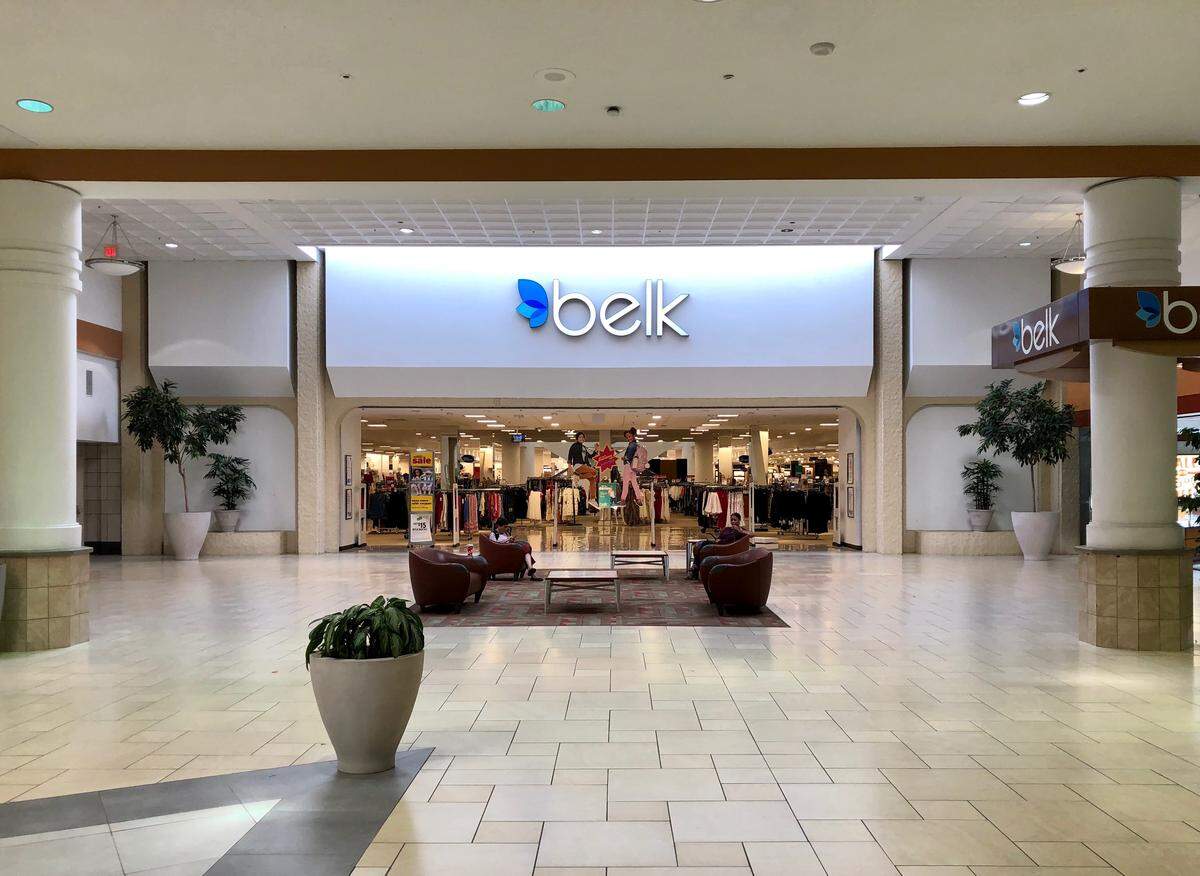
The average age of a department store customer is 60, said Cindy Fox, marketing and retail expert professor at UNC Charlotte Belk College of Business.
If a department store is going to survive longer than that customer base, it needs an appealing “omnichannel,” Fox said. That’s the industry term for integrating in-store and online shopping, like in-store pickup for online orders. Belk, according to retail experts, struggled to do this.
“Belk failed to launch early on,” Fox said.
Before the COVID-19 pandemic, Belk same-store sales were slipping, according to data from Moody’s. Revenue dropped from $4.2 billion annually in 2016 to $3.8 billion in 2019. It had layoffs at its headquarters in 2016 and February 2020.
The pandemic’s impact
Then the pandemic struck. Businesses that were behind on digital had to catch up quickly as the coronavirus led to shutdowns nationwide.
Retailers, many of whom were loaded up with buyout debt like Belk, started collapsing one by one. Within two weeks in May, JCPenney, Nieman Marcus and J.Crew went bankrupt.
People also had less discretionary income to spend at places like department stores, said Roger Beahm, executive director of the Center for Retail Innovation at Wake Forest University. At the same time, clothing sales slumped as more people worked from home.
Consumers also looked for value over brand names, he said. Carrying familiar brands has been a strength for companies like Belk.
“So what you end up with is a lot of things that made Belk so strong are now working to its disadvantage, and they’re having to adjust their strategies,” Beahm said, “And that’s going to be very hard because it’s not in the nature of the department store industry.”
In March, Belk furloughed workers and cut senior staff pay up to 50% as the coronavirus closed stores. And in July, an undisclosed number of jobs were cut, mostly at its headquarters, the Observer previously reported.
Making changes
Still, Belk had to try to adapt.
It added same-day delivery as well as in-store and contactless curbside pickup. There are signs that its omnichannel offering is picking up. Online sales penetration is expected to jump to 40% for last year, up from 15% prior to the pandemic, according to S&P’s Pasha Azadmard.
The chain is still making some investments, too. Belk said it plans to invest $2.5 million in upgrades at its 20-year-old Blythewood, S.C., distribution center over the next five years.
Ultimately, hope for the future at Belk likely lies in a thundering economic recovery that sends people shopping at a record clip. Its creditors, expecting tens of millions of dollars due in 2022, will be watching, as will customers and employees.
“It’s been a challenge for everyone in the department store industry. Belk is not alone in that,” said Christina Boni, a Moody’s analyst who covers Belk.
“It’s much more difficult for players that don’t have the scale,” compared to stores like Nordstrom, Boni said. “And Belk is small in scale.”
This story was originally published January 13, 2021 at 6:00 AM with the headline "Belk on the brink: NC department store in deep financial trouble as COVID takes a toll."