
What’s the key to long life for Outer Banks wild horses? Birth control, experts say
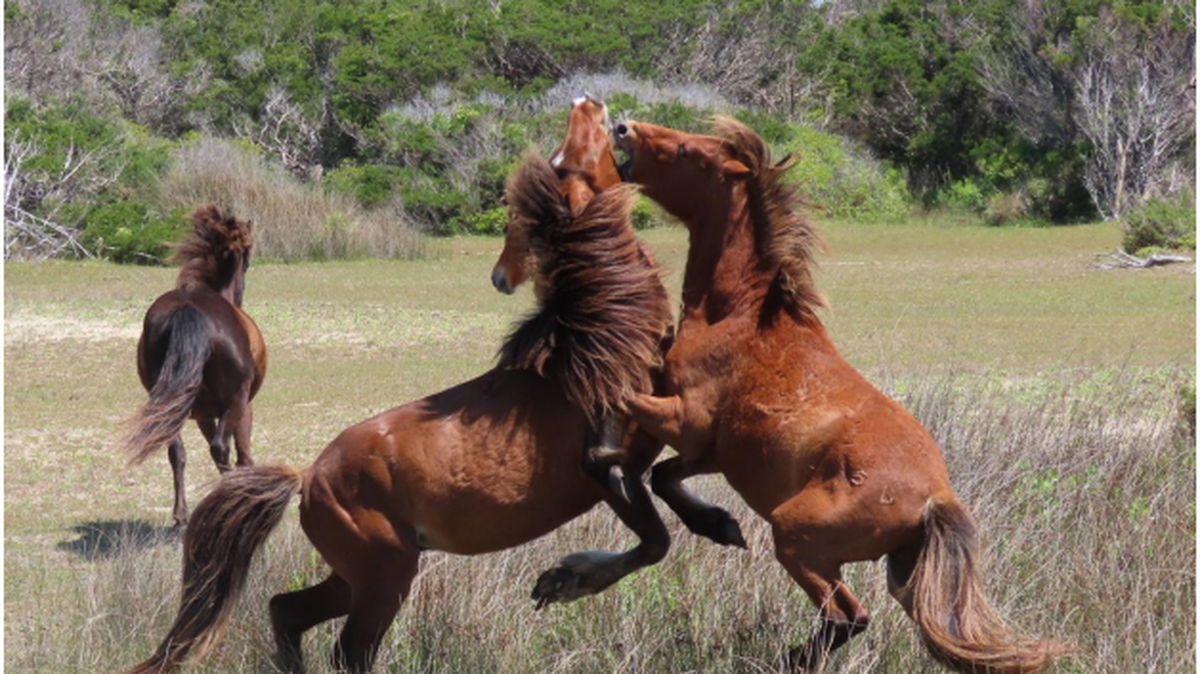
Wild horses on North Carolina’s Outer Banks live short lives, but the oldest among them typically have one thing in common: They’re on birth control.
Child rearing jokes aside, experts say there’s something to be said for dodging motherhood in a place where food is sparse, fresh water limited and hurricanes come in waves.
Proof was supplied this month when Cape Lookout National Seashore released its annual wild horse survey, revealing 11 years is the average lifespan for horses roaming the Shackleford Banks. However, there are two outliers: A pair of 27-year-old mares.
“Those two old girls are living the good life courtesy of birth control,” according to Margaret Poindexter of the nonprofit Foundation for Shackleford Horses.
“They’ve had their foals and done their part to contribute to the island’s population, and so now they are birth controlled and not dragged down in old age by pregnancy and nursing foals. We have seen that birth control helps extend the life for the mares. It is a joy to see them fat and happy in old age.”
The same is true for older mares living on nearby Corolla, according to herd manager Meg Puckett. However, that herd also has a few stallions in their 20s, she says. (Unlike the horses at Cape Lookout, the Corolla herd is privately managed by the nonprofit Corolla Wild Horse Fund.)
Birth control is administered annually to the horses in both herds via darts fired from air guns, and the chief motive is to prevent the horses from over-populating their islands. On Corolla, shots are given to mares who are younger than 5 or older than 15, leaving about 20 horses to reproduce annually, Puckett says.
Here are other details revealed in the National Park Service survey of Shackleford Banks horses:
- “At the end of 2020, there were 117 horses on Shackleford Banks.
- The herd is 62% female and 38% male. Of the horses over 23 years of age, there are 2 males and 8 females.
- Herd mortality was 5% with 6 deaths. Mortality still averages 6%.
- Since 1999, the average lifespan of horses on Shackleford Banks has been approximately 11 years.”
This story was originally published January 21, 2021 at 10:21 AM with the headline "What’s the key to long life for Outer Banks wild horses? Birth control, experts say."