
Sixth earthquake in two weeks reported near NC mountain town, USGS says

UPDATE: A seventh earthquake was reported early Tuesday, June 6, near West Canton, N.C., the United States Geological Survey says. It measured at 2.5 and was centered about four miles northeast of the community. About 20 people reported feeling “weak” shaking, officials said.
The original story is below:
The mysterious shaking under West Canton in the North Carolina mountains is continuing, according to the United States Geological Survey.
Two earthquakes were reported Sunday, June 4, bringing the number of quakes to six since May 23, experts say.
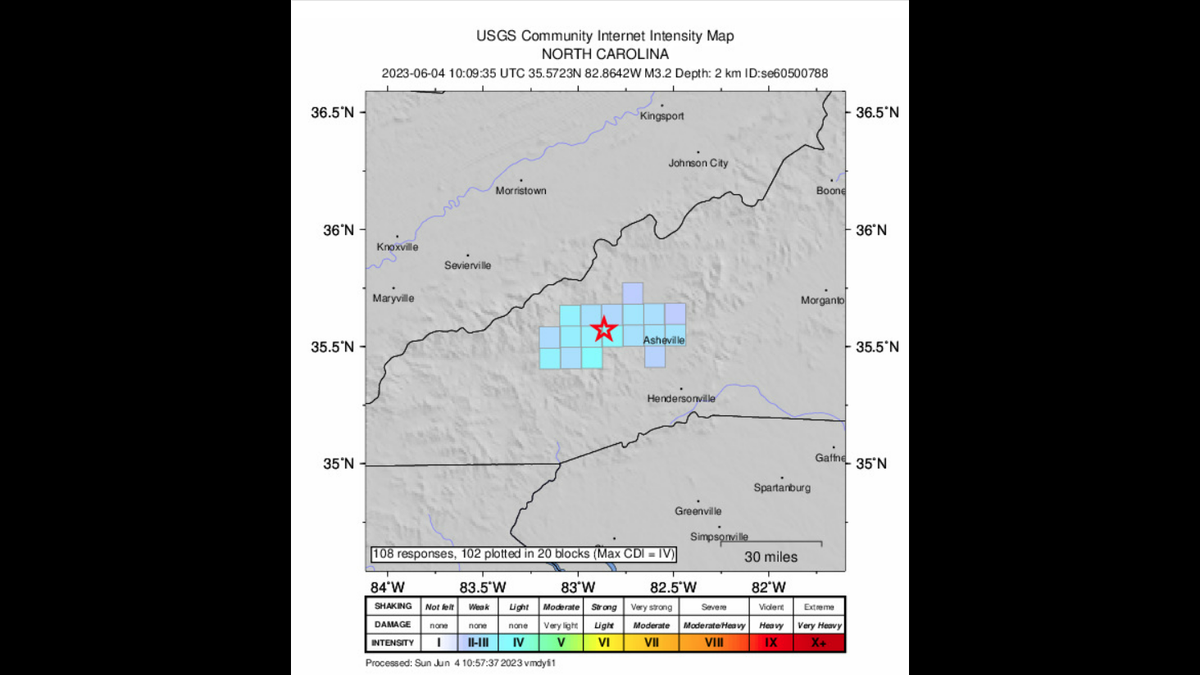
Sunday’s quakes were a 3.2 at 6:09 a.m. and a 2.2 around 4:30 p.m., both centered just under 2 miles north of West Canton, which is about 137 miles northwest of Charlotte. The source of the quakes was between 1.4 and 1.8 miles deep, officials said.
More than 600 people filed reports of feeling the 3.2 quake, according to the USGS. Most reports came from the towns of Clyde, Canton, Candler and Waynesville. However, reports were also filed from South Carolina, Virginia and Maryland, data shows.
No reports of anyone feeling the 2.2 quake had been filed as of 1 p.m. on Monday, June 5.
West Canton saw four quakes recorded over three days between May 23 and May 26, including some just minutes apart shows. The magnitude ranged from 1.8 to 2.8, McClatchy News reported.
Earthquakes typically aren’t felt until they exceed 2.5 magnitude, experts say. That’s also the point at which minor damage can occur, the USGS says.
There have been no damage reports from the 3.2 quake, officials say.
What’s causing it?
The Appalachian Mountains are not on an active tectonic plate boundary — where earthquakes are common — but the region has sporadic minor quakes linked to old fault lines, geologists say.
It is also possible for earthquakes to trigger more quakes, according to the Department of Geological and Environmental Sciences at Appalachian State University.
“In areas with lots of old faults, like the Appalachians, we tend to get earthquakes along pre-existing fault zones that have weakened rock at depth,” the department wrote in a report on Earthquakes in the N.C. High Country.
“Even though the southern Appalachians are not currently at an active plate boundary, our tectonic history means that built-up stresses from time to time are able to be released along old faults from the building of the Appalachians, which happened hundreds of millions of years ago.”
WHAT TO DO IN AN EARTHQUAKE
Earthquakes’ sudden, rapid shaking can cause fires, tsunamis, landslides or avalanches. They can happen anywhere, but they’re most common in Alaska, California, Hawaii, Oregon, Puerto Rico and Washington, according to the Department of Homeland Security.
If an earthquake strikes, it’s best to protect yourself right away.
Here are tips from experts:
- If you’re in a car: Pull over and stop. Set your parking brake.
- If you’re in bed: Turn face-down and cover your head with a pillow.
- If you’re outdoors: Stay away from buildings. Don’t go inside.
- If you’re inside: Stay and don’t run outdoors. Stay away from doorways.
The best way to protect yourself during an earthquake is to drop, cover and hold on, officials say. “Wherever you are, drop down to your hands and knees and hold onto something sturdy,” officials say.
“If you’re using a wheelchair or walker with a seat, make sure your wheels are locked and remain seated until the shaking stops.”
Be sure to cover your head and neck with your arms, and crawl under a sturdy table if possible. If no shelter is available, crawl to an interior wall away from windows.
Once under a table, officials say you should hold on with one hand and be ready to move with it.
“There can be serious hazards after an earthquake, such as damage to the building, leaking gas and water lines, or downed power lines,” officials say. “Expect aftershocks to follow the main shock of an earthquake. Be ready to Drop, Cover, and Hold On if you feel an aftershock.”
This story was originally published June 4, 2023 at 7:32 AM with the headline "Sixth earthquake in two weeks reported near NC mountain town, USGS says."