Debby’s rains will likely soak the ground in NC. What that means for power outages.
Heavy rains expected this week from what’s now Tropical Storm Debby likely will saturate the ground in much of North Carolina, leaving some trees and even power poles vulnerable to being uprooted by gusty winds.
Toppled trees and poles can mean downed power lines that cause spotty to widespread outages.
What is soil saturation?
Normally, soil has voids where it can take in water, easily absorbing average amounts of rainfall. Saturated soil occurs during periods of heavy or extended rainfall when rainwater fills all the voids, leaving no more spaces.
Saturated soil doesn’t hold together as well as unsaturated soil, becoming muddy and pliable.
Tree roots, which create friction with unsaturated soil as a tree rocks in the wind, are more likely to slip and slide through saturated soil, reducing the tree’s stability and increasing the chance it will uproot and fall in high winds.
How much rain does it take to saturate the ground?
The National Oceanic and Atmospheric Administration says it takes 2 to 2.5 inches of rain to saturate the soil to a depth of about 8 inches.
In his blog on Monday, Assistant State Climatologist Corey Davis said that after the second-driest June on record for the state overall, North Carolina saw the 11th-wettest July since record-keeping began in 1895. Preliminary totals show a statewide average rainfall of 8.29 inches for the month, Davis said, more than 3 inches above the average from 1991 to 2020.
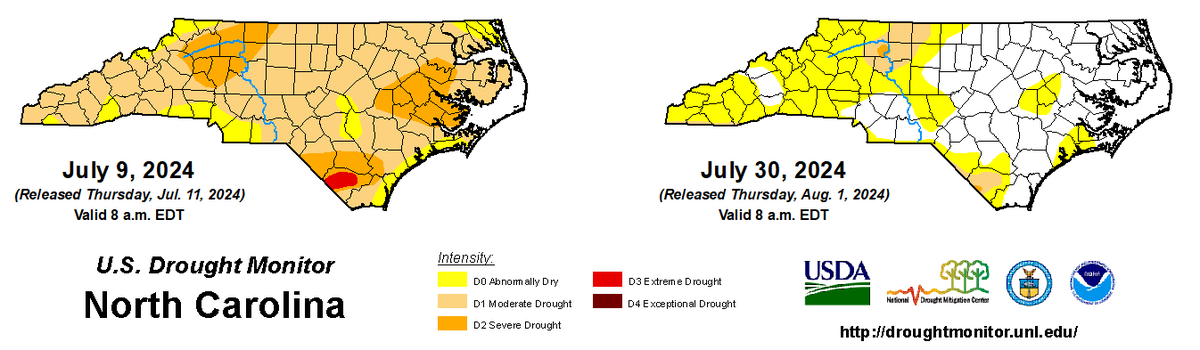
While every county in the state was in some level of drought on July 9, by July 30, when the most recent drought map was published, half the state showed no drought at all and the other half showed abnormally dry with just a few counties in moderate drought.
In areas where the ground is parched — or saturated — meteorologists say, heavy rains tend to run off, causing flash flooding.
How much rain is coming?
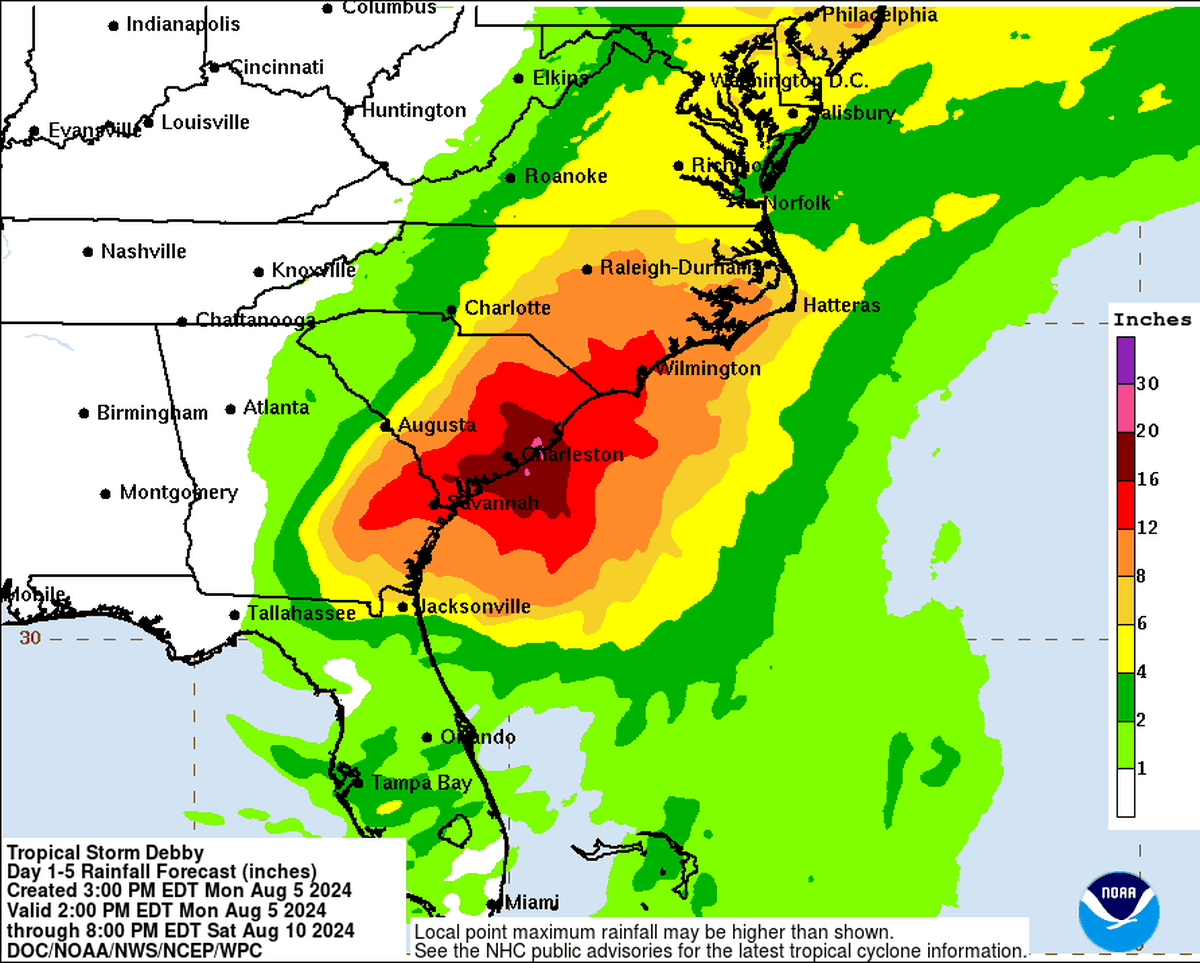
Debby is a slow-moving storm carrying a lot of moisture, and meteorologists say it could drop record-setting amounts of rainfall in southeast Georgia and coastal South Carolina.
As it comes into North Carolina, Debby is expected to bring:
▪ 12 to 16 inches of rain in the extreme southeastern corner of the state;
▪ 8 to 12 inches of rain in the area reaching horizontally from Anson County to Pamlico County;
▪ 6 to 8 inches in a crescent from Union County to Hatteras Island, including Raleigh, Durham and Chapel Hill;
▪ 4 to 6 inches in a crescent from Charlotte to the northern Outer Banks;
▪ 2 to 4 inches in the foothills west of Charlotte;
▪ 1 to 2 inches in much of the mountains.
How strong are Debby’s winds?
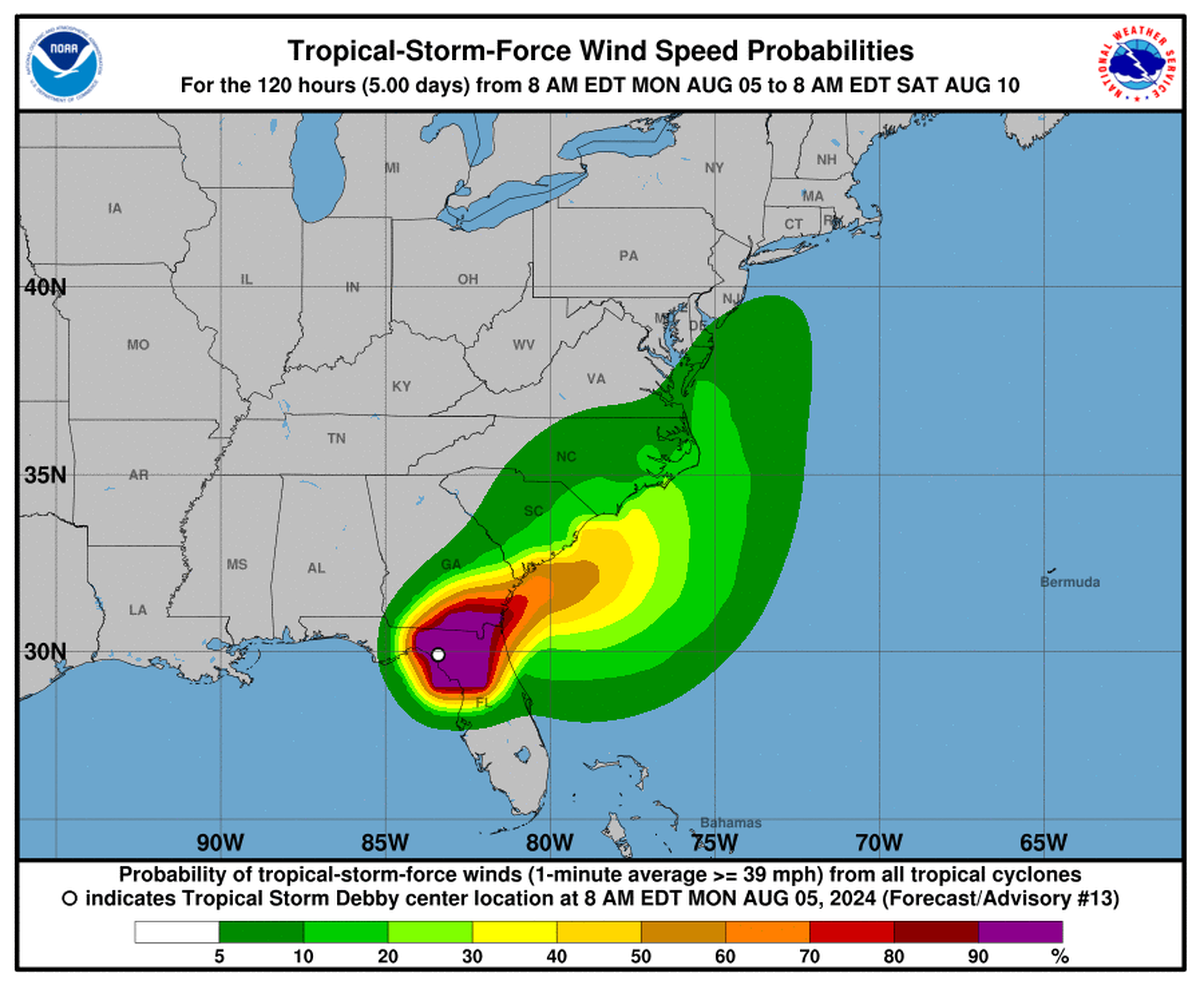
The National Hurricane Center forecasts showed a 5% to 20% likelihood of tropical storm-force winds in much of North Carolina as Debby moves through or near the state. A few small areas near the coast have a 30% chance of tropical storm-force winds, meaning sustained winds of at least 39 mph.
Basil Camu, a master arborist with Leaf & Limb of Raleigh, said Monday he doesn’t expect widespread loss of trees as a result of Debby because the wind speeds will be relatively low. He said some trees are likely to fall along creeks and rivers, however, because of flooding from heaving rains eroding the soil around the roots.
Trees that are diseased or have been damaged, such as having some of their roots bulldozed for a house addition, he said, also could be vulnerable.
Otherwise, he said, in much of North Carolina, “Our trees and flowers and grasses are still feeling a little dry, so the rain will actually be a good thing for our plants.”
Is Duke Energy worried?
Duke Energy, the largest electric utility in North Carolina, is bracing for the impacts of Tropical Storm Debby.
Logan Stewart, communications manager for Duke Energy in Charlotte, said Monday the company’s meteorologists were saying it’s too early to know what effects the storm will have.
Where heavy rain and flooding do bring down trees onto power lines, she said, it complicates the process of restoring power.
Customers sometimes get impatient, she said, because it can take takes two crews to restore power after a tree falls: one to cut and remove the tree safely and a second to repair damaged lines.
With a storm like Debby, Stewart said, “We may see a lot of scattered outages, individual pockets with one, two, three, four or five customers out. But there will be a lot of them. And we physically send line workers to every single outage. We can’t just flip a switch.”
Duke has sent 350 crew members from the Midwest to help with power outages in Florida, Stewart said, and some of those line workers can come to North Carolina to help out if needed.
Meanwhile, she said, customers should make plans to relocate if the power goes out if they have household members who need electricity to survive.
Duke customers can sign up for alerts and updates about outages at their addresses, and can monitor widespread outages on interactive maps the company updates frequently.
This story was originally published August 6, 2024 at 5:58 AM with the headline "Debby’s rains will likely soak the ground in NC. What that means for power outages.."