Sections of NC’s Appalachian Trail and Mountains-to-Sea Trail finally reopen after Helene
Some recovery work in the North Carolina mountains since Hurricane Helene has happened off the beaten path as volunteers and government crews repair damage on the Appalachian Trail and Mountains-to-Sea Trail.
Both popular trails still have some closures, but as the weather warms and the outdoors beckon, trail managers say it’s safe for hikers to venture back into the woods. The key is to check the most up-to-date information on which trail sections are opened or closed and what condition they’re in.
Here’s what to know.
Along the Appalachian Trail
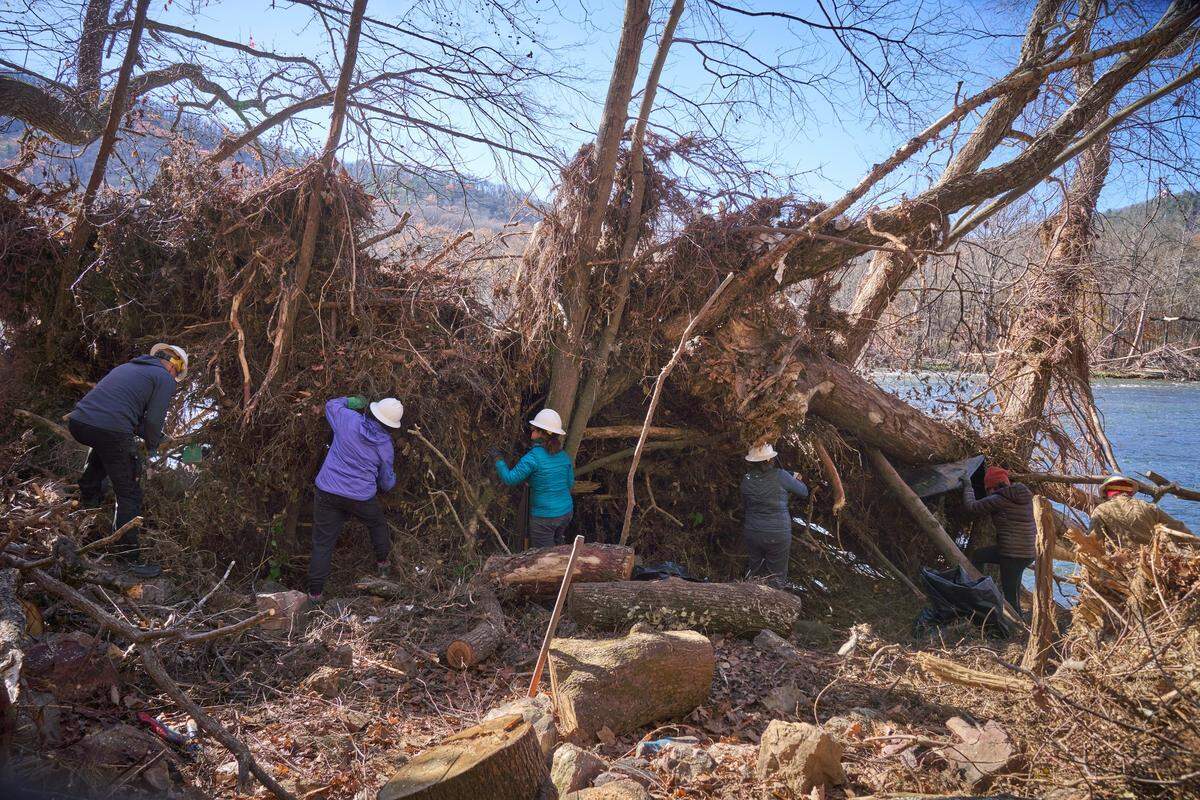
Damage on the AT in North Carolina and Tennessee was extensive from Helene’s landslides and washouts, along with high winds that dropped trees across the path. This time of year, the 3,000 or so people who thru-hike the AT from Georgia to Maine are finalizing their plans, but some 3 million people use the trail each year for much shorter jaunts.
Franklin Tate, the Appalachian Trail Conservancy’s associate regional director in the South, said Friday, Feb. 2, that volunteers from hiking clubs have performed nearly 10,000 hours of work on the AT since Helene hit on Sept. 27. Most of the work so far has been by volunteers from two clubs, he said: the Tennessee Eastman Hiking & Canoeing Club and the Carolina Mountain Club.
When they first started, he said, “You would walk a mile or two and everything would be great. Then you’d round a corner and there would be a hundred trees across the trail.”
In some places, the storm turned the forest into what Tate called “jackstraw timber, piled as high as your head.” Where volunteers can work with chainsaws, he said, they are clearing a swath several feet wide along the AT’s treadway, giving hikers some breathing room.
In designated wilderness areas, where chainsaws are not allowed, the work has to be done with crosscut saws.
A crosscut saw is no joke. Picture an old cartoon saw with one blade and two lumberjacks, one on each end ripping it back and forth. It’s a slower, more laborious process.
Are tourists welcome in towns near the Appalachian Trail?
Those who make a living off mountain tourism are happy to see the trail being rebuilt, Tate said.
In Asheville, Hot Springs and other towns that cater to hikers, many restaurants, hotels and Airbnb’s have reopened. Road repair work in the mountains is still underway, the N.C. Department of Transportation has established detours where necessary.
The Hot Springs Resort & Spa has announced it will reopen to guests on Friday, Feb. 14 and is accepting reservations.
Will the AT be like it was before Helene?
Tate said crews should be able to restore most of the Appalachian Trail to its pre-Helene route, though some temporary detours may be required.
One of those would be getting the trail across the Nolichucky River outside Erwin, Tenn.
Before Helene, the trail crossed the river using the Chestoa Bridge, but that was wiped out by flooding on the Nolichucky. Planners have blazed a 3.5-mile detour, but Tate said the Conservancy has raised money though its Resiliency Fund it might be able to use to engage a ferry operator to take hikers across the river.
If it works out, he said, the ferry could be in place in the spring.
What sections of the AT are open?
The Appalachian Trail Conservancy regularly updates its interactive map showing the status of the trail. The U.S. Forest Service also updates trail information through the web page for the Appalachian Ranger District, which includes the areas hardest hit by Helene.
The Forest Service announced in early February it had opened a total of 114 miles of the Appalachian Trail within Pisgah National Forest, from I-40 to Indian Grave Gap (milepost 241.3 to 351.8), which traverses Haywood, Madison and Yancey counties, as well as from Hughes Gap to Carvers Gap to Doll Flats (milepost 373.1 to 390.9) in Mitchell and Avery counties.
The Forest Service also has opened other trails that were damaged by the storm.
If a section of trail is open, is it safe to hike?
The Appalachian Trail Conservancy said that just because a section is open and reported as passable does not mean it is safe and returned to pre-Helene condition.
Storm-damaged areas are dynamic: trees will continue to fall, and ground will continue to move. For information about what you may encounter and how to stay safe, visit the Conservancy’s blog post about hiking the AT in 2025 and its Hurricane Helene’s resource page.
Along the Mountains-to-Sea Trail
Work continues on the section of the MST that were damaged by Helene as well. The Friends of the Mountains-to-Sea Trail said this week that while volunteers have not yet been allowed in to survey and repair the trail on some affected lands, other sections have been cleared and reopened to hikers.
Green areas on this regularly updated map show sections of the Mountains-to-Sea Trail that are open in western North Carolina.
This story was originally published February 7, 2025 at 4:31 PM with the headline "Sections of NC’s Appalachian Trail and Mountains-to-Sea Trail finally reopen after Helene."