
Rainbow babies: Devastated by loss of child, SC parents find courage to try again
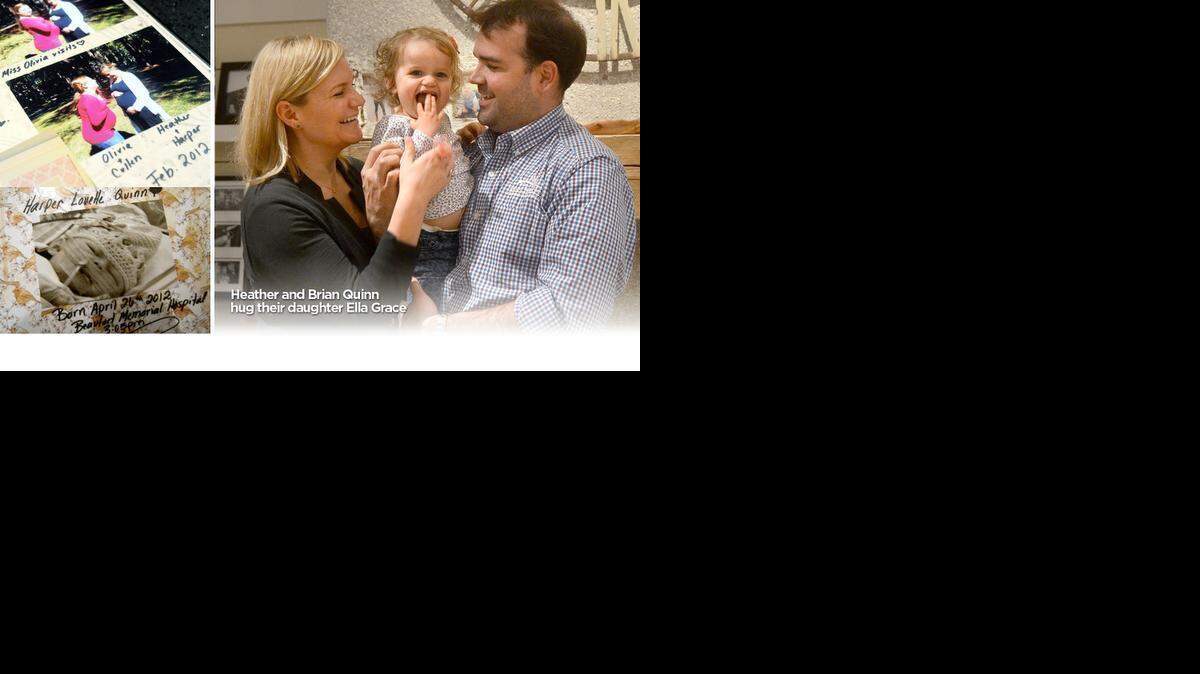
The doctor told Heather and Brian Quinn that once their newborn daughter died, her little body would quickly go cold. "But hold her as long as you want," he quietly said before leaving the hospital's neonatal unit.
And they did. For 15 minutes, the Hilton Head Island couple cradled the little girl they had named Harper Louette Quinn, swaddled in a blanket that moved ever so slightly with each tiny, shallow breath.
They didn't know why Heather, eight months pregnant, had suddenly felt nauseated and light-headed earlier in the day. They never expected that a trip to the hospital would reveal that the baby's lungs were filling with liquid. And that an emergency C-section -- and all the technology in the hospital -- couldn't stop Harper's little organs from shutting down one-by-one.
They didn't let those questions bother them for those precious 15 minutes the three of them were together. Instead, there was their new baby to admire who didn't look sick. She looked beautiful, a pink crochet hat perched on her perfectly round head. And two tiny ears sticking out below. They stroked her face and told her they loved her. And they apologized. The three of them would not be together as they had hoped.
Then Harper was still.
"It was a beautiful moment to be with her," Heather said. "We literally held her until she took her last breath. And it just changed us forever."
Just 14 months later, the Quinns were back.
Back at the hospital to deliver another baby girl.
Back with the same doctors and nurses.
Back on the same operating table for a C-section.
Heather cried and prayed that this time -- that this baby -- would live.
They're called rainbow babies, children born shortly after a stillbirth, late-term miscarriage or loss of a child.
Fifty to 60 percent of women become pregnant again within one year of such a loss, according to various studies published in The Journal of Perinatal Education.
Meredith Mitchell, Heather's Quinn's obstetrician who practices in Beaufort, said in her experience, the number is even higher.
While women have been having rainbow babies for generations, it's a different experience in the 21st century, unseen in previous generations.
Old experience, new twists
Just a couple of generations ago, losing a child was considered more commonplace.
At the start of the 20th century, approximately 100 infants out of every 1,000 died before age 1, according to the Centers for Disease Control and Prevention. But improvements in living conditions and nutrition, the introduction of milk pasteurization and antibiotics along with better, more accessible prenatal care has driven the rate down by 40 percent, to 60 out of every 1,000 infants.
While the drop is considered a modern marvel, it has created some new, not-often-discussed misconceptions.
The concept of "You're not alone in losing a child" has been replaced with an attitude of "What's wrong with you?," say obstetricians and anthropologists.
"We come from a culture of women dying often in childbirth and some children dying young in nearly every family," said Meredith Small, a pediatric anthropologist who teaches at Cornell University in New York. "And then we have the entry of antibiotics and everything changes."
For women today, the loss of a child may create feelings of inadequacy that their mothers and grandmothers did not experience.
"As women, it's something we're supposed to be able to do," Mitchell said. "We're supposed to be able to get pregnant, carry a baby, have a baby and raise a child. And when something goes wrong, even if it's completely not your fault or your body's fault, just one of those terrible things that happens, it can affect how you feel that you are doing your job as a woman."
The situation is exacerbated by a plummeting fertility rate that hit a record low in 2012 -- 63 births per 1,000 American women. The American norm of four or more children in a family has been replaced with families of just one or two kids.
"This is a gigantic social change," Small said. "To be a woman who loses a child who only was going to have one, maybe two, it's a situation we've not previously seen."
And having another baby shortly after the loss of a previous one can be anxiety-inducing and terrifying, even when a woman intentionally gets pregnant.
"They sometimes have to deal with inadequate grieving and the anticipation and preparing for another child at the same time," said Leon Bullard, a recently retired ob/gyn who practiced in Columbia for 40 years. "It can be a lot to handle."
The grief of losing a child is so deep it can be debilitating. Parents have nightmares. They have flashbacks. They feel alone and uncertain on how to go on.
And it's not limited to just women.
The worst time of their lives
To this day, the image still haunts Brian. He'd brought the car around at the Medical University of South Carolina in Charleston to pick up his wife after the birth and death of their daughter.
The other new mothers sat in their wheelchairs near the hospital exit, waiting for their rides home, too. Each cuddled a baby in a cocoon of blanket.
And there sat his wife. A bag full of pamphlets about loss on her lap.
"It was the most heartbreaking thing that I've ever seen," Brian said.
It didn't improve when the couple returned home and attempted to return to normal life. Heather stayed in bed for days. She didn't want to talk with anyone.
"You lose your child, and you also kind of lose your wife at the same time," Brian said. "Usually you go to your wife for support, but your wife's not really there because she's so grief-stricken with the loss of the baby. It's just a very lonely feeling."
Heather said she just couldn't come to grips with losing Harper.
Her heart raced and stomach churned each time she went out in public. "Where's your baby?" other women would brightly ask, beaming down at her still swollen stomach.
Her milk came in. Her C-section stitches pricked. Her body didn't seem to know what her mind couldn't forget -- there was no baby.
And so she would flee. Jump in her car and drive for hours, trying to put distance between the life that should have been and the life that was.
"I would literally drive around for hours, crying," she said.
There was the day she drove almost all the way to Charleston, and then back. And there were drives to Ridgeland where she circled round and round.
In between the car rides, she took long walks by herself. She thought about her father who died when she was 18 years old.
That had been a horrible time, too. But losing Harper was a pain so intense that it gnawed at her body as well as her heart. Just hearing a baby cry in T.J. Maxx one day made her physically sick. Covering her mouth, she stumbled for the door.
Going back to her job as a special education teacher didn't work out, either. Some of her students were so severely disabled that they seemed like babies. They had to be bottle-fed.
She just couldn't do it and quit.
Getting help and giving help
Women who lose babies need time to grieve, according to licensed counselor and pastoral counselor Mary Bieda who practices in Bluffton. That could include seeing a counselor or talking to a trusted friend. Meeting someone who has lost a child and gone on to have another healthy child can also be very encouraging.
"It's always so hard to lose a baby or a child, but when it's your first, you don't see the light," Mitchell said.
Worried about Heather's depression after losing Harper, her mother and husband searched online for help. They stumbled across the Zoe Foundation, a national nonprofit started in Savannah that helps families who have lost children under age 2.
Heather attended a support group organized by the foundation. For the first time in months, she wasn't alone with the pain.
"It was so helpful meeting other women who had gone through similar situations -- like lifesaving," she said.
Zoe Foundation leaders encouraged her to start a South Carolina chapter of the foundation.
She agreed -- and named it The Harper Project.
The nonprofit, which held its first event in February 2013, is the only one in the state that offers financial assistance to help families pay for their children's funerals. The organization also offers a twice-monthly grief support group, facilitated by a retired pediatrician and a licensed counselor, in Bluffton.
Heather helps to facilitate the meetings, too. She also gathers quotes from the funeral homes, so mourning parents don't have to be bothered with it.
The old pain sometimes returns when she takes parents' phone calls. "It still sometimes takes my breath away," she said.
But she pushes through as a way to pay tribute to Harper.
"I think in a way, having the Harper Project makes me feel like her life meant something."
Read more here.
This story was originally published March 22, 2015 at 9:49 AM with the headline "Rainbow babies: Devastated by loss of child, SC parents find courage to try again."