
SC militias fought for America’s freedom – who fights for their battlegrounds?
As a boy, Rick Wise was hooked on military history from the beginning. But he was never told he lived mere miles from the pivotal spot where the backcountry’s “Swamp Fox,” Revolutionary War hero Francis Marion, first rallied his own brigade.
“South Carolina’s role in the American Revolution is not very well told, not at all,” Wise, executive director of the South Carolina Battleground Preservation Trust, said. “There’s history in your own backyard, and people don’t know about it, and we want people to understand where those sites are.”
He grew up near Johnsonville and Witherspoon’s Ferry, where the Williamsburg militia joined Marion in the first days of his campaign to regain control of the Palmetto State.
A passion for military history first led him to more than 20 years in the Army, but he now strives to make sure none of the state’s more than 200 battles and skirmishes are forgotten.
“We want to preserve those sites, so that people for future generations can know what took place,” Wise said. “Because history is about people, and we want to tell those people’s stories.”
And it isn’t always easy to protect the sites of these long-ago clashes — South Carolina is the fastest growing state in the country, and preservation trusts often have to rush to acquire land before it’s paved over.
“The idea is to try to get these places before development has a chance to happen,” Wise said.
But that is not always possible.
In one of the last battles of the Revolutionary War in the Carolinas, commander Nathaniel Greene forced the British to retreat toward Charleston in the Battle of Eutaw Springs, now called Eutawville.
Residential and commercial developments mingle with greenery near to where the American Battlefield Trust has protected 18 acres of the land that lies outside Eutaw Springs Battleground Park, which has been on the National Register of Historic Places since 1970.
“You have homes and stores and other places built up on the battlefield,” Wise said. “We’re trying to be able to tell the story and preserve the pieces of property that we can get there to preserve the battlefield and be able to tell the story of the folks over at Eutaw Springs.”
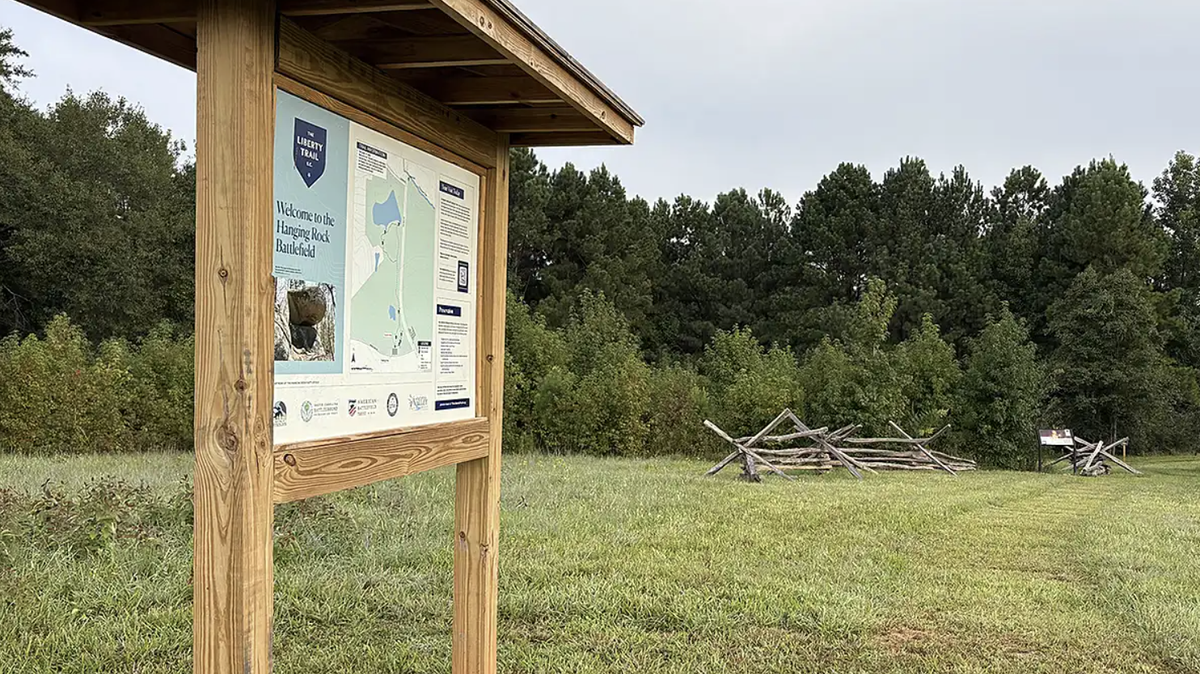
Hanging Rock — another battle significant for Patriot efforts to dislodge British control of the South — was named as one of the top 11 most endangered historical places by the National Trust for Historic Preservation in May.
Located in Lancaster County south of Charlotte, Hanging Rock was an important British outpost that is now threatened by urban sprawl and commercial development.
Between 2001 and 2022, Charlotte has creeped outward about 70 square miles according to city data, increasing the push for highway and residential development in surroundings areas. The American Battlefield Trust, in partnership with the South Carolina Battleground Preservation Trust, have saved more than 170 acres of the threatened site.
Acquiring more property opens up opportunities for education, such as interpretation trails at Hanging Rock which detail the history and layout of the battleground.
To Wise, these battlefields tell the story of a state that refused to be counted out.
“In 1780, the British captured Charleston, and that was followed up by the defeat at Waxhaws, and then the terrible defeat at Camden,” he said. “You would think that it would be all over, but the people here in the backcountry of South Carolina rose up in defiance, and they refused to bow down to a king who was taking advantage of their people.”
Stacey Ferguson, deputy director and battlefield manager at Historic Camden, says people who visit the site of the costly Battle of Camden often don’t know much about the significant role the South played in the war.
“The thing that I hear most interacting with visitors here in historic Camden… They’re just surprised, they’re like, ‘I never knew anything about the South, I didn’t know this was here,’” she said. “(The war) probably ended as soon as it did because of that work that had happened in the Carolinas with the Southern troops.”
Most of the Camden battle site — about 700 acres — is protected in perpetuity by Historic Camden and the American Battlefield Trust, though the latter still classifies residential development and the lumber industry as a “significant threat” to the outskirts of the battlefield, where the Maryland brigade carried out a fighting retreat.
A spokesperson for the American Battlefield Trust said it is in the process of pursuing new property in the state, though it won’t disclose where until the deal is final.
Managers of the Camden battlefield halted all timbering on their land more than four years ago, when they discovered shallowly-buried remnants of soldiers on the property. Those soldiers were reburied with military honors in 2023, and one was even identified using genealogical forensics.
With the 250th anniversary of the Declaration of Independence coming up, Ferguson urges South Carolinians to think about all the important milestones to come in 2026 and beyond.
“We always want to encourage folks to know that the 250th doesn’t end on July 5, 2026,” Ferguson said. “That was just the beginning of the hard work that had to be done in order for us to earn our freedom, earn our liberty.”
All of these battlesites and more can be explored through The Liberty Trail: SC, developed with the South Carolina Battleground Preservation Trust to highlight the state’s contributions in the Revolutionary War.
Virtual and guided tours are available at most locations, with more information available on the Liberty Trail app.
This story was originally published July 3, 2026 at 6:00 AM with the headline "SC militias fought for America’s freedom – who fights for their battlegrounds?."