
How Duke football team learned how to save a life to the rhythm of ‘Staying Alive’
AI-generated summary reviewed by our newsroom.
- Duke football team completed CPR training using 'Stayin’ Alive' as a timing guide.
- Training emphasized 120 chest compressions per minute and AED device usage.
- American Heart Association aims to teach CPR to one member of every household.
Duke defensive tackle Preston Watson pushed himself Tuesday, working hard, displaying good technique on his repetitions while softy singing, “Stayin’ alive, stayin’ alive.”
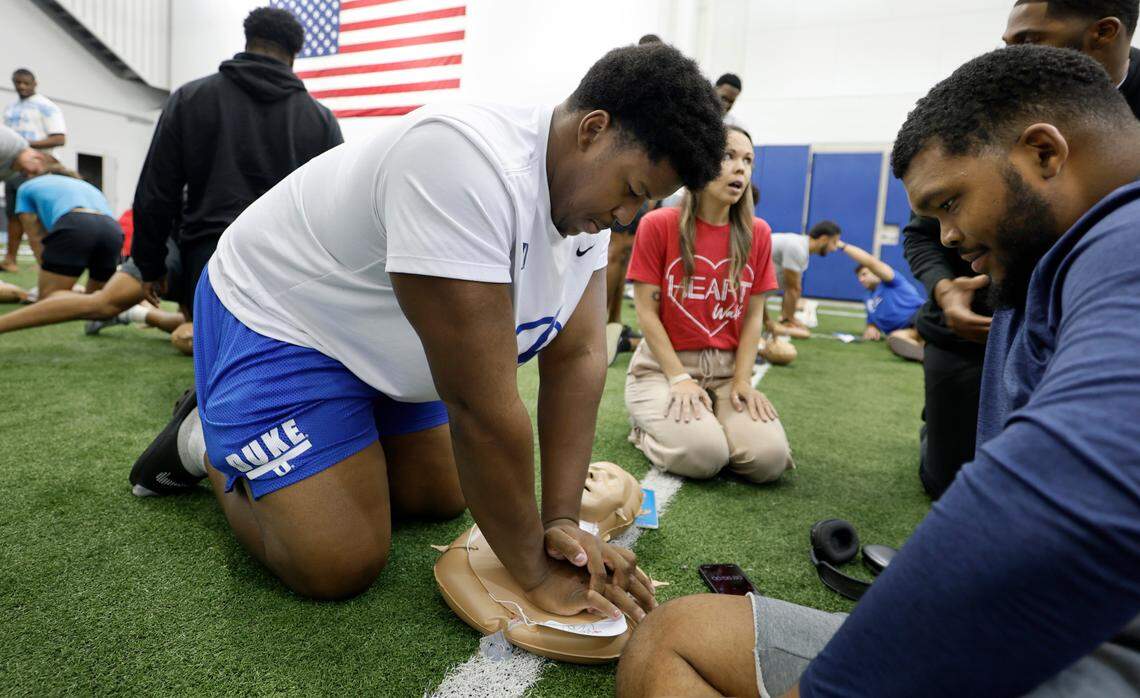
But Watson wasn’t on the practice field. He was inside the Yoh Football Center, joining 85 or so of his teammates in getting CPR training, pushing up and down on the chest of a dummy torso.
It’s the kind of training you hope to never use. It’s also the kind of training that can save a life.
Watson, a sophomore from Lake Mary, Florida, was watching ABC’s Monday Night Football on Jan. 2, 2023, as the Buffalo Bills faced the Cincinnati Bengals. Bills safety Damar Hamlin made a jarring tackle, stood up, then fell to the ground, motionless.
Hamlin had suffered cardiac arrest, and only the quick response of the Bills training staff and doctors to administer CPR saved his life. The first person to him was assistant trainer Denny Kellingon, now the Carolina Panthers’ vice president of player health and performance.
“Denny saved my life,” Hamlin later said in an ABC interview.
Hamlin, who played college football at Pittsburgh, recovered and plays for the Bills. His life-threatening incident only underscored the need for CPR training. Cardiac arrest, in which the heart stops, usually is fatal if not treated in the first three minutes.
“It was really scary,” Watson said. “I think the people who were more scared were my parents, because they know I play that sport and that something I want to do when I grow up is make it all the way to the ‘League.’
“It really puts it into perspective to them of how important learning stuff like CPR is and just how dangerous … it can be rare, but it can happen to anybody.”
The training session Tuesday was handled by members of the American Heart Association in the Triangle and Eastern North Carolina. They instructed the players on the proper CPR technique – right hand applied to the middle of chest, left hand planted on top of the right hand, elbows locked and up-and-down pressure constantly applied until medical personnel are on the scene.
The players were told to get in 120 compressions a minute, and that a good cadence would be to the strains of the Bee Gees 1970s hit, “Stayin’ Alive.” Also fitting.
“Me and my partner timed it for two minutes each and it was pretty tiring,” Watson said, smiling. “It’s a simple process, but just doing it for an extended period of time can definitely be a little bit tiring, so sure.
“You had to keep in the back of your mind that it is a training exercise, but you’ve got to treat it like it’s real, just in case …It’s a skill you can never really forget.”
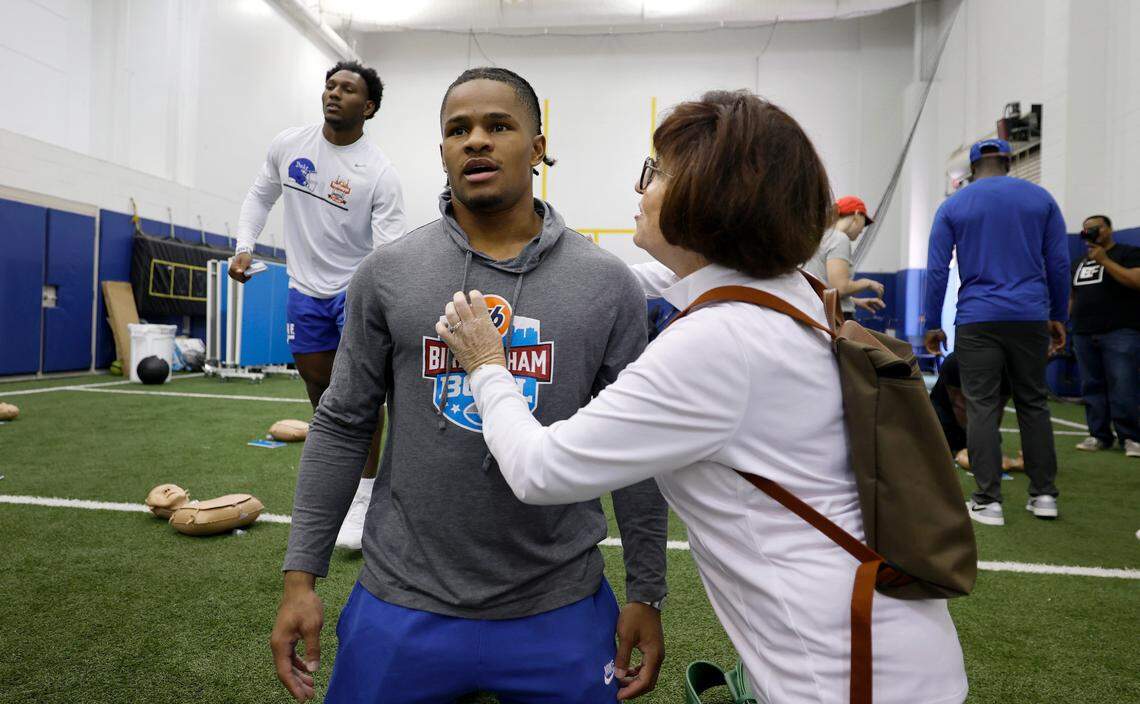
Kevin Siesel, the Blue Devils’ head football trainer, helped set up the session with the American Heart Association, which also included the how-to and use of defibrillators.
“When it came across my desk it was like, ‘Yeah, this is a no-brainer,’” he said, noting Hamlin’s medical scare hit home with the players.
Siesel said he liked the response of the players. Some took it a bit more seriously than others, others combining a little fun with the training – some of the dummies took extra-hard poundings – but the key was receiving the training.
“They were really engaged,” he said. “These guys are with each other all the time and we’re not always here with them. I think that clicked for them.”
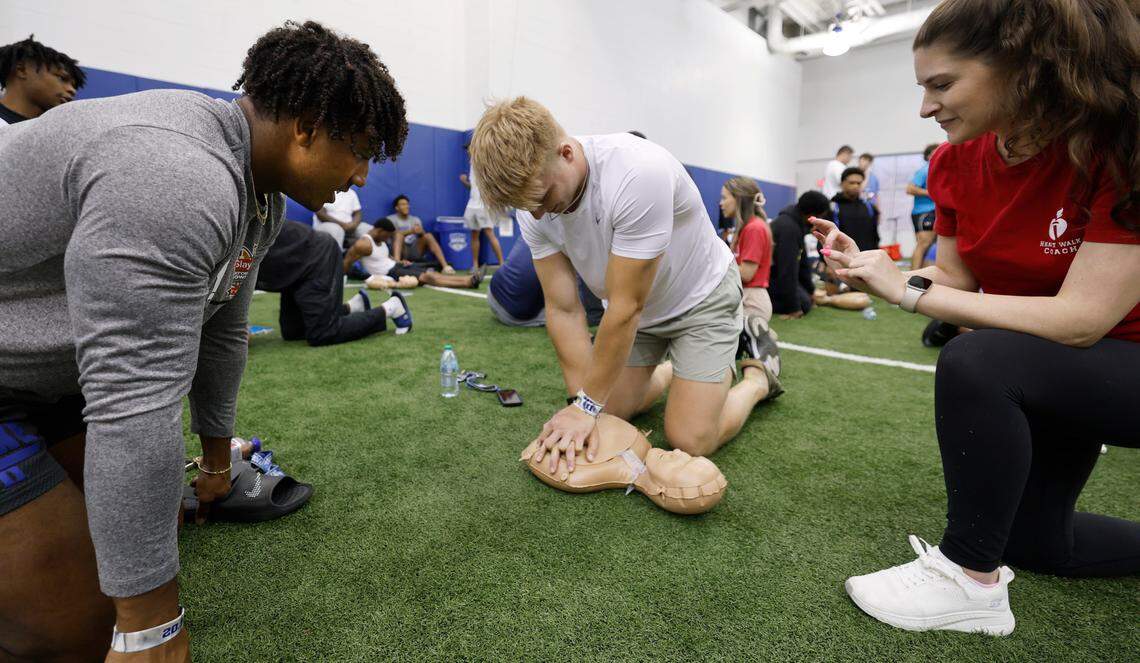
Debra Lowder, executive director of the American Heart Association in the Triangle and Eastern North Carolina, said the “Nation of Lifesavers” campaign has a goal of providing millions of people with the life-saving skills of CPR – “One in every family,” she said.
Lowder said Duke’s football team was the first in the area to have the CPR training but that the hope was football staffs at other schools in the Triangle and Eastern North Carolina might join in.
“I was impressed today,” Lowder said of the Duke players. “It was a lot of fun, definitely lively. Probably the liveliest training I’ve been to. Definitely dramatic, but the guys were asking a lot of great questions and I would trust them to save my life.
“One thing I shared today is that they have influence, and we want them to use that and share the message to as many people as possible, so that the people in Durham and the community can hopefully learn from them. And hopefully learn to save a life.”
This story was originally published July 23, 2025 at 5:30 AM with the headline "How Duke football team learned how to save a life to the rhythm of ‘Staying Alive’."
