
UNC mourns ‘selfless’ James Spurling, who impacted Tar Heel football for decades
AI-generated summary reviewed by our newsroom.
- Served over two decades as Kenan Stadium director and community hub.
- Spurling aided players and locals with practical help and steady presence.
- UNC gave him awards, dedicated the west concourse, and held Feb. 15 service.
You had to be careful what you mentioned to James Spurling.
If you said it, he heard it. If he heard it, he handled it. And he never expected anything in return.
Rick Steinbacher, UNC football’s longtime administrator, learned that years ago. At some point, his wife mentioned to Spurling how much she loved her father’s tomatoes. After her father died, she told Spurling, in passing, how much she would miss those summer deliveries.
Spurling heard it.
“Two weeks later,” Steinbacher said, “James shows up with fresh-off-the-farm tomatoes.”
Nearly every summer after that, the tomatoes came. Steinbacher says (jokingly, but perhaps not) his wife may have loved Spurling more than she loved him.
That was the pattern. Ask around Chapel Hill and you’ll find stories just like it about Spurling, the longtime director of Kenan Stadium, who died last Thursday at age 68.
Mary Ellen Kelly has one, too. In 2011, when she was a sports nutritionist at UNC, a colleague teased her about still owning a bulky box television. Spurling overheard.
“By the end of the next week, he had brought into work an extra flat screen TV,” Kelly said, “And was telling me, ‘I have your new TV.’”
He mounted it in her home, hauled away the old one and made sure everything worked before he left.
Kelly and her coworker were texting about it again recently, revisiting that story and many others after Spurling’s death.
“He really was a glue that strung together six straight football coaches,” Kelly said. “He was the constant that anytime and for anyone who, when you leave and you come back, the familiarity of James is always there. It’s just going to be really hard for me and for probably a lot of people, when you come back. He really was that permanent fixture that’s not going to be there anymore.”
On Sunday, for the first time in more than half a century, Carolina football will gather without him.
A Celebration of Life will be held Feb. 15 at 3 p.m. in Carmichael Arena. Generations of players, coaches and administrators — from former chancellors and athletic directors to Mack Brown and Bill Belichick — are expected to attend. Many carry their own version of the tomato or television story. Small gestures that felt personal in the moment but, together, reveal the breadth of Spurling’s reach.
He never sought recognition. The attention would have embarrassed him.
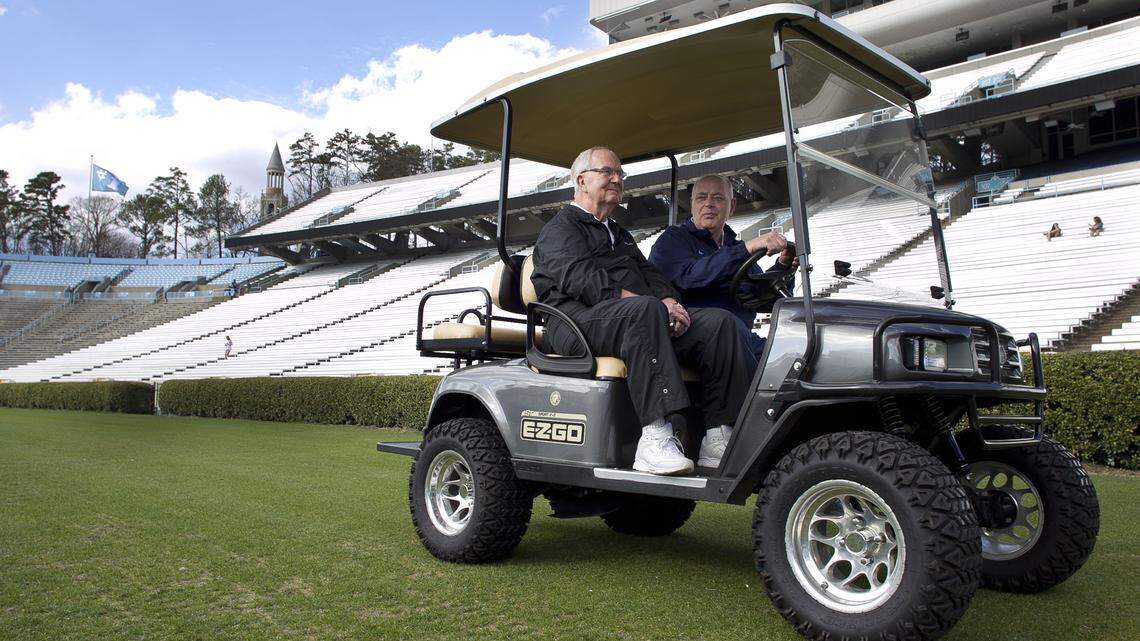
“He treated Kenan Stadium like it was his own home,” athletic director Bubba Cunningham said. “He treated people like they were guests in it. He made everyone feel good about being here. He’s the most selfless person I’ve ever met.”
‘I’ll make sure to be there’
Before he ever unlocked Kenan Stadium at dawn, Spurling unlocked the doors at Eastgate BP.
He bought the Chapel Hill gas station in 1982, a leap of faith he would later recall down to the dollar: $3,508 a month on a 20-year note. “I was scared to death,” he later recounted. He paid it off in 17.
If your car wouldn’t start, Spurling was the one to call. If you locked your keys inside, he’d come out and pop the door open. Locals drifted in and out all day, not just for gas but for conversation.
“There would always be somebody just sitting there chewing the fat, just spending time,” said local writer Lee Pace, later adding, “Back before the internet, that’s how news traveled. You went by Eastgate BP, and caught up on gossip and politics and recruiting and everything else.”
It was hard to stop by with kids in the car, former UNC assistant coach Dan Brooks joked, because Spurling would inevitably hand out M&Ms or packs of crackers. He ran tabs on a handshake, trusting customers to settle up at month’s end. That kind of credit barely exists anymore. The relationships it built still do.
“It was the community gathering place because of James,” said former UNC assistant coach Dan Brooks. “You could go there and you knew you was gon’ see (Harlem Globetrotter) Charles Harrison, (UNC legend) Ernie Williamson… it was an unbelievable, hospitable place.”
One of the regulars at Eastgate BP was the voice of the Tar Heels.
Woody Durham would swing by the station, and somewhere between the counter and the gas pump, a friendship took root. Both men were raised in small towns — Durham raised in Albemarle, Spurling in Creedmoor — and there was a familiarity in that shared upbringing.
What began as casual conversations at the gas station deepened when Spurling eventually moved into the Kenan football building. Spurling became a quiet caretaker of sorts for Durham in his later years, when aphasia began to set in.
“My dad was still trying to come to football games and James would make sure he could get to where they were sitting that day,” Wes Durham, Woody’s son, said. “They had to park far away. James would always ask, ‘What time y’all gonna get here? I’ll make sure to be there.’”
After Woody’s death, Spurling helped his widow. Woody’s wife still attended games for many years, despite having struggled with mobility. No matter where they parked, James would appear to help her.
“The first time we took the kids, to a football game in Kenan, I remember, James came and found us,” Wes Durham said, “because we weren’t sure how we were gonna get the twins and my mom, my ex-wife, and me, all into the stadium. And James showed up where we were parked. The next thing you know, we got a golf cart riding to the press box.
“It just shows you how that that relationship lasted. He was just so special to so many people.”
‘Going about 100 miles per hour’
All Mike Faulkerson-Dulaney could think of was to call Spurling.
It was the early 1990s and the former UNC football player was finishing his final semester and preparing for the NFL draft. He had recently bought a small Toyota pickup. He also owned four snakes.
During one on-campus workout, he left two of them — five-to-six-foot Colombian red-tailed boas — in a pillowcase in his trunk. When he returned, only one was still in the bag. The other had slithered beneath the steering column and coiled deep inside the dashboard.
So Faulkerson-Dulaney drove straight to Eastgate BP.
“Of course, I was freaking out,” Faulkerson-Dulaney said. “I didn’t want to turn the steering wheel too hard.”
Spurling listened and, with a bit of hesitation, crouched under the dash for a look.
“He was like, ‘You better make sure that (snake), that thing doesn’t come striking at me,’” Faulkerson-Dulaney recalled with a laugh. “He said, ‘I’ll cut his head off.”
Spurling grabbed his tools anyway. Together, they removed the screws and pulled the dashboard loose while Faulkerson-Delaney kept the snake calm. Once freed, Spurling helped reassemble the truck as if this were any other roadside problem.
Spurling’s readiness to help — no matter how unusual the request — was why so many players turned to him. Long before he worked for the athletic department, he employed numerous football players at Eastgate BP. In this pre-NIL era, Spurling hired guys to pump gas, scrape windows, change oil and clean bays so they could make ends meet in the offseason.
This is how Jeff Saturday first met James Spurling at Eastgate BP when he was 18, a UNC football player looking for summer work.
“I don’t know how old James was at the time, but he was young and carrying a briefcase,” Saturday recalled, “and he’s going about 100 miles an hour.”
Spurling laid it out fast: full service, tires, windows, oil, cleaning bays. Show up on time, work hard, we’ll get along just fine.
“He’s like, ‘You’re hired,’” Saturday said. “Go sit down, get your stuff going, and let’s get it on.”
Saturday quickly noticed Spurling’s relational approach and tireless energy — the blue collar work ethic his siblings credit to growing up farming tobacco. You weren’t going to outwork Spurling, Saturday soon learned, but it wasn’t always about work either.
When Saturday’s NFL career seemed all-but-dead following a disappointing combine performance, Spurling greeted him hours later at Eastgate BP with a pat on the shoulder and a quip: Hey, worst case you work here. With that Carolina degree, you’d be the most qualified gas pumper I got.
“He was always with a joke… hit you even when you were down,” Saturday said. “He hit you with a good one right there, to kind of rattle you out of your funk. And when it turns right, like when it turns for you, he’s your freaking biggest fan, dude. Like he really cared, and he really wanted you to succeed in what you loved, and when you did, he was your freaking biggest fan.”
That much was the case for Saturday’s prolific, 14-year NFL career and later broadcasting ventures. Shawn Hocker, too.
When the former football player and Eastgate BP employee was rejected from medical school the first time, Spurling stood behind the register and read the letter with him.
Both the denial and, later, the acceptance letter as well. For the gap year in between, Spurling offered Hocker work, support and, for a while, a place to crash.
“The definition of altruism is supporting somebody without any personal gain,” said Hocker, now a prominent orthopedic surgeon in Wilmington. “And he did all of this without public fanfare. He did not want recognition… but didn’t let me falter and helped me succeed, to which I’m still benefiting from today.”
.jpg "Image from iOS (1).jpg")
The same could be said for Dennis Tripp, who worked and played alongside Hocker in the 90s. After Tripp’s playing career ended with the Giants, Spurling let Tripp stay at his home for two months while the young athlete figured out his next move.
“I was way away from home, needing a job and, man, James filled that void for me,” Tripp said. “Almost like a father figure, almost like a best friend. But that’s the void he filled for me.”
‘James, what are you doing?’
On his first night touring the Kenan Football Center after being hired as head coach, Larry Fedora noticed a bulb flickering in the hallway. He pointed it out in passing, kept walking and didn’t think about it again.
The next morning, before 6 a.m., Fedora walked into the building and found Spurling. He stood on a ladder, already sweating, replacing not just that bulb but checking lights throughout the facility.
“I said, ‘James, what are you doing?’” Fedora recalled. “He goes, ‘Well, you said that light was going out, so I’m getting it all fixed.’”
Fedora tried to explain he hadn’t meant immediately. But with James, immediately was the only timeline that existed.
That’s part of the reason he got hired to be the Director of Kenan Stadium in 2005, despite having no college education.
“This was a position that people with undergraduate degrees and master’s degrees in sports administration were applying for,” Steinbacher, UNC’s football administrator, said. “University, HR said he’s not qualified. So Dick Baddour, who was the AD at the time, had to really work with them. And then he did a brilliant thing.”
Baddour brought the hiring committee in to sit with James and hear firsthand about his experience running Eastgate BP. By the end, Baddour wasn’t just introducing him — he was vouching for him. In his recommendation, Baddour wrote that Spurling would be one of the best hires the university ever made.
HR eventually signed off and Spurling went on to hold the role for more than two decades.
“I don’t think anyone’s ever done a job better than he did that one,” Steinbacher said.
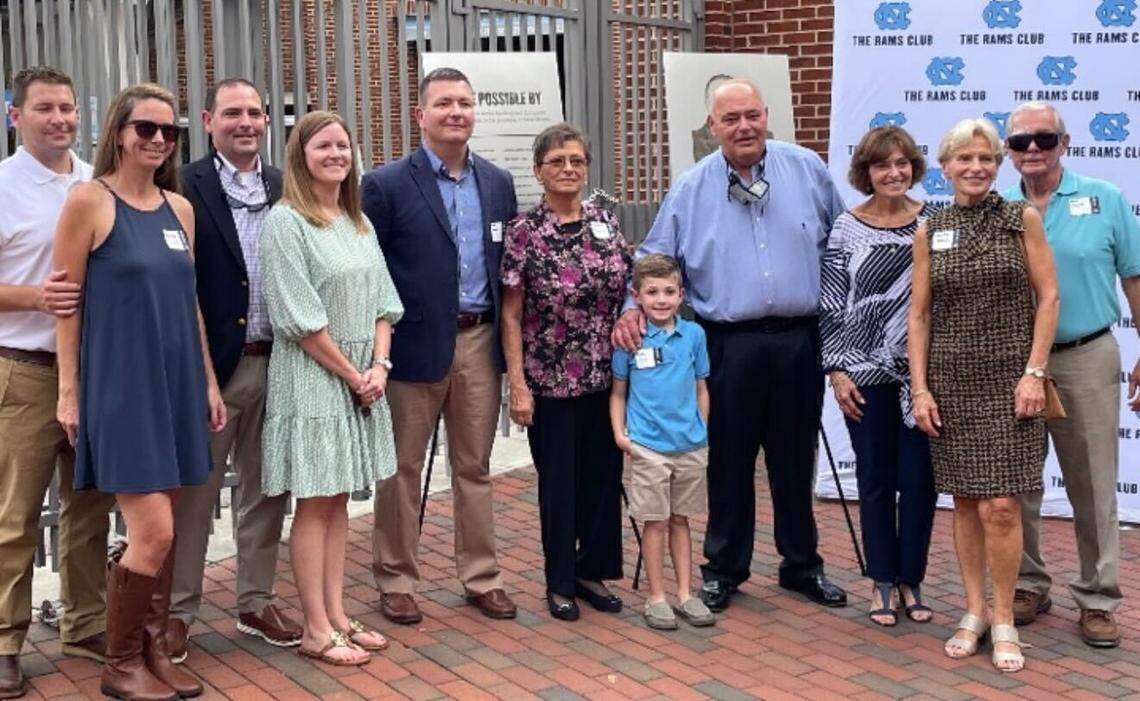
Spurling proved invaluable, earning the respect of six head football coaches and numerous awards over his tenure. In 2007, he received UNC’s Iron Man Award — the only non-football player ever selected. Two years later, athletics presented him with the Ernie Williamson Award for loyalty and service to the university and its athletes. In 2015, he was awarded the C. Knox Massey Distinguished Service Award, one of UNC’s highest honors for faculty and staff. And in 2021, the west concourse at Kenan Stadium was officially dedicated in his name.
“I told Rick (Steinbacher),” Brown said, “there’s no way anything can happen around here without James knowing it. And it actually happened. He was really shocked. And then we had a good crowd, and he was absolutely crying like a baby when they announced it and showed it to him. He was so proud, and he would not ever ask for anything for him personally. So that was really a special moment.”
Opening the gates
At First Watch restaurant in Chapel Hill, James Spurling’s sisters, Phyllis (72) and Dorothy (69), were mid-story Thursday morning when a glass shattered, tomato juice bleeding across the floor. A waitress warned a nearby customer not to move — there was glass in her shoe. The sisters and family friend, Rams Club employee Dawn Williams, turned in unison.
If James were here, they said, it’d already be handled. Glass gone. Shoe cleared. Crisis over.
The moment — small, ordinary — sent them back to him. For the next hour, stories rolled in a sweet Southern drawl, laughter swelling and folding into tears. They still call him “Little Is,” a nickname from their childhood. They marveled at how he could dance — all 300 pounds of him. Back then, Dorothy said, you either played football or you danced to impress girls. James’ football career stalled, but he could call a square dance, clog, flatfoot and buck with surprising grace.
He loved country and bluegrass. He tried the banjo, mastering just “Cripple Creek” and “I’ll Fly Away,” both to be played at his service on the same instrument he once loaned to a friend. His laugh started deep in his gut and rose all the way through his belly, mischievous and contagious. When he told stories — about Lawrence Taylor’s college hijinks, Vegas jackpots, things players like Mitch Trubisky still chuckle and say they can’t repeat — it felt, Williams said, like the world paused to listen.
He was prankster and caretaker in equal measure: hoisting a giant TV through a dorm window with a cherry picker; setting off a cherry bomb in a sister’s boyfriend’s car; delivering a baby in a Piggly Wiggly parking lot as an 18-year-old EMT and then telling the mother she “better name the boy James.” He mediated sisterly bickering like a patient referee, but also instigated plenty as well.
He never had children, but he loved his nephews like his own. They learned work ethic from him, his sisters said. An 8 a.m Eastgate BP opening meant arrive by 7:40 — he’d be checking. Don’t call after 8:30 p.m. unless someone was bleeding. He was up at 4.
“He knew when your child got accepted to UNC,” Dorothy said. “He knew when your sister was in treatment. He knew when your daddy died. He knows when you’re expecting your first baby and when your daughter’s getting married.”
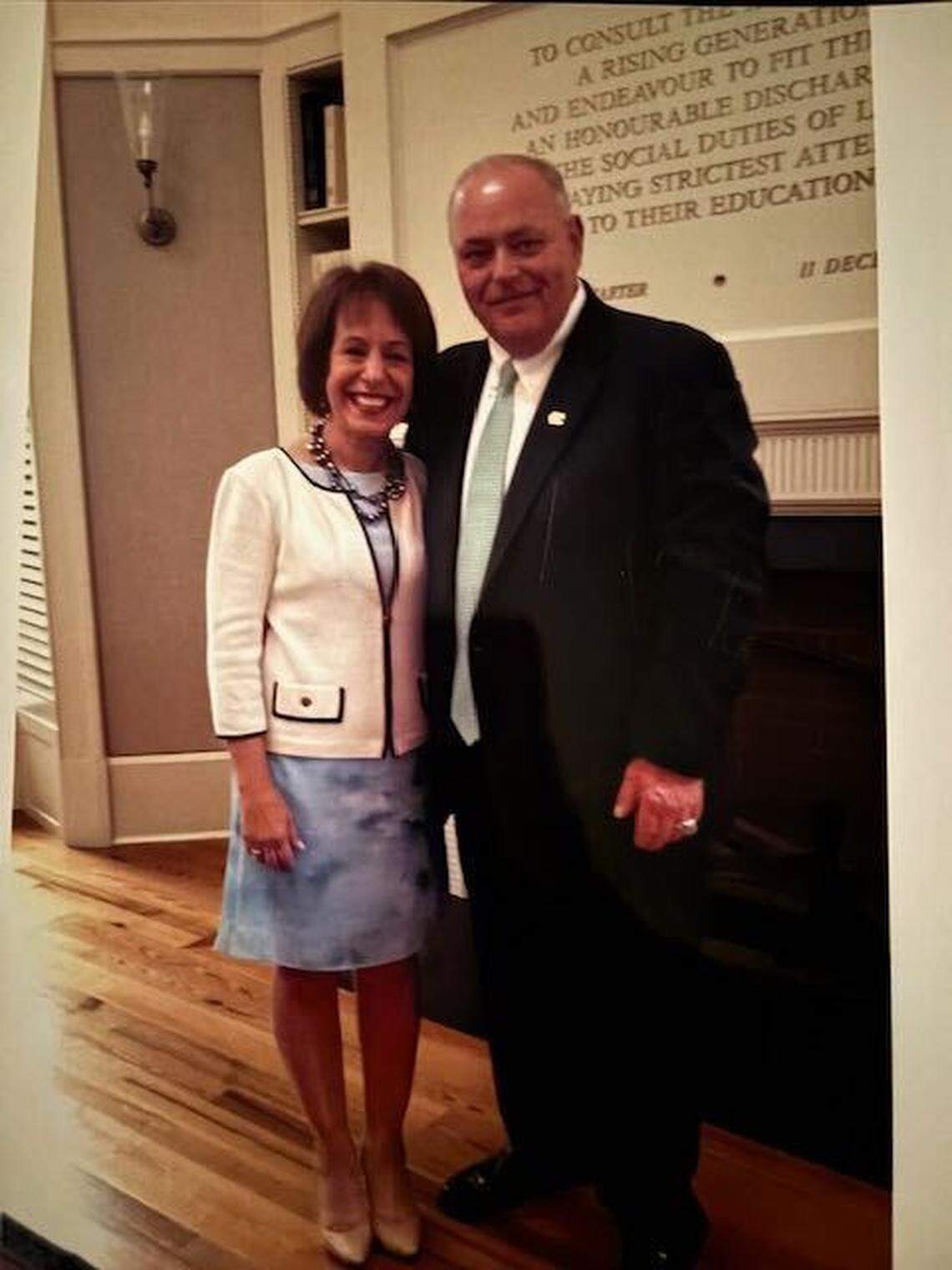
At the table, the sisters and Williams kept talking, trying to decide where to start and where to stop before realizing they couldn’t. Across Chapel Hill, since Spurling’s death on Feb. 5, myriad people who knew him have come to this same realization.
Pace is one of them. When the writer ran into Baddour, the former athletics director, at a car wash last week and asked him: Could he even imagine a world without James Spurling? Baddour simply looked up and said he couldn’t.
For so many in Chapel Hill, Pace said, that’s the hardest part — picturing the town, the campus, Carolina football, without Spurling. He had, over time, become inseparable from all three. In many ways, he still is.
One such example: A few days ago, associate athletic director John Brunner found himself chatting with fellow UNC employee Mary Kay Root, about Spurling. They were in Carmichael Arena. Volleyball player Jackie Taylor heard the conversation and asked, “Who’s James Spurling?” They showed her a photo.
“Oh yeah,” Taylor replied. “That guy would open the gates for me every morning at 6 a.m.”
His sisters like to think he’s still doing that now.
“I think God’s probably got him right at the pearly gates as the greeter,” Phyllis said, causing her and Dorothy to laugh. “He’s probably running that place up there right now.”
Even now, as he is about to be laid to rest, they can’t imagine him sitting still.
This story was originally published February 13, 2026 at 6:15 AM with the headline "UNC mourns ‘selfless’ James Spurling, who impacted Tar Heel football for decades."