As Dale Earnhardt’s mythology grows, so does that of his NC hometown. ‘One of us’
Sometimes, Ryan Dayvault has no idea what he’s stepping into.
This was one of those times.
It was several months ago, on a cool weekday in Kannapolis. Dayvault, the town’s mayor pro tem, had received a text to meet with some folks who’d road-tripped from hours away. So he made arrangements to get off work early and to meet the couple, in their 50s, at Dale Earnhardt Tribute Plaza, in the heart of downtown Kannapolis.
They shared their names, and then their stories, and then their souls. The couple was from Arkansas. It was a bucket-list trip to see Dale: the 9-foot, arms-crossed, mustachioed, smiling, weather-resistant statue looking out over a bricked walkway. The husband and wife were farmers on 20,000 acres of land, and 20 years prior, they had nearly lost everything after a tornado ripped through their property.
“I mean, his house is gone,” Dayvault says, recounting the couple’s story. Dayvault is a Kannapolis native and sounds like it. He’s wearing khaki pants and a No. 3 hat and tired eyes, the father of newborn twins. He’s also wearing a shirt with his last name emblazoned on it — representing “Dayvault’s Tune-Up & Brake Service,” the company his father, Gregg, owned in town. Gregg and Earnhardt were the same age; the Dayvaults and the Earnhardts were practically family.
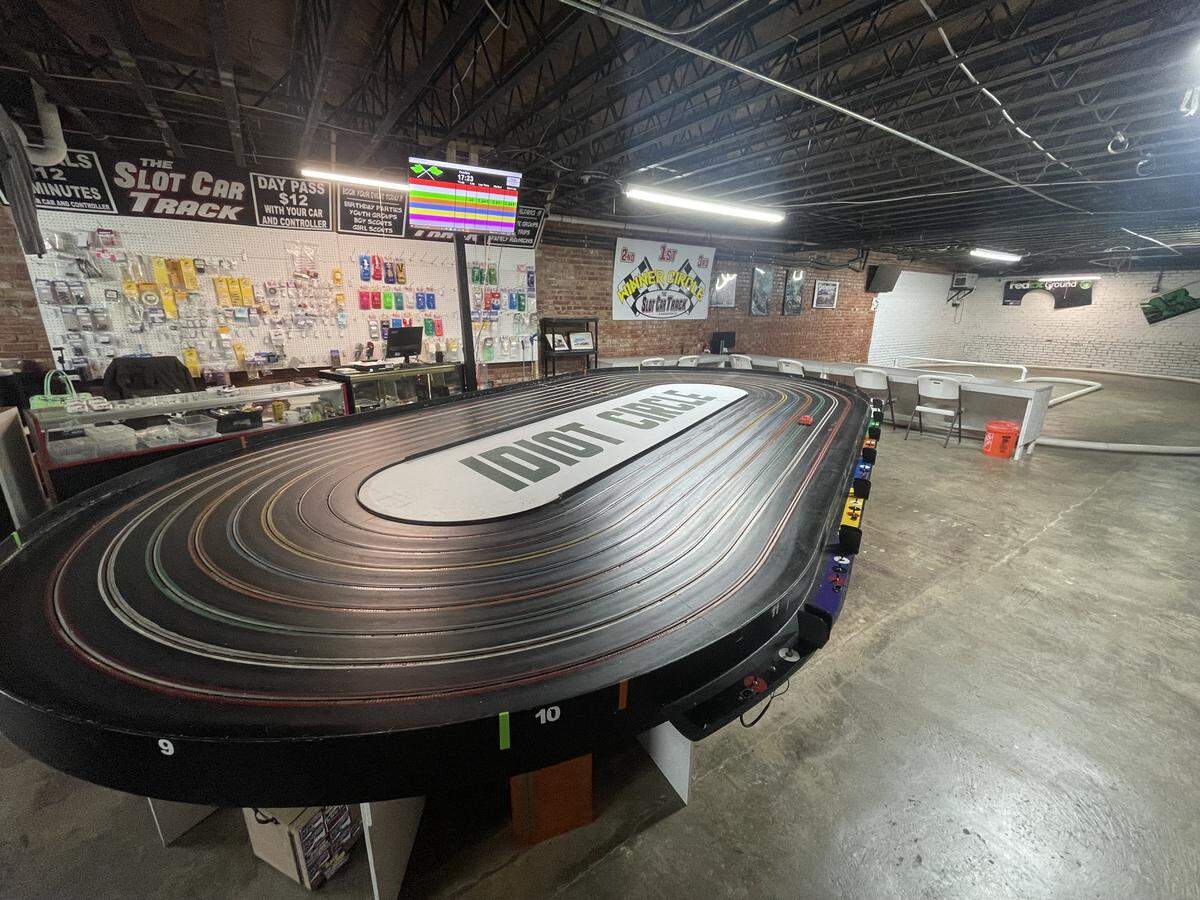
“It’s all absolutely gone,” Ryan says, continuing this stranger’s story. “So he’s walking around. And he finds this picture that had survived because he had this big collection of stuff. It’s from the 1998 Daytona win.
“It’s a picture of Dale, standing up on his car like that” — Dayvault mimics both of his fists triumphantly in the air. “And the picture says something about perseverance. Something about going against all odds. It’s a postcard. It was laying face up. Out of all this debris, it was in immaculate condition.
“And he said, ‘Well, God, I guess you’ve given me the sign. My hero, this is what he would do. This is what I gotta do. I gotta get myself pulled together. Rebuild our house. Rebuild our farm. And keep going.’”
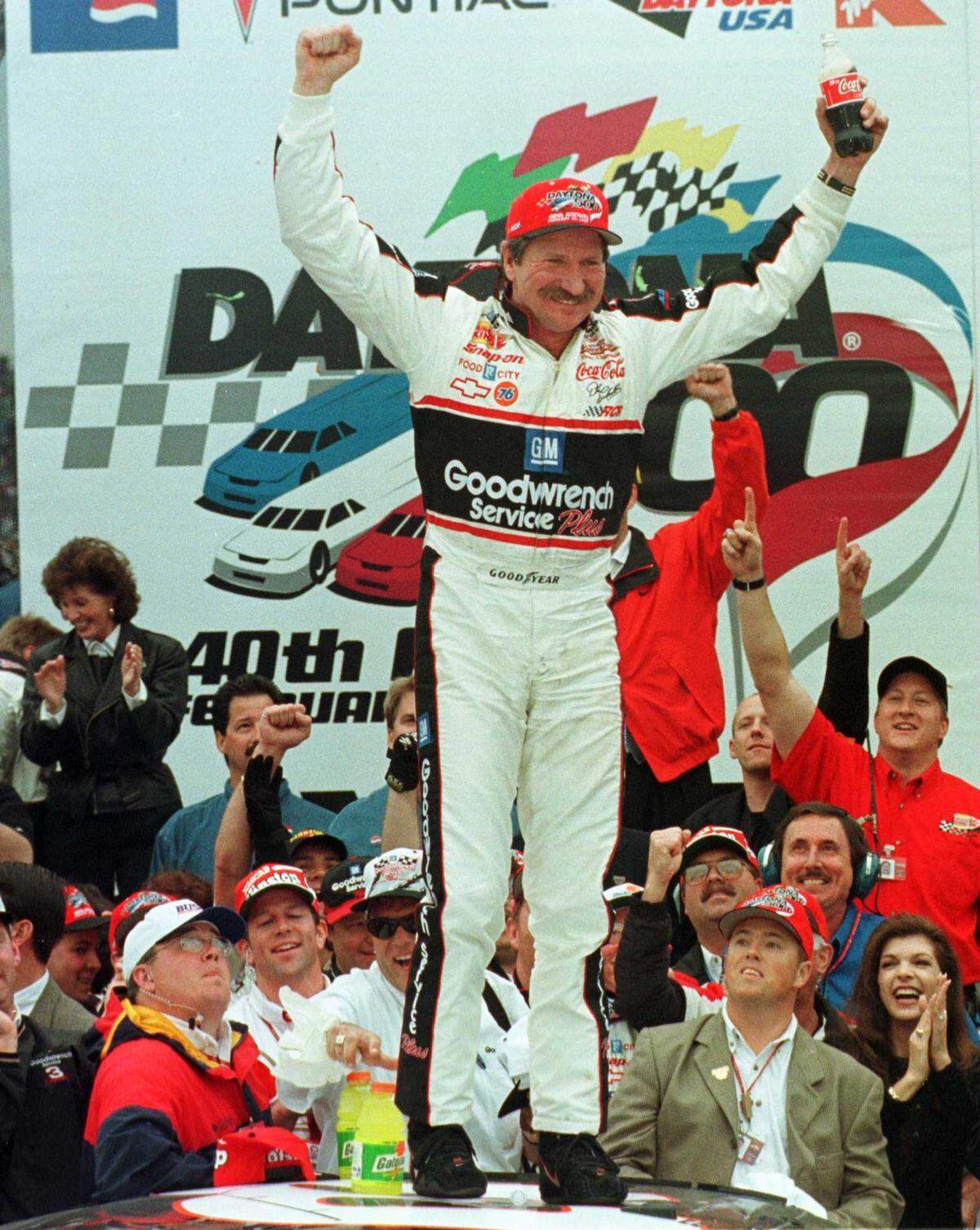
Dayvault tells this story on Wednesday in front of the same Dale Earnhardt Sr. statue that he met those folks at months ago. He tells it to me and Eric Dearmon, another Kannapolis native, who in retirement has become a Downtown Kannapolis Ambassador.
“And there’s stuff like this that you don’t ever know about,” Dayvault says.
Dearmon chimes in: “Happens all the time.”
If you let them, Dayvault and Dearmon can go memory-for-memory. Not necessarily with stories about Dale The Person or Dale The Driver — Dayvault has the familial advantage there. But stories about Dale The Myth. There’s a distinction.
Dale The Person and Dale The Driver stopped evolving in February 2001, on the last lap of that NASCAR season’s Daytona 500, when he never got out of that car, a dark day that needs no reintroduction. But Dale The Myth? Somehow, he’s grown. On Wednesday, the day of what would have been his 75th birthday, here Earnhardt stands: not in his fire suit; not bearing any of his seven Cup Series championships; not as the take-no-prisoners driver who was loved by some, hated by some and respected by all — but as a Kannapolis native in jeans and a collared shirt with sunglasses in his chest pocket and his arms crossed, looking out over the town he grew up in. Some see Dale The Person in the statue. But all see Dale The Myth.
“Two and a half decades in, he’s as popular now as he was then, if not more so,” Dearmon says.
You might wonder why that is — how the mythology of Earnhardt continues to expand the further we get away from him. It’s been on Dayvault’s mind, too. Theories abound. Simple ones, like that of Dale Earnhardt Sr.’s son, Dale Jr., selflessly sharing his father’s story whenever possible. Complex ones abound, too: ones about connection, about the unsettling power of nostalgia, about what we as a humanity are searching for, something we thought we once had.
“I don’t know,” Dayvault says. He’s trying to answer this impossible question.
He then shrugs.
“I think this town has always had its own mythical aura about it,” he says. “Because we have defied things, all sorts of odds, for a long time.”
The Kannapolis that Dale Earnhardt knew
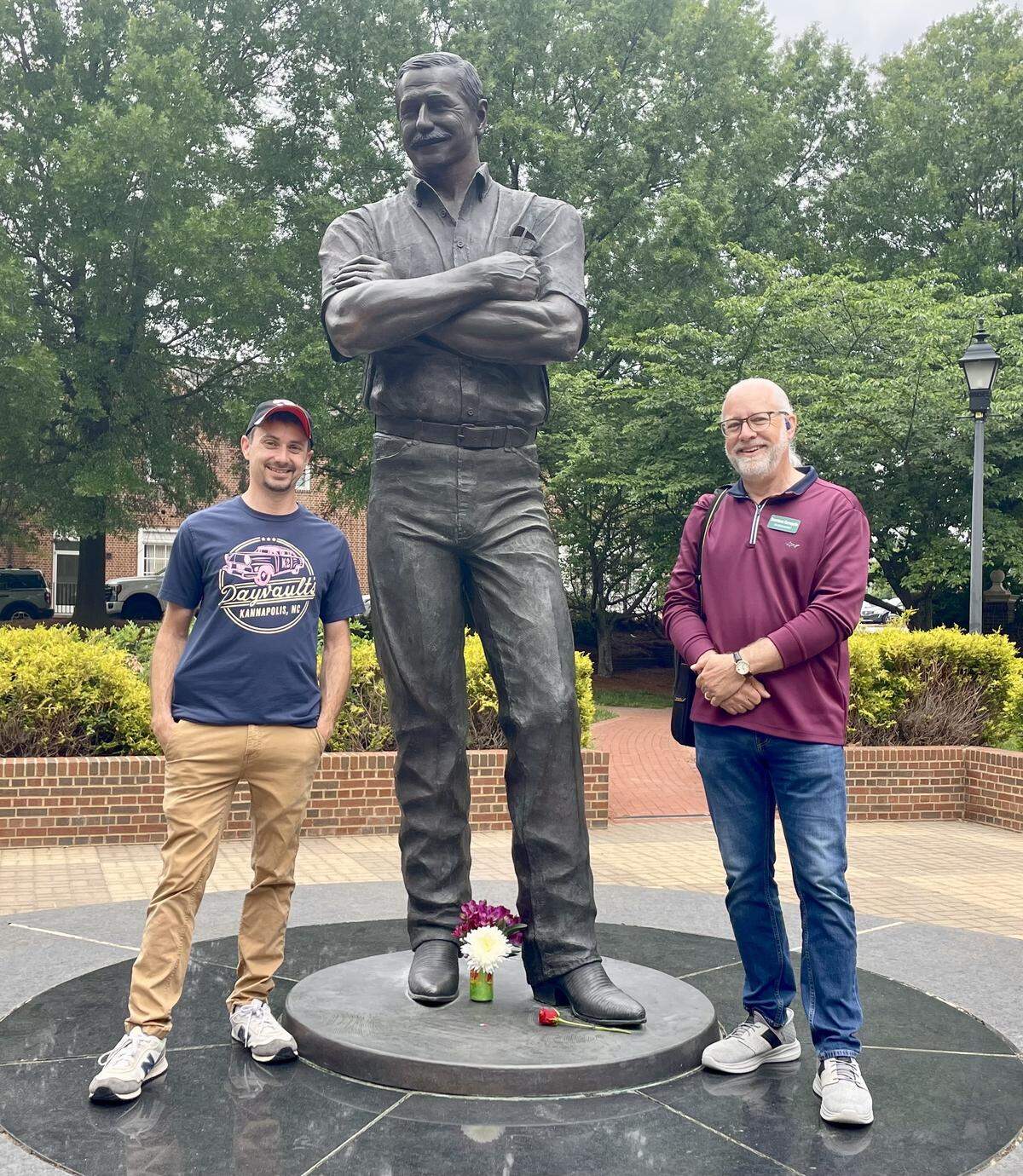
It’s earlier Wednesday morning, just past 9:30 a.m., when Shelley McAnulty is operating a slot car. She’s explaining its workings at the same time. She and her husband, Randy, own The Slot Car Track, where miniature vehicles sprint over grooves that guide the cars and provide electric power via metal braids.
She’s demonstrating how this all works — how you have to let off the “throttle” into the turns or your car will spin out, just like in a real race, for one — when the name of the oval track she keeps on zooming around comes into focus.
Why is it called “Idiot Circle”?
“I can tell you’re young,” McAnulty says, respectfully holding in a laugh. She’s a Kannapolis native, too. You could tell that by the Earnhardt memorabilia plastered on the walls and by all the racecar doors that contribute to the shop’s ambience. One of Randy’s hoods from one of his old racecars hangs by the back wall. Shelley and Randy met at a racetrack in the ‘80s. Just like her hometown, racing is in her bones.
But Idiot Circle is no racetrack. It was once an unofficial Kannapolis landmark.
“You know how teenagers were always just looking around for somewhere to hang out?” McAnulty says. “Well, the hangout was downtown Kannapolis. And you would just circle the main drag, and the grown-ups got to where they called it Idiot Circle because all the teenagers were there.”
“I’m 55,” McAnulty continues, “so if you ask somebody around my generation or older, they’d know exactly what you mean.”
In the ‘60s and ‘70s, that’s exactly where Earnhardt was, riding around in a souped-up muscle car on a Friday night, blasting the radio, “looking for a class ring somebody lost” as the tall tale goes. And while he was growing up there, the rest of life in downtown was happening.
Kannapolis, for decades, was run by Cannon Mills Co., which had plants in and around town. Plant One, the flagship facility, sat right in downtown Kannapolis. It was the size of the Pentagon. It held 15,000 employees at its peak. Kannapolis was at one point the largest producer of towels in the world because of it. The mill, like much of small-town Southern Americana, “was everything,” Dearmon says. That’s the Kannapolis Earnhardt Sr. knew.
Then two years after Earnhardt Sr. passed, in July 2003 — “1 o’clock in the afternoon,” remembers Dayvault, whose mother worked in the plants — the mills closed. An announcement was made right outside the Swanee Theater. It marked the largest layoff in North Carolina history at the time. And when the jobs evaporated, the businesses closed, one by one, heartbreak by heartbreak.
Such was the fate of other small towns across the state, the nation, the world. In some places, the scars haven’t healed. And Kannapolis could have been one of those places; at its worst, an estimated 30% of the town was unemployed.
But every time the community got knocked down, it lifted itself back up. Families helped families. Churches opened their doors to assist people in receiving unemployment benefits and finding jobs. There were other powerful forces at play as well.
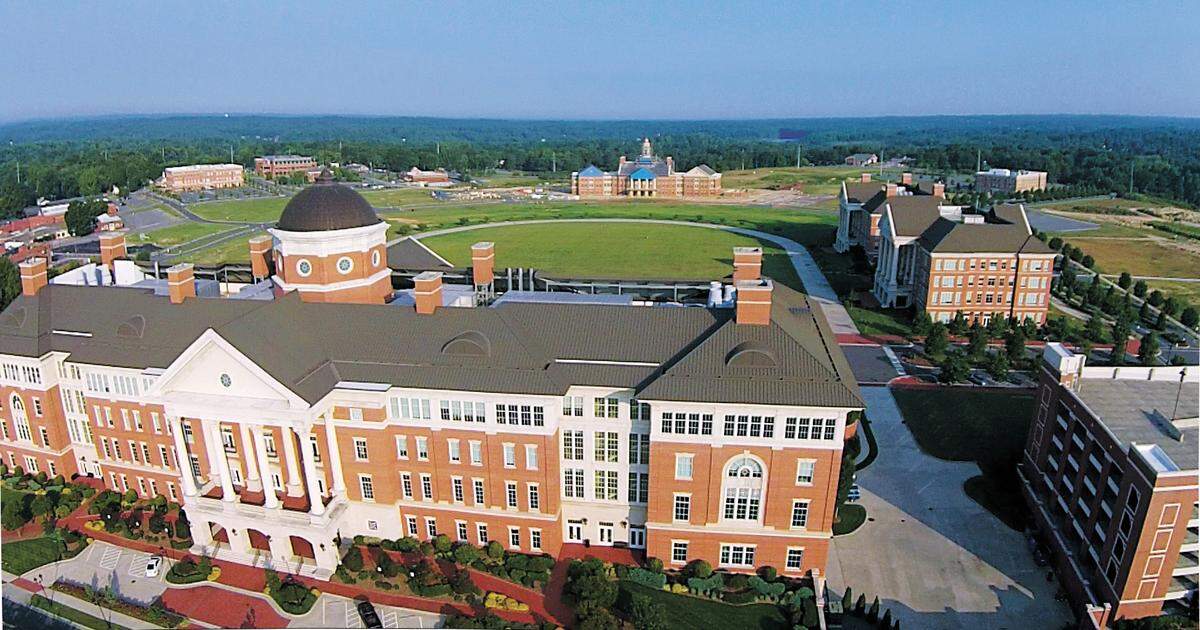
In September 2005, David Murdock, who’d bought the mills in the ‘80s from Cannon Mills and thus had a previous connection to the area, announced that he’d establish a research campus where the mills had closed. That spawned hope. Then came the deconstruction of the 7 million square feet of the old plant. A painful erasure — but importantly, as Dayvault acknowledges, a clean slate.
With modernity, friction would arrive. Murdock constructed the North Carolina Research Campus, but his plans to revitalize the town were stunted by the 2008 recession. Money drained from his pocket. Businesses that had returned downtown because of the renewed hope of the campus left again. It was so bad that in 2015, the city went to Murdock to buy some of the downtown properties he owned for $8.75 million. He agreed.
And that — in the broadest strokes — enabled the city to control its own future, to build the Kannapolis Cannonballers stadium right in the middle of everything, to construct Kannapolis into what it is today. It took time. Loads of infrastructure improvements. Faith.
But in ways unmistakable, and ineffable, Kannapolis avoided the fate that a lot of other small towns couldn’t.
“Seven years ago, there was nothing here,” Dearmon says. “You can’t imagine that looking at what’s here now.”
An aura grows
It’s later in the afternoon Wednesday, and Dwayne Jackson is busy at work. He owns Decadence Popcorn on the town’s main strip, just outside Dale Earnhardt Tribute Plaza, serving “fresh-popped favorites” in a small business he owns with his wife, Kimberly.
Jackson is originally from Syracuse, New York. He and his wife live in Mooresville. He started his business here five years ago and just re-signed another five-year lease, he said. And even though he wasn’t here prior to the mills closing, he’s integral to the town’s story. He’s a small business owner contributing to the revitalized area — the town that never relented.
It doesn’t hurt that he’s right next to Earnhardt’s statue.
“You don’t really notice it on a day-to-day basis, but when they have something going on, you can tell,” Jackson says of how his proximity to Earnhardt helps his store. “You see a lot of people from around the country come in and visit Kannapolis.”
Whatever the means, people get here. Many stay, drawn to the small town that found a way to scrape its way through modernity, not without challenges past and present, but here anyway. Some don’t stay. And that’s OK, leaders say. They pilgrimage here for Earnhardt — who was a driver and a friend and a father, and now, just like his town, he’s a myth, too.
“He’d be the one buying businesses,” Dearmon says, adding, “Dale, if he were here and alive today, I think he’d be an integral part of this.”
As Dearmon and Dayvault continue on, they’re interrupted by something special. A couple and their excitable son walk up to the statue. They’d taken the train from Charlotte to see Earnhardt’s face. They notice at his feet, there’s a can of Sun Drop being used as a vase with flowers coming out of it. Another single rose lay, too.
“It’s his birthday today,” Dayvault interjects.
Eyes widen. It’s the son’s birthday, too. He turned 5 years old.
“We gonna have to bring you every year!” the father says.
The father knew Dale The Driver. Dayvault knew Dale The Person. But then for the next few minutes, through exclamations and stories and words like “legend” and “king” and others, they both tried to intimate to the son how much Earnhardt meant — to everyone.
It’s an impossible task without resorting to mythology.
Later, after they’d left, Dayvault found the right words:
“He’s one of us.”
This story was originally published April 30, 2026 at 5:45 AM with the headline "As Dale Earnhardt’s mythology grows, so does that of his NC hometown. ‘One of us’."