
NCAA president Mark Emmert’s tenure nears end as NIL, transfer portal change landscape
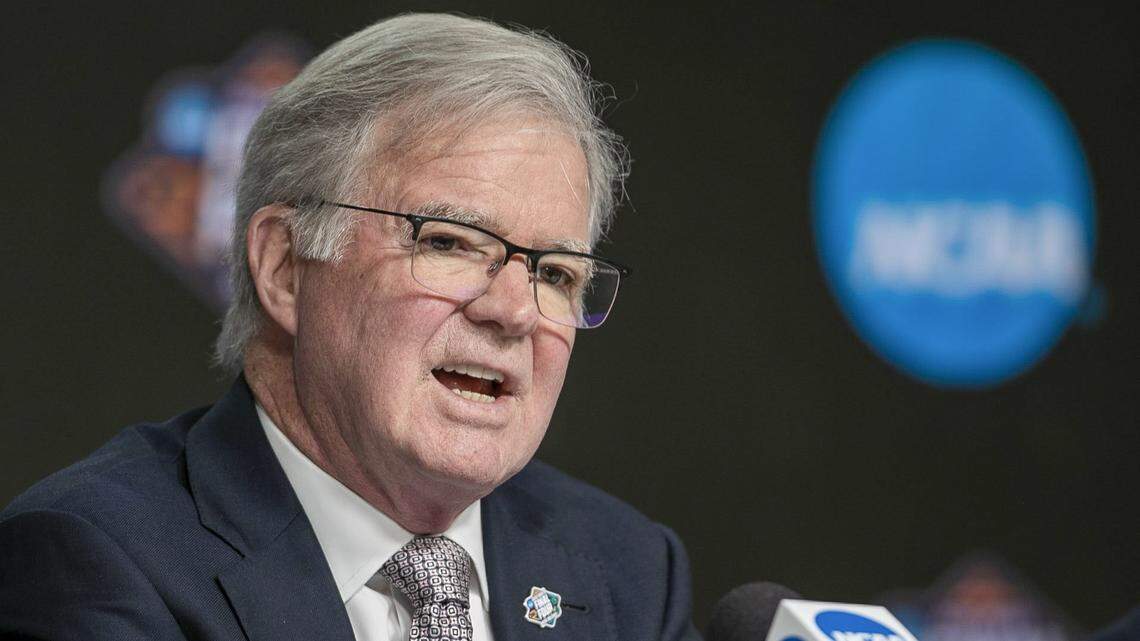
A year after agreeing to a contract extension with the cloud of controversy around his tenure ongoing, NCAA president Mark Emmert announced his time running college sports is coming to an end.
Emmert, 69, will step aside no later than June 30, 2023, or as soon as the NCAA hires his successor.
“Throughout my tenure I’ve emphasized the need to focus on the experience and priorities of student-athletes,” Emmert said in a statement released by the NCAA. “I am extremely proud of the work of the Association over the last 12 years and especially pleased with the hard work and dedication of the national office staff here in Indianapolis.”
It was just one year ago that the NCAA faced criticism over inequities between the men’s and women’s basketball tournaments. Duke athletics director Nina King, who chairs the women’s basketball committee, called that experience “painful” and sought changes.
The NCAA commissioned an outside law firm to conduct a gender equity review that reported a $35 million gap between spending for the men’s and women’s tournaments.
Despite all that and his growing unpopularity, Emmert was awarded a contract extension through 2025 in April 2021.
That all changed on Tuesday with that the NCAA called a “mutual decision” for him to step aside.
“With the significant transitions underway within college sports, the timing of this decision provides the Association with consistent leadership during the coming months plus the opportunity to consider what will be the future role of the president,” said NCAA board of governors chair John J. DeGioia, the president of Georgetown. “It also allows for the selection and recruitment of the next president without disruption.”
The college sports landscape continues to dramatically change in ways few thought possible back in 2010, when Emmert took over as the NCAA’s president. Court rulings and new state laws continually picked away at what were once tenants of the collegiate sports amateurism model that Emmert and other NCAA administrators fought so hard to protect.
College athletes are now allowed to receive payments via marketing deals for their name, image and likeness. The rules that required players to sit out from a season of competition after transferring from one school to another was also changed to allow immediate eligibility in most cases.
Too often, many in the college sports industry have complained, Emmert’s NCAA resisted change and had to scramble to make changes when it was forced to do so.
Earlier this month at the men’s Final Four in New Orleans, retiring Duke basketball coach Mike Krzyzewski once again aired his frustration with what he called the NCAA’s lack of leadership on major issues.
“Where are we going? And who is going to be in charge?” Krzyzewski said during a press conference two days before Duke played North Carolina in the national semifinals. “Not that I’m saying that he shouldn’t be. But what are we doing? What are we doing to make sure we’re taking care of all divisions that are under your roof — men, women, all sports, those that make money and those that just make men and women out of people. And probably that’s more important than the other, but you have to do that.
“So there’s balance. And we’re understanding that everyone cannot be treated the same. That doesn’t mean that everyone’s not treated fairly. And it’s a new day that should have been a new day decades ago. So we’ve got a lot to make up for.”
The ACC found two of its schools involved in two major controversies during Emmert’s tenure.
In October 2013, NCAA officials punished Miami for lack of institutional control over its men’s basketball and football programs. The sanctions resulted from booster Nevin Shapiro’s improprieties, which included providing impermissible benefits to as many as 72 Hurricanes athletes over an eight-year period.
But the already sordid tale tainted the NCAA when it acknowledged during the investigation that the organization used improper methods to collect evidence.
Around the same time, North Carolina’s academic fraud scandal was beginning to come to light. Over 18 years, internal investigations by UNC and an NCAA investigation found athletes, as well as the general student body, took some classes that required little or no effort to pass.
But, by 2017, the NCAA concluded its investigation by saying it wouldn’t punish UNC. That caused Emmert to say the American public had lost confidence in the NCAA because UNC did not face sanctions.
This story was originally published April 26, 2022 at 9:26 PM with the headline "NCAA president Mark Emmert’s tenure nears end as NIL, transfer portal change landscape."