The ‘pixel pushers’ who help power Gamecocks recruiting efforts behind the scenes
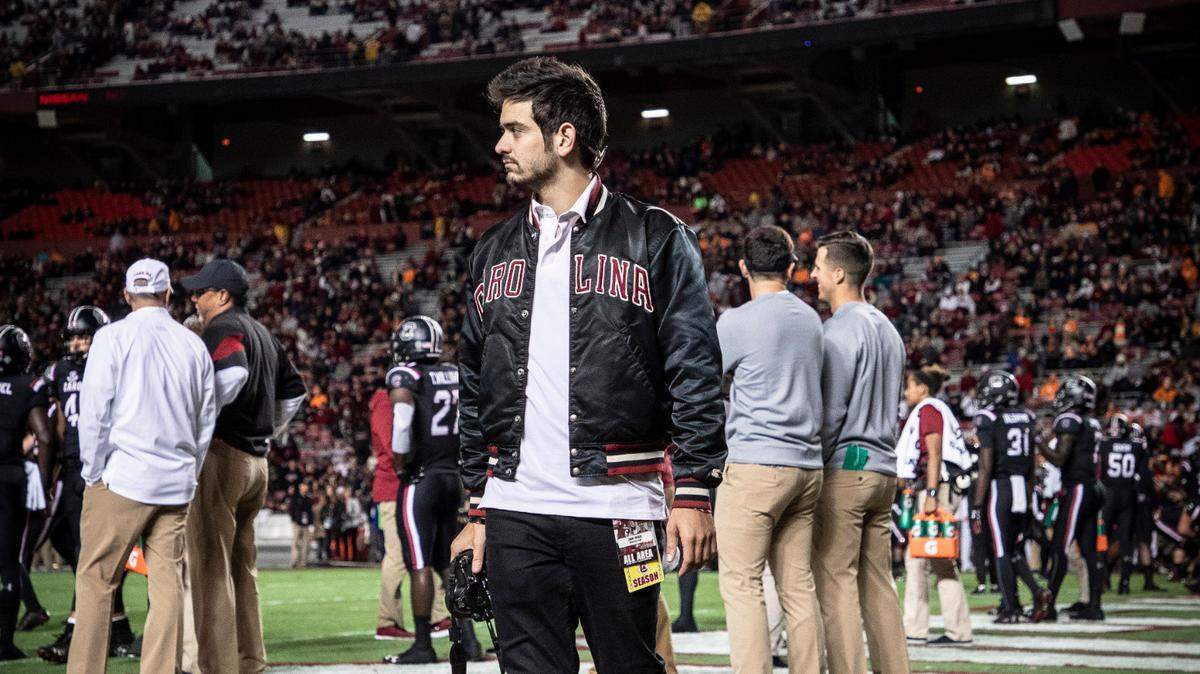
Zach Frehse made clear rather quickly the central theme of his role with South Carolina’s football program.
“Basically, all I care about is recruiting,” Frehse told The State. “That’s really what it comes down to. Obviously, I care about winning, but you can’t win unless you recruit.
“I don’t really want my stuff going on social media. If it goes to help to get a kid, that means more than anything.”
Speaking like that, he sounds like a coach, and if one feeds his name into Google, he’s actually listed as such in some part of the team’s website.
But what he does is a mostly unseen part of South Carolina’s powerhouse creative department. As an assistant director, he oversees football graphics design.
That department is most prominently known for the work of director of creative media Justin King and his coworkers on the video side. They’re public facing enough that a close follower of Gamecocks Twitter has probably heard the name of most of the team.
The graphics group, “pixel pushers” as compared to “video drones,” works more behind the scenes. King estimates more than 95 percent of their work isn’t put out to the public.
But make no mistake, it’s an arm that matters to the program, led by a young and creative mind without much interest in the limelight.
“He’s never satisfied with his work,” King said. “You know he’s driven, realistically because of what he does, he’s driven by wanting to see the success of others as much as anything else and that’s a really admirable quality. And it’s something that he didn’t have to learn. That’s who he is.”
Producing anything graphical they need
Frehse has an exercise he likes to put his students through.
Each one is given a theme, two photos that have to be used, one font and the requirement of finding another. They get one hour (this shouldn’t take all night) and they’re off.
“The end result, ideas just pour from that,” Frehse said.
The range of content his group produces is vast. It includes notes for coaches to write, good luck messages before a Friday night game, even birthday cards. It includes slick graphics to highlight a fresh uniform look or the beach-themed template that was eventually adapted to pump up young stars and NFL alums.
There’s an ebb and flow. Summers are lighter, and ideas can be stored up. Off a win, content will highlight the latest victory. And things ramp up when signing day starts closing in.
King recalled a particular recent project where Frehse got the perfect shot of a player, possibly Josh Vann, running out of the tunnel for “2001” against Tennessee. That image could be tweaked (ironically King was erased from it) and altered to make it look like a specific recruit with the message: this is what it would be like for you to run out at Williams-Brice.
“It starts with, what looks cool?” Frehse said of the process. “That’s the bulk of what the high school kids like, what looks cool. We try to get a message behind it. Not just what looks cool, but how can we tie this into what we’re doing.”
Sometimes that’s showing off the palatial football facility or highlighting a great third-down defense(Frehse says he is a big fan of stats and breaking a new typeface).
In total, his group has three designers, himself, his right-hand man Jayson Jeffers, a paid intern, plus a set of students. Three of his charges have gone on to full-time jobs in the field. One former intern is working with the San Jose Sharks. Another just announced taking a position at SMU.
The role is heavy on collaboration. Designers bounce ideas off each other, sometimes off creatives on the video side. They also trade ideas and information with coaches and especially with South Carolina’s robust recruiting staff, a group in charge of knowing what potential Gamecocks like and are interested in, down to musical taste.
There’s a communal aspect to it, full-timers teaching, but also learning from the younger folks coming in.
“All of us full-time people would have trouble getting a job in this day and age,” Frehse said. “The talent of these kids in school is fantastic.”
An unusual path to the football world
Had you spoken to a college freshman version of Frehse coming from Charleston, you would not hear talk of getting any creative field at all. College shifts the outlook of many students from start to end, sometimes in subtle ways, sometimes more turbulently.
“If you had asked me in high school what was your five-year plan, I was going to be a State Farm agent like my dad,” Frehse said. “That did not work out.”
Business school knocked him around, not an uncommon experience. He switched over to art school. There were a few laments (“Nobody wanted to talk about sports. Nobody knew that the game happened”), but he liked the experience and the people. He wasn’t doing much on the sports side, working in licensing and trademarks and penning cartoons in the newspaper.
He needed an internship to graduate and had something lined up with the Charlotte Hornets, only that fell through.
“I was worried,” Freshe said. “I was freaking out. I had no idea what I’m going to do.”
Out of the blue came an offer. Joe Johnson, creative director of the marketing arm of South Carolina’s athletic department, needed an intern, and Frehse was in.
Soon enough, the football program needed some help. Knowing that was the best path to a job in the profession, he made the change (Frehse says he still owes a lot to Johnson) and went to work for Kristen Sheetz, who led a small set of designers for football.
The internship became a job after graduation. Frehse feels indebted to Sheetz as well, and in her time, the demand for and interest in graphics from players and coaches grew. Then at the end of 2018, she moved on to working with the Seattle Sounders of the MLS.
And King was in charge of finding her replacement.
“I interviewed some people for the position and really kind of looked at Zach and saw Zach, he might not have had the experience in another place as being a director-level person like that,” King said. “But I saw that there’s just a lot of potential there. He cared. He cared, like a lot.”
In the position, the art student learned to be a photographer. He set that level of care and passion toward developing his skills.
Although folks in his department mostly live in Adobe Photoshop, they also dabbled in other formats (at one point, he would draw images they animated for what they called “doodles”).
And after learning and expanding his own skills for the role, he hones them by passing them on.
“It’s not going to happen overnight,” Frehse said. “You’ve got to do your research and you’ve got to learn the dos and don’t. You’ve got to be hands on. And teaching people helps. Even when I teach my students stuff, I learn new things all the time.”
Photo shoot as recruiting event
When Frehse gets the camera, the lights go up and the background is set up, something comes out.
King calls it his “superpower.”
“The dude is seriously like the most social dude I’ve ever met in my life,” King said. “He never meets a stranger. He’s that kind of person. It’s almost like a superpower.”
The shoots are a standard part of on-campus visits, when players get to don jerseys and helmets, maybe get family in on the action and have some cool pictures made.
But they’re more than that.
Part of the skill of a good photographer is putting a subject at ease. The best shots often come when a person feels like there’s no camera at all. And when a recruit, or anyone else, is trying to pick a college, the feeling of comfort is highly important.
As King explained, “it’s not a photo shoot. It’s an experience.”
Frehse might have the superpower, but there’s also work that goes into it.
“You’ve got to do your research,” Frehse said. “And find out where the kid is from or watch some highlights of him beforehand and tell him you’ve flipped through some of their tape, they like that stuff.
“Can’t be awkward. The worst thing you can do is be awkward and not say anything.”
He learned a good deal of this from a respected figure in the field: James Quantz.
The veteran photographer is a South Carolina alum and based in Columbia. He’s worked with the likes of NASCAR’s Danica Patrick, Rob Gronkowski of the Tampa Bay Bucs, the Charlotte Hornets and the Atlanta Falcons.
Frehse has known Quantz since his days as an intern, and the athletic department uses Quantz’s skills during its showcase weekend. Those are key parts of the recruiting calendar, a point when a player is getting his impression of the University of South Carolina.
“It’s all about the experience,” Frehse said. “It’s all about making the kid or recruit feel welcome. Making them feel like family.”
Making magic in the background
Some of the work from the graphics department will make it to social media. Athletes post what gets shared with them. Some of it is out there to help build the brand. But most isn’t, instead getting shared with smaller audiences.
This in some ways reflects the way Frehse operates. He’s not out there too much on Twitter, though he did get a little louder this week to trumpet the success some of his former interns are having. He works with King, whose name was known to Gamecocks fans before he was hired to head the department.
But Frehse and his team are a little more in the background, and he’s OK with that.
“I kind of like to stay in the shadows,” Frehse said. “I’m not one for the limelight. Everyone knows who Justin is, and that’s great. That helps our brand and stuff. I do what I can to help the brand.
“I’m not one to ... be out there.”
This story was originally published October 22, 2020 at 5:06 AM with the headline "The ‘pixel pushers’ who help power Gamecocks recruiting efforts behind the scenes."