
The Winthrop men’s basketball team is on a roll. How much better can the Eagles be?
In an interview last month, Winthrop men’s basketball coach Pat Kelsey told The Herald he wasn’t worried about his team’s early-December losing skid because he trusted that his team was what its “bubble gum card” said it was.
Sounds like a one-liner from Kelsey’s articulate late mentor, Skip Prosser, doesn’t it? (Kelsey has a lot of Prosserisms stored in his coaching memory. A lot.) Well, this particular one wasn’t.
It was inspired by Prosser, the man who used to tell his talented teams that the one thing they didn’t have to worry about was being good because they were — but the saying itself is Kelsey’s.
“That’s what I believe, in terms of our shooting,” Kelsey explained at the time. “We’re a very good shooting team that’s due to get on a roll.”
Kelsey’s words, which he said on Dec. 13, proved prescient. The Eagles, after losing four straight after Thanksgiving, started playing like their coach had always advertised they could.
The contrasting numbers are telling: Between Nov. 29 and Dec. 14, the Eagles were shooting, on average, less than 30 percent from three and turning the ball over 15 times a game.
Since their loss to Furman in mid-December, however, Winthrop (9-7, 3-0 Big South) hasn’t lost. In those five games, the team has shot over 44 percent from beyond the arc and turned the ball over less. And although the rotation hasn’t changed much — it seems like things are different.
So how did the Winthrop men’s basketball team get on this roll? And what’s reasonable to expect ahead of the bulk of the conference season?
Here are three storylines to consider.
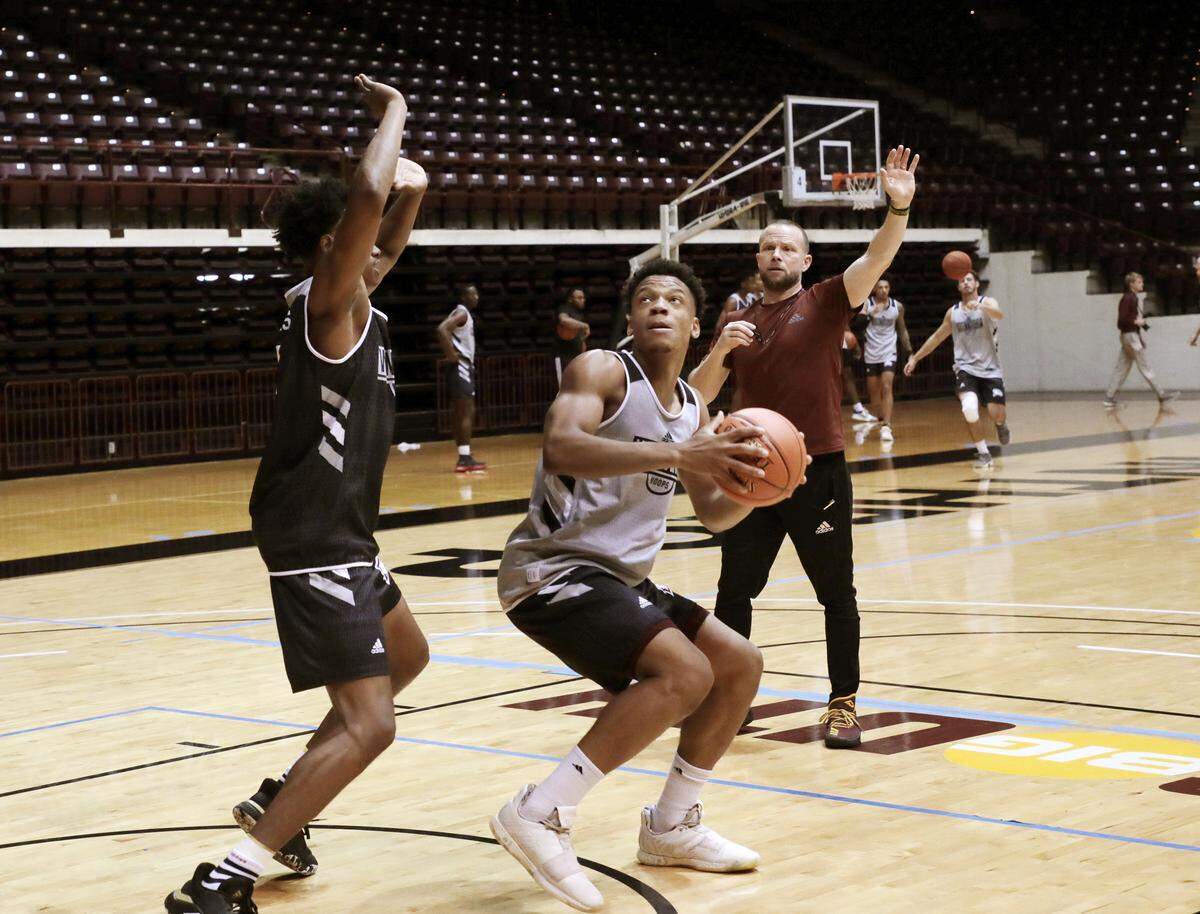
Micheal Anumba has emerged as a key player
Before a preseason practice, Winthrop’s Micheal Anumba said his confidence was a work in progress.
After all — despite his talkative exterior (he’s the team’s self-anointed “clown”) and starting every game of his freshman season in 2018-19 — Anumba, he said, struggled pinpointing his identity on the court when he first arrived to Rock Hill from London, where he previously played.
“I used to always be the main leader, the main scorer, stuff like that,” Anumba said. “And coming here and not having that and having to get used to not having the ball in my hands every single time, just play behind other people offensively, it just kind of (hurt) my confidence. But at the same time, I learned how to play my role.”
To be clear, Anumba was among the best players in the country at his age as a player in England. The 6-4, 220-pound guard, who was born in Italy, was used to having the ball in his hands every possession. All of a sudden, as the team’s sole freshmen who often started alongside four other seniors, he had to adjust.
Even back in the preseason, Anumba said this year’s newcomers — including Adonis Arms, who has to sit out a year due to a transfer — helped infuse confidence in him.
“From Adonis, he always shares some thoughts with me,” Anumba said. “Adonis and Hunter are very good leaders. They always try to explain stuff. Adonis (told me) to have more confidence. Or even, like Jamal and other freshmen, they tell me to play with more confidence. ‘Believe in yourself. You’re a good player.’ Stuff like that.”
This season, Anumba has emerged as a critical component of his team, even if his offensive averages aren’t eye-popping: In 15 games played, he’s averaging 6.9 points and 3.7 rebounds a game.
But his presence has been undeniable. Winthrop’s head-scratching loss to Tennessee Tech early in the season was the only game Anumba missed, after having to be helped off the court after a hard fall against Mid-Atlantic Christian the game before.
In the games he’s been active, he’s been tasked with defending the opposing team’s best player. Anumba — who normally plays off the ball but has recently been asked to take up some point guard responsibilities since Russell Jones’ injury — said he’s grown comfortable in his role.
“I feel like I’ve embraced my role, especially as a defensive leader,” Anumba said. “As long as it helps my team reach a victory at the end, I’m happy to do whatever coach asks me to do — whether it’s waving a towel on the bench, or coming on the court and locking up their best player.”
Vaudrin and Hale: DII additions proving helpful
In Winthrop’s Big South opener against Longwood, two players fielded postgame interview questions.
One was Chandler Vaudrin, the team’s 6-7, 210-pound junior starting point guard. He’d just notched his first triple-double as an Eagle. Two years earlier, he’d led the country in triple-doubles at Walsh, a Division II school, before transferring to play at Winthrop.
The other was Hunter Hale, the team’s 6-foot-3, 185-pound graduate transfer from Grand Valley State, also a DII program. He’d just put together a career-high 29 points.
“Oh, is that how it works?” Hale responded after he was asked about his career high, his smile hinting that he was used to scoring this much at GVSU.
Vaudrin and Hale, despite both playing Division I basketball for the first time this season, have ostensibly had different experiences.
Vaudrin, after all, was on the Winthrop bench all of last year, practicing with the team. He’s been steady all year. He’s leading the team in minutes played; despite only shooting 29 threes on the year, he’s second on the team in 3-point shooting percentage at 45 percent, behind Anumba’s 52 percent; and perhaps most importantly, he’s a calming influence when the ball is in his hands, an important characteristic for a point guard.
Hale has started to be more consistent down the stretch. He’s always been able to hit the big shots — including hitting some late threes against Fresno State, nationally-ranked Saint Mary’s and Tennessee Tech — but now he’s hitting more of them. Since conference play began at the turn of the new decade, Hale is shooting 41 percent from three and is averaging 17 points, which is well over his season average.
Kelsey, after the game against Longwood, said that he expected Hale and Vaudrin to produce for him, regardless of where they played college basketball previously.
“I have an unbelievable respect for the high level at the DII level of basketball,” Kelsey said. He recalled that when he was at Xavier, he’d play pick-up ball with some players from then-DII Northern Kentucky over some college summers, and that they were “just as good” as he and his teammates.
“I just know that those efficiency numbers that both of them (Vaudrin and Hale) had at the DII level, at a high level at DII, translate,” Kelsey said.
Missing Russell Jones
It’s tough to talk about the Eagles without addressing the status of Russell Jones — the team’s 5-foot-8, 175-pound freshman point guard from Westwood High School.
For a stretch at the beginning of the season, he looked to be the Eagles’ most valuable player. He was the engine to the Eagles’ fast pace and was the player the team looked to when it needed a spark. Take, for example, Winthrop’s early loss to Tennessee Tech, where he ignited a 10-plus point run late in the game with a few steals and threes; or consider his play against Elon, the only game he’s played more than four minutes since November.
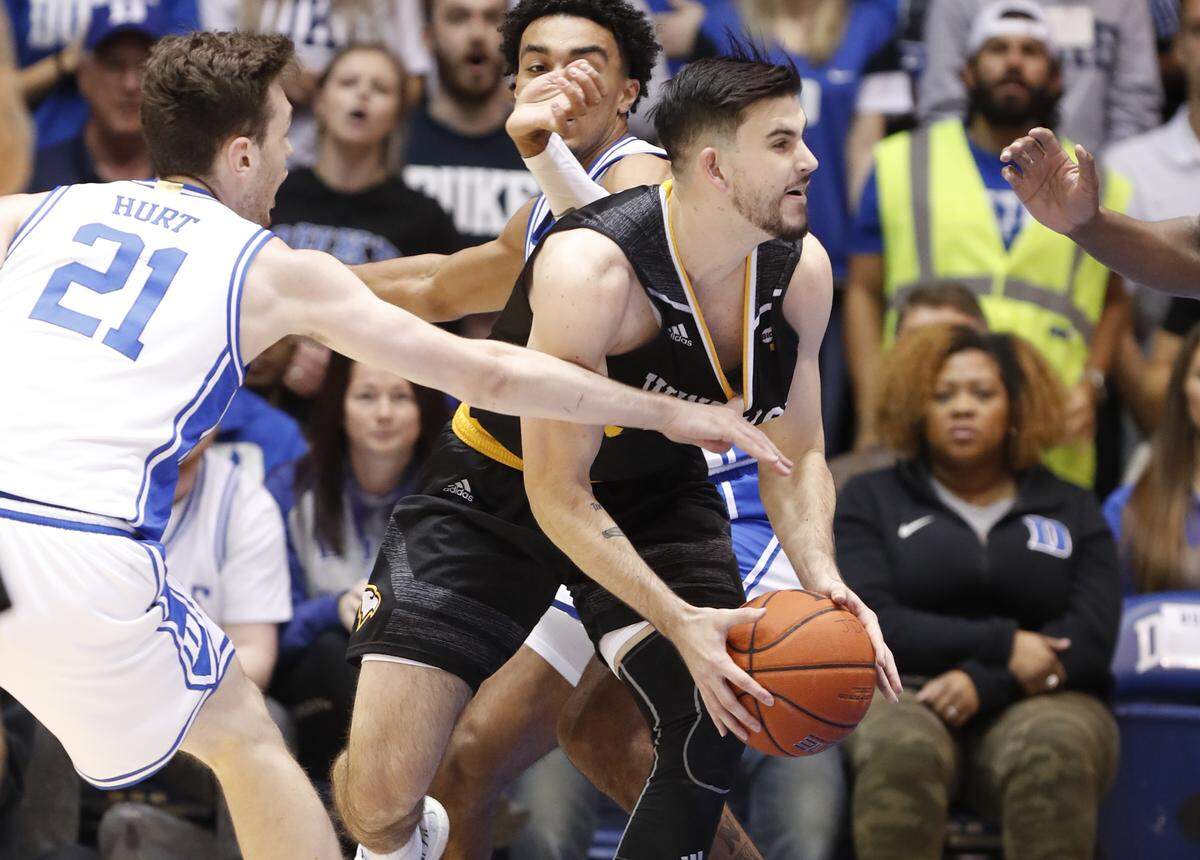
But an injury — the one he suffered after getting his right ankle stomped on in the final two minutes against Duke on Nov. 29 — has certainly changed his season’s prospects. It’s the first injury of his basketball-playing career, he said.
Jones has been on his rehabilitation grind — plowing away on the elliptical, running through calisthenics and putting up shots once the gym has cleared out — instead of practicing with the team.
Although it’s not clear when he’ll return, when he does, he’ll be joining a group of players that have proven that they’re as good as the back of their bubble gum card says they are.
And that begs a final question: How much better can this team be?
Gardner-Webb at Winthrop
When: 7 p.m. Saturday
Where: Winthrop Coliseum, Rock Hill
Watch: ESPN+
This story was originally published January 10, 2020 at 2:02 PM.
.jpeg)