
After 45 years, Fort Mill coach and 5-time state champion ready to ‘pass the torch on’
His right hand weighed down by a gold-banded state championship ring, Willie Ware Jr. clutches a fence around the Fort Mill High School tennis courts on Saturday afternoon and looks out in front of him.
On one fence wall, there’s a large windscreen that reads “FORT MILL” in yellow block lettering. And on an adjacent wall, there’s a sign cinched with zipties that spells out all five of the state championship years (1994-98) and all 18 of the region title years that came on Ware’s watch.
Ware’s coaching career didn’t start on these courts, but nonetheless, they’re home. Technically, his 45-year run as Fort Mill boys’ tennis coach began at the old school building on Banks Street in 1975. At that time, the Fort Mill School District was so small that the only high school’s classrooms and the district offices were under the same roof — and the school’s campus was so small that it only fit four courts on it: two in front of the school building, and two behind it.
“This particular set of courts wasn’t the beginning of my career,” Ware says, his gray mustache framing a friendly smile. He then shakes his head in disbelief. “But this particular one brings back a lot of memories.”
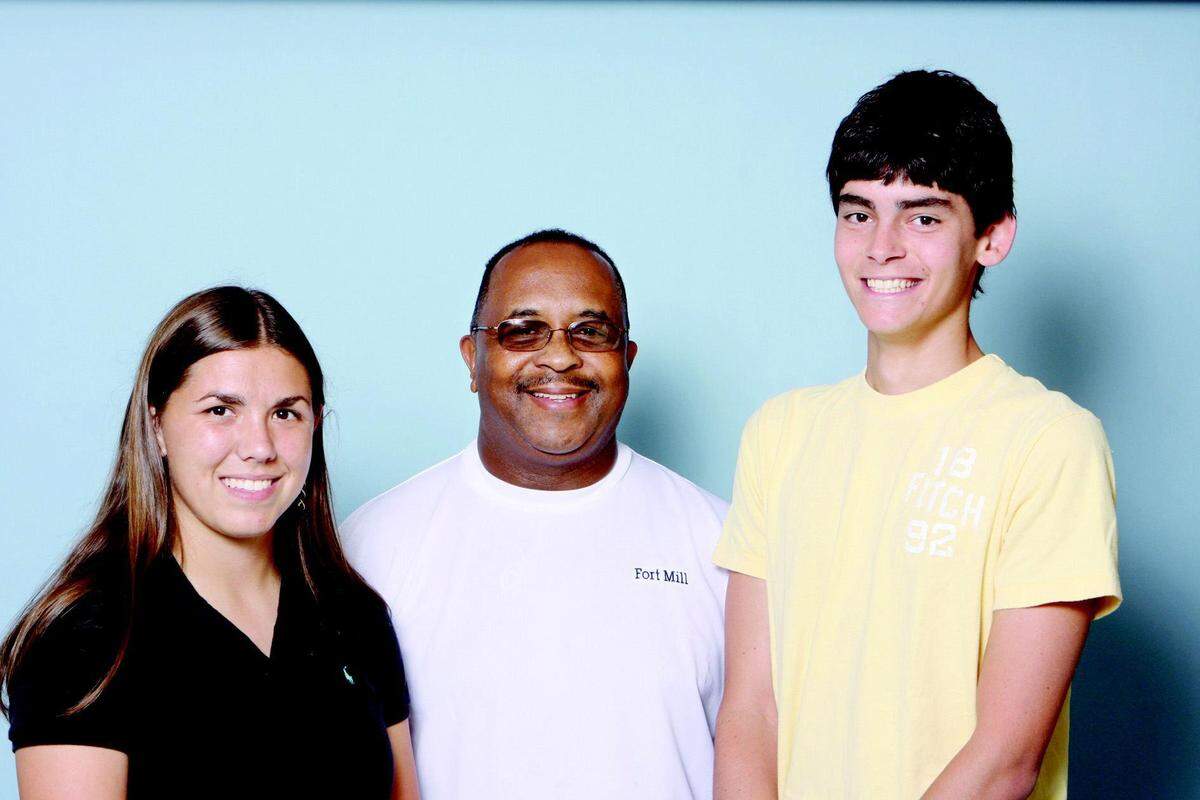
Earlier this month, Ware, 73, retired as Fort Mill High School’s tennis coach for good. And by virtue of what he did, who he is, and how long he’s done it, his legacy won’t soon be forgotten: The soft-spoken leader left as a 2013 York County Sports Hall of Fame inductee, a three-time coach of the South Carolina North-South All-Star game and a former president of the S.C. Tennis Coaches Association.
He was also one of the first persons of color hired by the Fort Mill School District, undoubtedly paving the way for generations of Black educators and high school coaches in York County.
“I’ve been toying with it for a long time, when would be a good time to give it up,” Ware told The Herald. “But the camaraderie with the kids kept me in it over these last 10 years, because I retired from the school district in 2010, and I’ve just been coaching since.
“So I feel like it’s time to pass the torch on.”
From Emmett Scott to Fort Mill
Ware was “born and bred” in Rock Hill. He was a self-proclaimed country kid who played in the band at now long-closed Emmett Scott High School, the only school Black students could attend in Rock Hill during segregation.
He then went to Friendship Junior College in Rock Hill before attending the private historically Black college, Claflin University, in Orangeburg, where he majored in math and minored in science.
After college he went to work for a footwear company for two years, he said, and then scored a job with Fort Mill schools in July 1972 after a friend referred him. In September of 1972, he picked up a part-time job at department store company SEARS, in addition to his teaching job, and then three years later, in 1975, he started coaching.
Yes, for decades Ware had three occupations: teaching (teleproduction, algebra, applied math, others), coaching (tennis and even soccer for three years) and SEARS. And he still found time to regularly volunteer at his church.
“He worked multiple jobs, made time for all of us, and made us all better people,” John Boetsch, who played for Ware before graduating in 2000, told The Herald.
Boetsch was first invited to come out and practice with the Fort Mill team when he was in the fifth grade, he said, and would go on to play college tennis at Clemson. He later served as the head coach of the Tigers, where he’d occasionally get visits from Ware.
“He always had a knack for keeping up with us,” Boetsch said. “At different times, he’d reach out, or I’d reach out. Even when I was coaching at Clemson, he would show up at matches from time to time, and I think that just says so much about his character. It was more than just a coaching job. It was something where he took a genuine interest, honestly, in all our lives.”
One player, Pat Barnett, ended up coaching alongside Ware after he graduated. Barnett said at first he asked Ware if he could hit with the team to take advantage of a flexible work schedule and stay in shape. But the pastime slowly turned into an assistant coaching role, one he’s been in for about six or seven years now, he said.
Said Barnett on his old coach: “He’s like kinda quiet, but confident. Tough. Sort of quiet until he needed to say something, and then when he did, it meant something… A leader. He’s the best man I’ve ever met, I’ll say that.”
Ware blazes a trail in Fort Mill
Ware could be viewed as someone who opened doors. But Ware himself said he’s lucky to have landed at Fort Mill for all these years, and he said that he’s fortunate to have had some “good people come along behind” him who helped support him.
Among those people was the late Bennie Bennett — the first 1,000-point scorer in Winthrop basketball history and a Black coach who joined Ware at Fort Mill when he became the Yellow Jackets’ basketball coach in the mid-80s.
“People like him were the ones who kind of kept me in line, as far as, you know, ‘You got to be a role model for people who are coming behind you,’” Ware said. “And hopefully I’ve been that model who helped other people.”
By all indications, he was that model — and as Fort Mill grew from the small town it was in 1975 into one of the fastest growing regions of the Southeast it is today, perhaps his story and his impact spread further.
But at home, he’s still remembered as the friendly, universally known “Coach Ware”: the coach who ran into convenience stores before big matches to buy Tums, those candied antacids, to keep his butterflies in check during big matches; the coach who remembers the 1995 state championship win, and how his players rushed over the fences like water down a hill to celebrate on the court; the colleague who, despite being at his station for decades and winning a handful of championships, was receptive and warm to everyone he met.
“I wasn’t a young guy, but still, coming into a school where a guy had won five state championships, and I’m sort of over him as athletic director,” Fort Mill athletic director Dwayne Hartsoe said when he took the job at Fort Mill 10 years ago. “My first impression was just his humbleness.”
.jpg "Willie Ware Fort Mill 3 (1).jpg")
Life after Fort Mill tennis
What’s next for Ware, the man who’s lived the same life for nearly half a century?
“Just enjoyment,” Ware said, chuckling at what all that could mean. He said he wants to travel — “I don’t want to venture out of the U.S. very much, but I’d love to see some other places” — and he’d love to spend more time with his wife, Patricia, and his grandchildren, who live in Greensboro. He’ll still sell tickets at the Fort Mill football games and volunteer at his church.
But his focus is on reaping all he’s sowed.
“Matter of fact, my father, when he retired, he got sick,” Ware said. “And it wasn’t too long after that, a year or so, he died. He never really got a chance to enjoy his retirement, so I’m hoping that, even at my age, hopefully I’m still healthy enough that I could enjoy some of those things.”
He then used a phrase reserved only for those secure and at peace with their legacies: “It’s one of those things,” he said, “where I feel like it’s time.”
This story was originally published November 24, 2020 at 8:00 AM.
.jpeg)