Big changes at the top, and all around Levine Museum as it leans into a new era
READ MORE
Charlotte Observer Fall Arts Guide 2022
Returning favorites and big new shows and events are on tap this season for local arts and culture organizations. Meanwhile, several major groups find themselves at a crossroads now. We have it all covered for you.
Expand All
Before the Levine Museum of the New South opened its doors on 7th Street in 1996, it staged pop-up exhibitions in uptown bank lobbies. The mini exhibitions were referred to as a “museum without walls.”
Nearly 30 years later, the museum is returning to those roots.
Earlier this year, the Levine Museum sold its uptown Charlotte building for $10.75 million to a New York-based development firm, which has plans for an apartment building. The sale helped fund Levine’s transition from a traditional museum with a permanent physical location to one that relies heavily on digital programming.
“People aren’t coming to museums in the way they used to,” said Kathryn Hill, the museum’s soon-to-retire president and CEO. “We need to go to them.”
So, the Levine is becoming a “digital-first museum.” But that doesn’t mean “digital only.”
“The Levine Museum isn’t going anywhere,” Hill said. “It’s going everywhere. Our evolution builds on a legacy of inclusion, innovation, connectedness and service to the community. This is the next logical step.”
For now, the museum is in two places. The public space is at Three Wells Fargo on 401 South Tryon St. in the heart of Levine Center for the Arts. The 6,000-square-foot former Wells Fargo Museum also is big enough to host school groups.
“It’s in close proximity to many of our sister institutions,” Hill said. “It’s a much smaller space and flexible, which is appropriate for us now as we experiment with new ways to develop and design exhibits. It will be a fluid space, changing all the time.”
For the first three years of the museum’s occupancy, Wells Fargo isn’t charging rent.
The museum’s other space — just over 3,200 square feet — is in the Visual and Performing Arts (VAPA) Center on North Tryon Street. That’s where the staff of 17 (there are currently four open positions) is based.
The Levine’s next project is presented in partnership with the Harvey B. Gantt Center for African-American Arts + Culture. It’s the Smithsonian Institution’s “Men of Change: Power. Triumph. Truth,” and runs from Oct. 8 to March 12, 2023.
The exhibition profiles Black men who have helped propel the country and culture forward, including Muhammad Ali, James Baldwin, Ta-Nehisi Coates and Kendrick Lamar. Twenty-five contemporary artists were invited to create their own works in celebration of these pioneers.
There are seven themes with the show. The Levine will display “Catalysts”, “Myth-Breakers” and “Community” while the Gantt will display “Storytellers”, “Fathering” and “Imagining”. Both museums will display “Loving”.
Downsizing the collection
As with any move, you discover items you’d forgotten you had. That applies to the Levine too.
“We found an amazing cauldron that had been used by enslaved people outside Charlotte city limits,” Hill said. “But, because our purview is 1865 forward, that was an object we didn’t feel we were the best stewards of. Now it’s in the hands of the (soon-to-open) International African American Museum in Charleston.”
Some objects have gone to the Charlotte History Museum, and some to other regional museums. “Cotton Fields to Skyscrapers,” the Levine’s flagship exhibition, has been preserved digitally. Most of the objects from that exhibit were on long-term loan and have been returned.
The Levine was founded as a non-collecting museum.
“We were only going to collect what we thought we would exhibit,” Hill said. “But museum people are hoarders. We collect stuff; we can’t help it.
“Charlotte doesn’t have a central repository for material culture, and the Levine Museum has kind of become that de facto,” she added.
“During this move, we brought in a guest registrar who worked with staff and interns to make sure we knew what we had, to return objects that were on long-term loan and to make sure we were deaccessioning things we should not have,” Hill said.
Diving into digital tech
In its new space, the Levine will continue experimenting with digital technology.
It’s also at work on the next iteration of the walking tour of the former Brooklyn neighborhood — a civil rights tour of uptown. That app-based tour, launching in early 2023, will take visitors to some of the seminal places where Charlotte’s civil rights struggle happened.
“With our Brooklyn walking tour, the technology... combines oral history, narrative, spoken word poetry, photography and augmented reality,” Hill said.
“There are seven places where you stand on the street, and (through augmented reality) you can see, for instance, the Alexander Funeral Home, the Savoy Theatre or the Brevard Street Library,” she said. “And you understand why the Savoy was such an important part of that community. It was an air-conditioned space where Black people could sit wherever they wanted in the Jim Crow South.
“It takes you to that place in a way you can’t do within the walls.”
The museum also is working with a UNC Charlotte professor who’s studying climate change refugees in Charlotte, Hill said. An exhibit the professor and her students are working on will travel around the state, but only after it debuts at the Levine.
COVID pushed the museum more quickly in this new direction.
“We realized that, through digital technologies, we could reach thousands of people across the country instead of hundreds in Charlotte,” Hill said.
The Levine is hardly alone in embracing technology.
“A lot of museums are experimenting with digital,” Hill said. “But so many museums are saddled with their facilities and often with really large collections, which we didn’t have.”
Examining the hard things
The Levine has never sugarcoated anything. Exhibits have mined painful episodes in Charlotte’s past. And present.
“In 2016, shortly after I came here, Keith Lamont Scott was shot (and killed by a CMPD officer), and the city erupted,” Hill said. The museum responded with a “rapid-response community exhibit” that was pulled together in just six weeks.
“ ‘K(NO)W Justice K(NO)W Peace,’ (the resulting exhibit), was a watershed moment,”Hill said. “When the Charlotte uprising was happening, civic leaders came to me and said: ‘What are you going to do with this? We need you to do something.’ That’s not a question museums get asked.
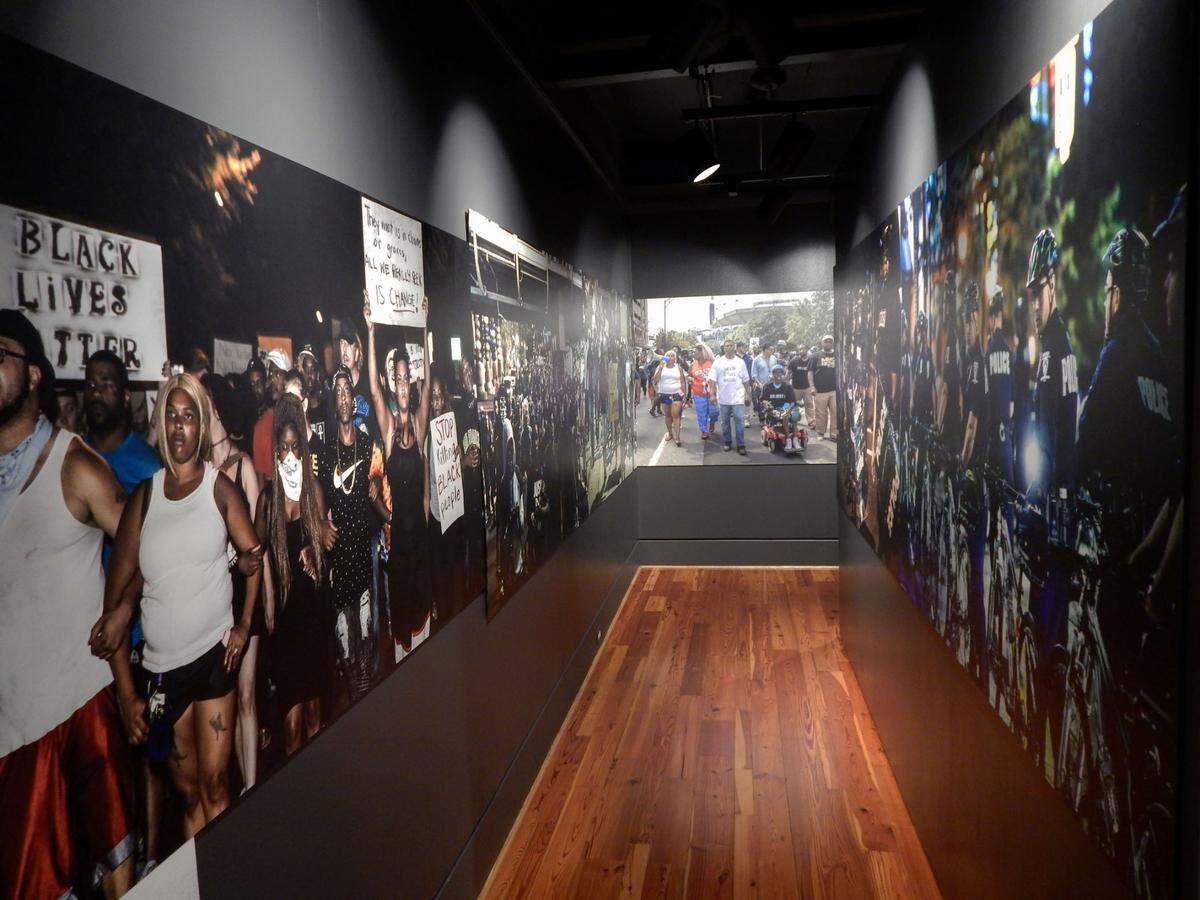
“We held a town hall, and the room was packed,” she said. “The discussion was anguished, authentic, important and insufficient. We looked at this event in the context of history because people were saying: ‘This isn’t like Charlotte.’ Well, when you look at housing segregation, school segregation and criminal justice, yes, it is Charlotte.
“It was a hard, painful project and ultimately, so rewarding, because many people in the community felt like it told their story,” Hill said.
“It wasn’t a diatribe,” she added. “We didn’t have an agenda except to help people understand.”
What’s next?
Hill wrote in her farewell: “As the museum explores ways to tell stories through new technologies… it feels right to make way for younger, more digitally savvy leaders who can create a cultural organization for, by and with the communities we serve.”
The board has formed a search committee and solicited proposals from search firms. Hill anticipates the search will officially begin this month. Her last day, still to be determined, will be by the end of the year.
Her near-term plans include a trip to Asia, where one of her sons lives and another is about to move. She also intends to continue her work with the county on shaping Latta Place’s future.
And the work of the museum goes on. Hill said the Levine will continue asking: “How did we get here?”
“If we don’t understand that,” she said, “we can’t have an informed conversation about what we should be doing.”
More arts coverage
Want to see more stories like this? Sign up here for our free “Inside Charlotte Arts” newsletter: charlotteobserver.com/newsletters. You can also join our Facebook group, “Inside Charlotte Arts,” by going here: facebook.com/groups/insidecharlottearts.
This story was originally published September 7, 2022 at 6:00 AM with the headline "Big changes at the top, and all around Levine Museum as it leans into a new era."