Fixing Rock Hill’s busiest interchange will cost $106M. Who pays for upgrades?
After millions of federal and state dollars were rerouted north to Fort Mill, local and state road planners finally have a way forward to fix the Interstate 77 interchange at Exit 82 in Rock Hill. It’ll cost $106 million, including $11 million in new money from York County.
The new cost estimate comes from the South Carolina Department of Transportation, one of several groups that laid out a proposed funding plan Friday to the Rock Hill-Fort Mill Area Transportation Study policy committee.
Despite being a top priority for traffic planners for more than a decade, the Rock Hill interchange at Cherry and Celanese roads has had to wait its turn.
York County asked for money from the South Carolina Transportation Infrastructure Bank multiple times since 2015, to improve its interchanges. A new bridge across the Catawba River to help with traffic at Celanese was studied, then nixed, in 2017.
Inflation that ballooned the Exit 85 upgrade under construction between Baxter and Kingsley in Fort Mill to $147 million is that latest variable to slow work at Exit 82. The Fort Mill project siphoned money from the Rock Hill-Fort Mill Area Transportation Study, the group that pledged nearly $73 million in federal money to Exit 82.
“It’s just not available (yet),” said transportation study Administrator David Hooper, “because of the debt service we went into on Exit 85.”
Who will pay for Exit 82 upgrades?
New ramps and lanes are under design for the Rock Hill interchange. By the time the state transportation department finishes design and buys the right-of-way, it’ll probably be 2028 at the earliest before construction starts, said Pennies for Progress Program Manager Patrick Hamilton.
That construction depends on funding.
Due to high costs at Exit 85 in Fort Mill, Hooper’s transportation group will be in debt service until 2031. An estimated $7.5 million in federal money will arrive the following year, with $13.7 million and $26.8 million arriving the following two years, respectively.
Those numbers could change due to a federal census in 2030 that could redistribute funds based on population changes. The upcoming census could change what urbanized areas are eligible for that funding.
Today, Hooper’s group serves Rock Hill, Fort Mill, Tega Cay, Lake Wylie, Indian Land and the Catawba Nation.
Rather than wait, York County continues to look at other funding options. The county applied for money from the state infrastructure bank in 2019 to get started on Exit 82. The infrastructure bank helps fund large public transportation projects across South Carolina.
In 2020, the bank approved nearly $75 million for Exits 82 and 85. Exit 82 would get $32.5 million from the bank and $5.7 million in required matching funds from York County.
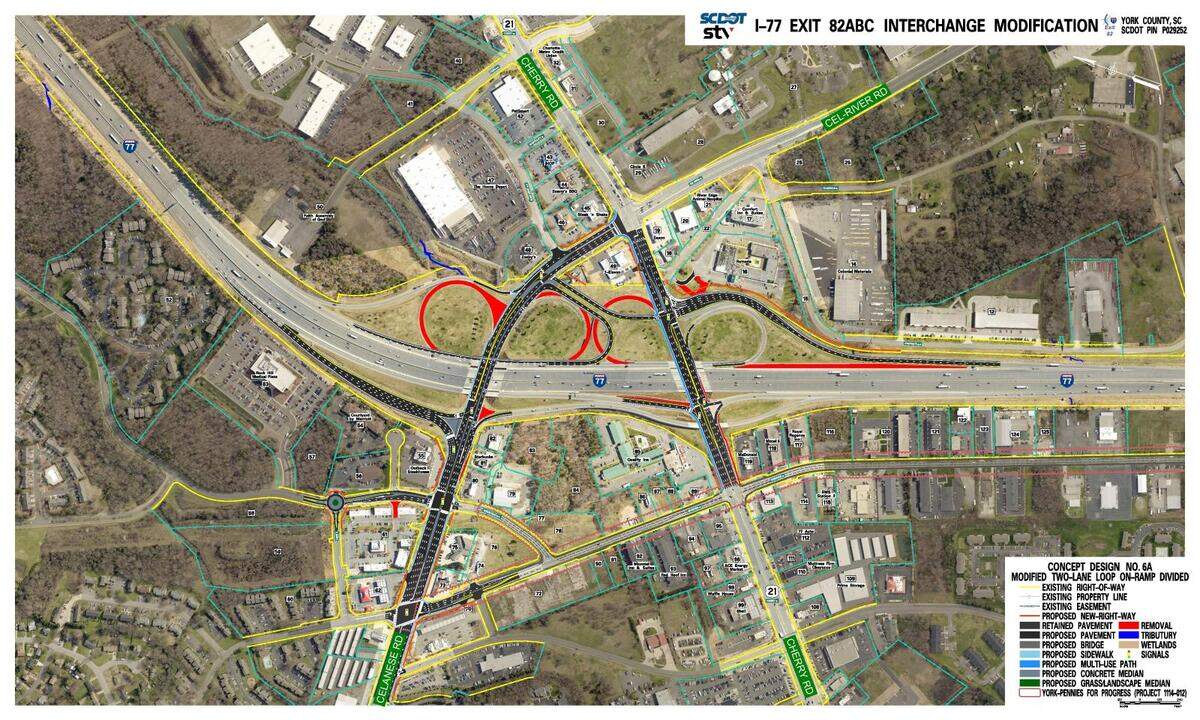
With the federal money tied to Exit 85 and the state transportation department projecting a $106 million price tag for Exit 82, officials needed a new plan. York County, with the state transportation department at its side, has been in negotiation with the infrastructure bank to increase funding.
Hooper’s policy committee approved a resolution Friday that would keep the initial county, federal and infrastructure bank funding. It adds $30 million from the bank, $11 million from the county and $21 million from the transportation department for bridge deck repair on the interstate.
“If you’re going to inconvenience the public, you might as well do it one time and not twice,” said state Secretary of Transportation Justin Powell.
Projects like interchange upgrades require what federal mandates call a reasonable availability of funding. The money doesn’t have to be in hand, but there has to be a reasonable plan to have it in place once it’s time for construction.
The $106 million plan presented for the first time Friday is a critical step in advancing work at Exit 82.
“That will be able to get us to sign term sheets between DOT, York County and the (infrastructure) bank to really go forward,” Powell said.
What if costs run high again?
Friday’s resolution is key in negotiating with the infrastructure bank, said York County Manager Josh Edwards, but there is a limit. In talks with York County Council, the additional $11 million from the county is it.
“This is as much as they’re willing to commit to this project,” Edwards said.
If the job exceeds $106 million, federal money will have to make up the difference for interchange costs once Hooper’s group is out of debt on the Fort Mill project. If prices run high on the I-77 bridge deck work, the state transportation department will pay for it.
Exit 85 was a wake-up call for how the transportation department and infrastructure bank work together, Powell said. It was one of several large projects statewide that were approved in 2020-21, right before the construction costs increased 30%-70% in 2022 and 2023, he said.
Part of the reason Exit 85 nearly tripled in cost from its earliest projections is an increased scope of the project.
Thoughts of a diverging diamond like the Gold Hill Road interchange morphed into a directional interchange to meet traffic demand. Still, at one point, cost estimates increased three times within eight months.
“We’ve got the bulk of the money to start the project now,” Hooper said. “Hopefully we won’t see a cost increase.”