Proposed Lancaster County park envisioned to be a regional attraction. What we know now
Lancaster County is putting the pieces in place to create a long-awaited regional sports complex.
By mid-2022 the county could issue hospitality tax bonds for construction. Impact fee revenue would filter in by then too. Steve Willis, Lancaster County administrator, outlined options Monday night for Lancaster County Council that include a 20-year bond with payments at about $1 million per year.
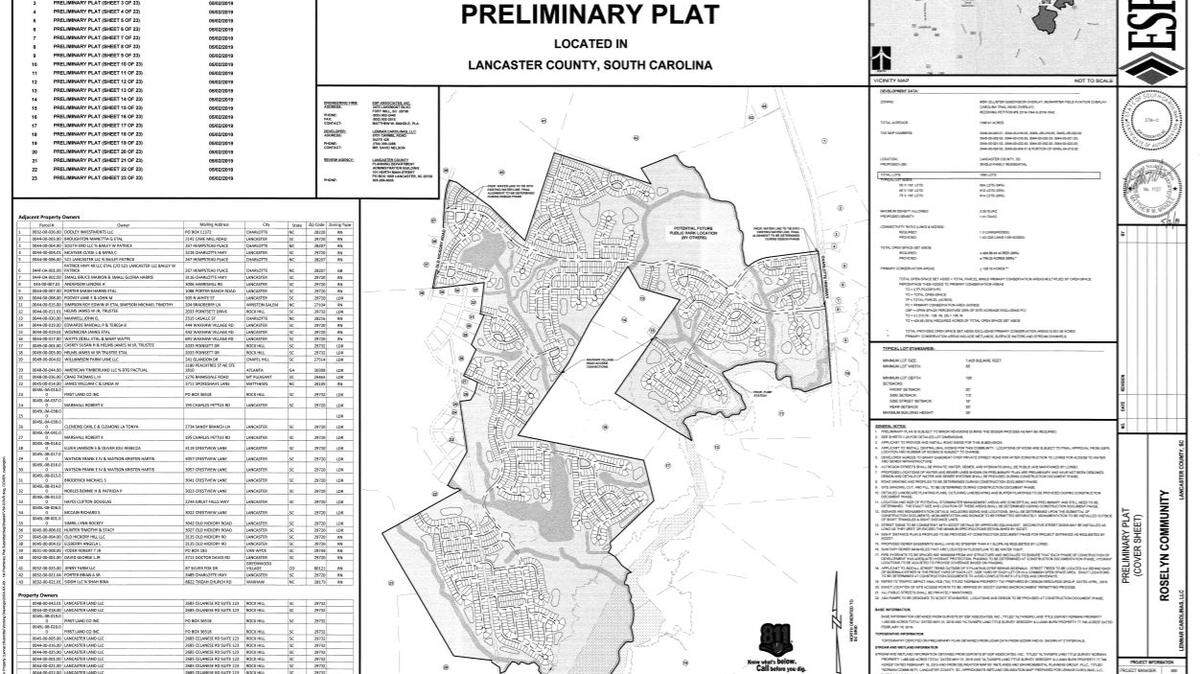
The regional sports park would be part of the Roselyn development.
In 2019 Lennar Carolinas got approval for Roselyn, more than 1,800 homes on almost 1,400 acres between U.S. 521, near North Corner Road, and Old Hickory Road. About 80 acres abutting the property was identified as a possible site for a future regional park.
Typically large area complexes -- such as Cherry Park in Rock Hill or Field Day Park in Lake Wylie or Dobys Bridge Park, and the planned Banks Athletic Park in Fort Mill -- serve area recreation programs during the week. Then they’ll focus heavily on regional tournament play on weekends. That model is particularly appealing for parks funded by hospitality tax dollars, as outside teams bring in large groups likely to eat at area restaurants.
The county has waited for hospitality tax collections, which would give council an idea what to expect from that revenue stream. Hospitality tax is a charge on prepared food and drink, in this case charged in unincorporated parts of Lancaster County. Indian Land is an unincorporated area.
About the time that revenue stream was established, COVID-19 hit and plans paused.
Sources of revenue
The county brings in about $1.5 million annually in hospitality tax. County projections put that number at about $3 million annually by 2030. A growing restaurant base in Indian Land should continue to grow revenue. At the roughly $1 million annual principal-plus-interest payment for a bond, money would remain for operations or other uses.
The county has about $5 million available in fund balance. The bonds would provide about $15.4 million for the park. Then, there’s a new revenue source that begins collection Oct. 1.
“Impact fees could be applied to this project,” Willis said.
The county recently approved development impact fees, or charges on new construction that will go to various infrastructure costs. Yet like the hospitality tax years ago, there isn’t a scouting report on what impact fees will generate.
“We have no track record,” Willis said.
Kim Belk, interim deputy county administrator, presented the possible financial path alongside Willis on Monday night. Willis said the park was envisioned during the study that helped create impact fees. A projection from the study forecast more than $11 million in planned revenue in the coming decade.
There wasn’t another park, or land for one, in the Lancaster County panhandle factored into the impact fee study projection.
“This was supposed to be the source of that revenue,” Belk said.
Much is still unknown
Councilman Brian Carnes, who represents Indian Land, added it may take a couple years to see the full flow of impact fees. They are charged when building permits are granted.
“The developers that have just got approved, they’ve got to go out there and clear the ground and do all that before they start building houses and selling houses,” Carnes said. “It’s not going to start coming in right away.”
Still, there’s reason to believe impact fee revenue will be significant. Money for recreation projects comes from new home construction. And people are steadily moving to this section of Lancaster County.
At a regional transportation meeting Friday, Carnes said he could lose half his constituent base because of redistricting. Most recent 2020 U.S. Census figures will add representation for Indian Land, which could mean creating two districts where there now is one. Carne’s area was the fastest growing state legislative district in the past decade, he said.
If Indian Land were incorporated into a city, it would be the eighth largest in South Carolina, Carnes said. Census data puts Indian Land at more than 40,000 residents, with one of the highest residential growth rates in the region. The Lancaster County panhandle sits just south of the North Carolina line, in the fast-growing Charlotte and Ballantyne regions.
The other track record Lancaster County doesn’t have is one for how much revenue a new sports park might generate. Details on what it might include or how it might be used weren’t presented.
Council chairman Steve Harper said Monday night it’s a bit of a guessing game what type of revenue a regional park might create, but there are similar facilities that might provide the county rough numbers of what to expect.
“We know these parks are going to require a lot of employees,” he said, “but I think they will generate a lot of revenue too.”
April 2022, six months into impact fee collections, is an estimate for when the county could decide whether to move forward with the current or a different proposal for the park.