Lancaster County’s explosive growth expands beyond Indian Land. Here’s what comes next
For someone new to Indian Land, it would be hard to imagine the same community back in 2000. That’s before the freight train of population growth rolled in and turned a rural outpost into one of South Carolina’s most inhabited places.
Now, the next surge of new Lancaster County residents is on the way. Only this time it’s coming faster and isn’t confined to the panhandle.
“Growth is everywhere,” said County Administrator Dennis Marstall.
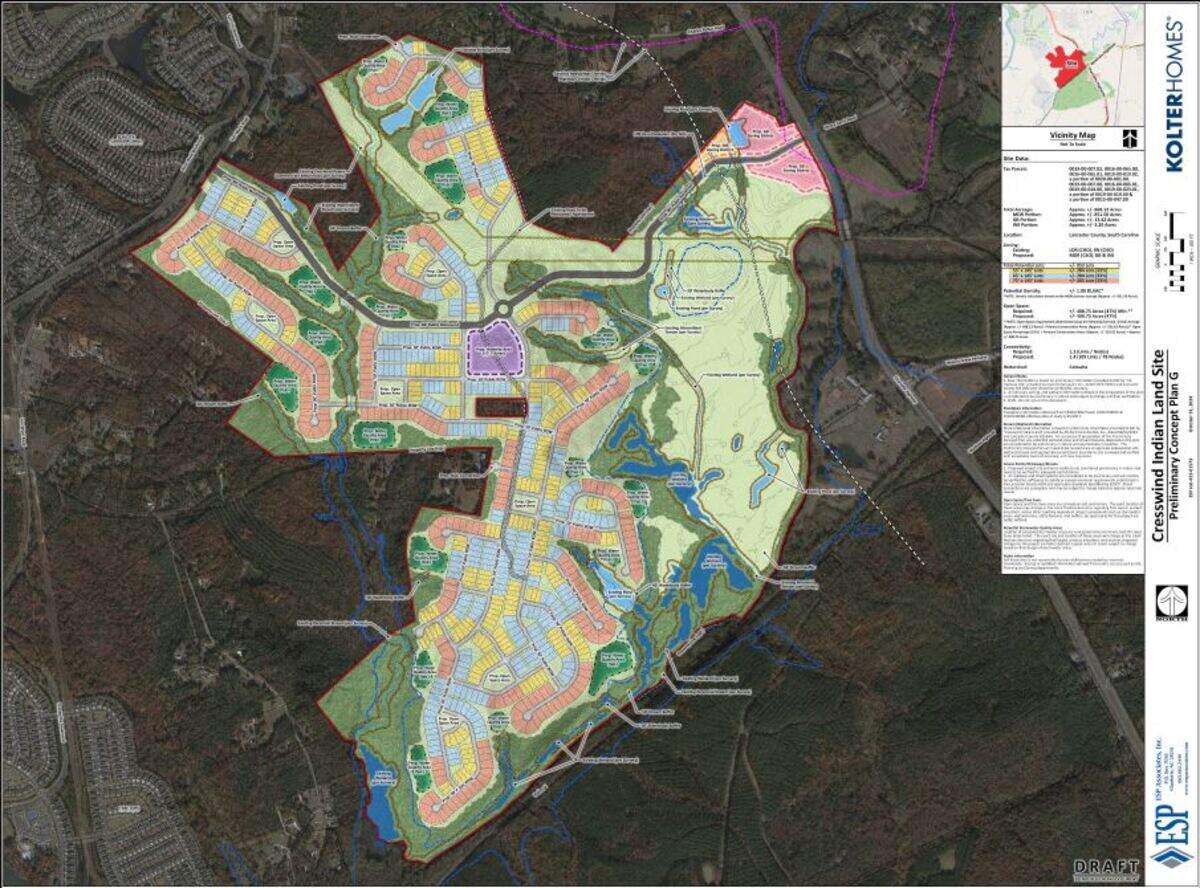
This month alone, the county planning commission faces decisions that could add more than 1,000 new homes. The largest project is the Cresswind neighborhood that would add 853 age-restricted homes, for seniors. It would go across Charlotte Highway from Walnut Creek.
Other communities are planning for thousands of homes they’ve already approved.
All that growth brings economic opportunity in places like Lancaster, but also challenges for roads, schools and public services countywide. The numbers are imposing, even for county and municipal planners.
“These folks are coming regardless,” said county Development Service Director Allison Hardin. “It just so happens South Carolina is a wonderful place to live, and the word is out.”
How big will Lancaster County get?
From 2000 to 2020, Lancaster County grew by 34,665 residents. That’s a nearly 57% increase. Now, the U.S. Census Bureau estimates the county grew by nearly 13% just from 2020 to 2023. That jump put the county at 108,215 people.
By 2035, the South Carolina Revenue and Fiscal Affairs Office estimates Lancaster County will have 128,294 residents. That’s up 32,278 people from 2020. So, that projection would have the county growing by about the same number of people in the 15 years after 2020 than in the 20 years before it.
“The growth in this 20-year period took up a lot of the land that was available for development,” Hardin said. “This (next wave) will take up even more, unless we take a step back and look at how we place density in the area.”
The county doesn’t intend to close the valve on growth, but people would keep coming even if the county did.
The county has about 190 residential or mixed-use, meaning business with residential, subdivisions. They combine for more than 29,000 home sites, but the properties they’re on would allow for more than 43,000 home sites.
Among those subdivisions already approved by the county, there are 26,484 lots that allow for a home but don’t yet have one built on them. The county already has roughly 45,000 housing units — homes and apartments, per the Census Bureau — on the ground today.
Indian Land population, community changes
In 2000, Indian Land was a vastly different place.
Massive communities like Sun City, Walnut Creek and Tree Tops didn’t exist. Indian Land’s one elementary school had 15 students per classroom. Its high school teams played in the state’s smallest classification, against similar-sized communities like Great Falls, Lewisville, Dixie and North Central.
U.S. 521 was a smooth, scenic drive from Lancaster to North Carolina. The ongoing development of Ballantyne just across the state line, though, foreshadowed some of what was to come.
Today, in its geography and growth potential, Indian Land is a city without limits.
If the panhandle were incorporated, it would be larger than Fort Mill. Only Rock Hill would be larger in the region. Some Indian Land residents put incorporation onto a ballot in 2018, but voters decisively turned it down.
Indian Land’s high school now competes in the state’s largest size classification against schools in Rock Hill and Fort Mill. A failed bond referendum last fall would’ve built a second high school in Indian Land. Most of the $588 million bond proposal was for Indian Land projects.
A drive along U.S. 521 is seldom smooth or scenic anymore. Of the $405 million transportation tax referendum vote last fall that narrowly failed, $150 million would’ve gone to widen U.S. 521 or nearby roads.
Growth brought challenges, but also additions that might have been unthinkable in 2000. Indian Land has a movie theater, restaurants and corporate headquarter sites. A new Target and then a new Costco are expected to open in Indian Land this year.
More than 60% of panhandle residents have moved there since 2010. Now when county planners interact with Indian Land, Hardin said, discussion tends toward what people want to see now that they’re here rather than what the area used to be.
“The people in the panhandle that lived there and grew up there are now outnumbered by the people that have moved in to that area,” she said.
Where will growth go next in Lancaster County?
The past 15 years, Lancaster County has ranked alongside York, Union (N.C) and Mecklenburg (N.C.) as the highest-growth counties in the Charlotte region. But Lancaster County growth is different.
“We’re the only county where the (majority of) growth has gone outside of the cities,” Hardin said.
The past two years, though, the city of Lancaster has had new subdivision requests for hundreds of homes at a time. Last fall, the city had three projects come in at a combined 1,500 homes.
“This (past) year we’ve probably annexed more (land) than we have in the last 25 to 30 years, so we’re excited about that,” said Mayor Pro Tem Jackie Harris. “We’re excited about some of the features that we’re going to have in our downtown.”
There are more large plans in unincorporated spots south of Indian Land, too.
They include three of the four largest subdivisions by approved but unbuilt homes. Edgewater, approved in 1999, has more than 15,000 home sites remaining. Roselyn has 1,850 and Riverchase has 737 sites.
While Indian Land has its proximity to Charlotte, Hardin said, Lancaster has rail service and is near Interstate 77. There’s opportunity for apartments above retail and higher-density options in the city. The southern, more rural part of the county has a gold mine, gravel pit and agricultural space for jobs.
“There is richness in every section of our county,” Hardin said, “and opportunities for growth in all of them.”
Growth creates public pressure
It’ll take a connected county, officials say, to tackle growth challenges that aren’t likely to stop soon.
The county sheriff’s office asked for four new deputies in Indian Land in this year’s budget, and the county will need to staff the $90 million detention center under construction. Marstall is ordering ambulances and looking at a new model for fire service.
Both the county and school district will hold public input meetings this spring, in part to determine why the bond referendum and transportation tax votes failed. New proposals could come to voters in tandem or separately.
The school board also will discuss impact fees this month, said board member Melvin Stroble, including whether to increase them from about $9,300 per new home or extend them outside of the Indian Land panhandle.
“All of that (non-panhandle growth) is going to impact future infrastructure for the Lancaster County School District,” Stroble said.
Part of Lancaster’s recent growth surge has been the availability of water and sewer service, said City Administrator Steven “Flip” Hutfles.
Other nearby communities in North Carolina have had capacity issues that led developers south. Lancaster has room for residential and industrial growth, but Hutfles said it would cost an estimated $150 million to double wastewater capacity to 15 million gallons per day.
The city doesn’t know how it would get that money if needed.
“That is going to be what is the main driver in the future,” Hutfles said. “It may be 20 or 25 years, but the way the growth is coming it could be sooner.”
Construction will start this spring on the Catawba Ridge Boulevard extension, Marstall said, to provide a second access to the massive Edgewater development. There’s county discussion on both a national and Lancaster County trend, Hardin said, where most housing tends to be affluent or subsidized.
“There’s not a lot of in between,” she said.
Even with so much growth spreading to other areas, there’s always Indian Land. It’s likely to remain the most densely populated part of the county, and a difficult place to manage since it takes countywide decisions to tackle issues there.
“Can we make our growth manageable in the higher-density areas with the same rules that we use in the lower-density areas?” Hardin said. “And if not, how can we adjust our rules to that they’re fair to each side?”
This story was originally published February 12, 2025 at 6:00 AM.