Fort Mill Schools releases air test results. But parents still uneasy about Silfab
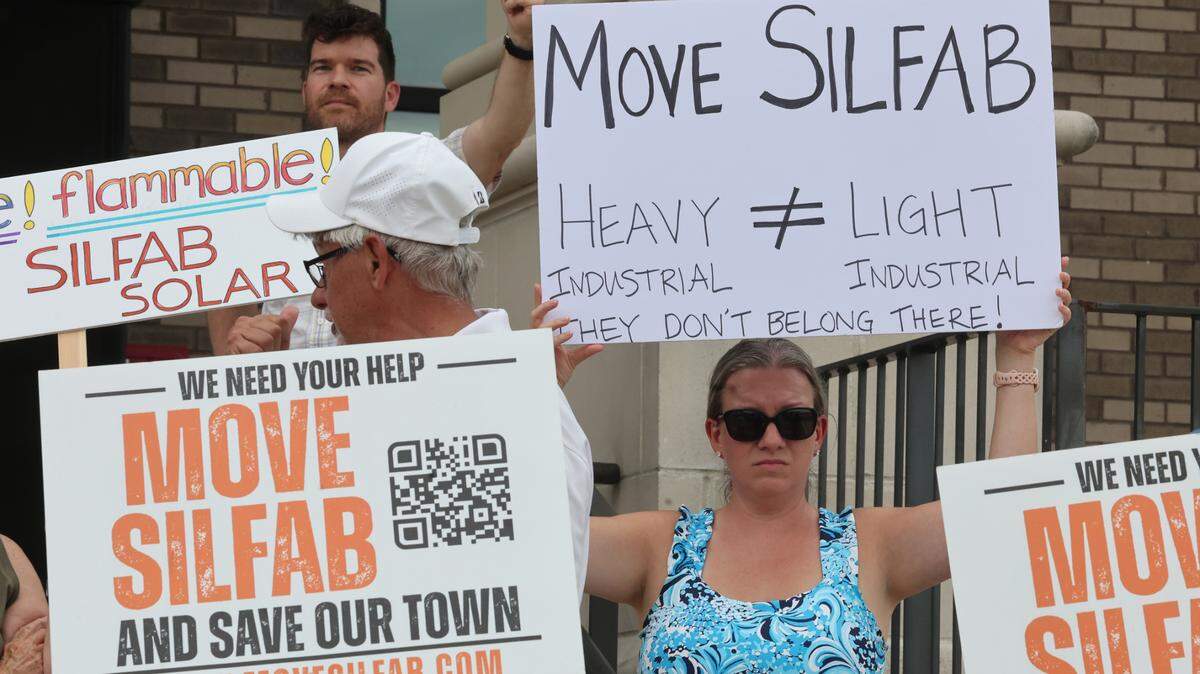
Tests found air inside two Fort Mill schools safe, with no sign of chemical hazards from the nearby Silfab Solar manufacturing plant. But parents still aren’t breathing easy.
At a Fort Mill School District community session Tuesday, environmental firm Citadel EHS reported that two rounds of sampling at Flint Hill Elementary and Middle schools detected only low levels of pollutants typical of new construction. Formaldehyde and several volatile organic compounds were present in small amounts, the firm said. Chemicals tied to solar-panel manufacturing, including silane, hydrofluoric acid, ammonia and hydrochloric acid were not detected.
“The monitoring confirmed the school’s air quality is safe and healthy for occupants, with no increased risk identified from the neighboring solar manufacturing facility,” industrial hygienist Adrian Olivares told attendees.
Citadel representatives outlined a continuing monitoring plan that includes quarterly indoor and outdoor testing and monitors around school property to provide real-time air-quality data. They also described a forthcoming joint emergency drill that includes the district, Silfab Solar and York County EMS as well as staff training on hazardous-gas incidents.
The consultants said sampling will continue as the plant begins full operations, allowing the district to compare baseline data to ongoing conditions.
The district hired Citadel earlier this year after pediatric health experts warned Fort Mill leaders to examine potential risks tied to the facility. As The Herald reported in April, the Southeast Pediatric Environmental Health Specialty Unit urged the district to commission an independent evaluation, citing children’s greater vulnerability to chemical exposure. The $150 million Silfab plant off Logistics Lane is still under construction amid ongoing zoning disputes and lawsuits.
A spokesperson for Silfab Solar said in a statement to The Herald on Wednesday that the company’s Fort Mill facility exceeds state and federal safety requirements and is equipped with multiple layers of protection. The spokesperson said Silfab has installed fail-safe systems, risk-mitigation processes and physical barriers designed to protect the community and employees.
The company said it was “pleased” to cooperate with Citadel EHS and the Fort Mill School District as they developed emergency plans for the two schools.
“Silfab Solar listens to community concerns and is committed to being a good community partner,” the statement said. “The safety of our employees and neighbors has always been a priority for Silfab, and we welcome future collaboration with the school board and with the Citadel team.”
Still, several parents expressed skepticism, saying testing alone doesn’t ease fears about the plant’s proximity to classrooms.
Parents still worried
At Tuesday’s school board meeting, held hours after the community session, residents accused the district of moving too slowly and communicating too little about the risks to students from the solar panel plant near schools. Several speakers said the district’s reassurances and air-testing plans have not rebuilt their trust.
Jared Muraco, a Fort Mill parent, said he was “furious” with the way the school board has handled the Silfab “crisis.” Muraco said he was disappointed the board scheduled the community session for 5 p.m. when it may be difficult for working parents to attend, and that the session was limited to just one hour.
He also accused the district of withholding air-sampling data until the meeting and said releasing intended testing dates publicly gave Silfab an unfair heads-up.
“You tell us you care about our children’s health and safety, but your actions tell a very different story,” Muraco said. “That’s not community engagement, that’s a box-checking exercise.”
Another speaker, Brandon Dunford, asked why the district hadn’t formally opposed zoning that allows heavy industrial operations beside schools and whether political considerations outweighed safety. He also said the district’s continuous air-quality monitors don’t detect silane or hydrogen fluoride. Instead, they’ll detect general pollutants such as particulates and volatile organic compounds, he said.
“The trust between this district and its families has been broken,” one Fort Mill resident, Frank Jurnak, said at the meeting. “We trusted that when a heavy industrial facility storing explosive and toxic chemicals began construction less than a mile from our schools, someone would speak up for our children’s safety… That trust has been shattered.”
This story was originally published October 23, 2025 at 5:00 AM.