
Rock Hill region water restrictions grow, as communities lay out drought rules
Editors note: This story was last updated May 8, 2026
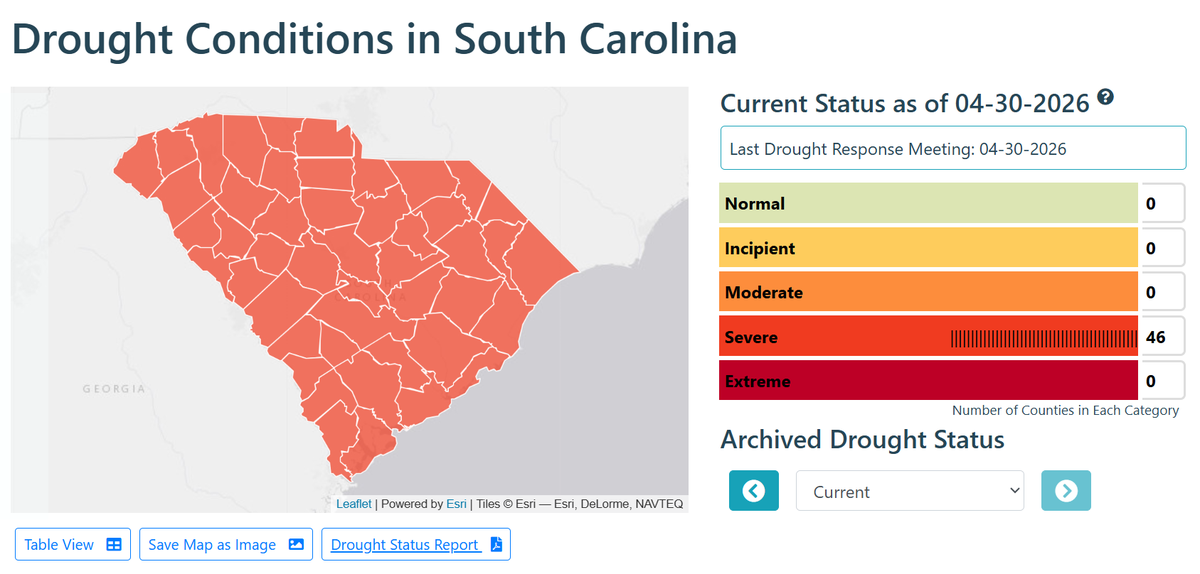
A growing number of Rock Hill region communities have mandatory water restrictions due to ongoing drought, despite recent rainfall.
The town of Clover announced mandatory water restrictions May 5 due to the ongoing drought. Fort Mill followed on May 6. York County announced water restrictions on Friday.
On May 1, the Catawba-Wateree Drought Management Advisory Group upgraded the region’s drought status to Stage 2. That’s the point when water use restrictions move from suggestions to mandates. The drought management group is a combination of Duke Energy and municipal water providers throughout the Catawba River basin.
Municipalities vary in when and how they enact water restrictions.
The city of Rock Hill, which draws water from Lake Wylie and provides it to much of York County, posted a public notice Friday about the Stage 2 upgrade. For now, customers are asked to reduce non-essential water use like irrigation systems and car washing “as much as possible.”
The Clover decision is based on Friday’s Stage 2 declaration, utility agreements with North Carolina-based Two Rivers Utilities and town code related to drought. Clover residents and business owners must try to cut water use by 15% until Two Rivers lifts the restrictions. Properties north of S.C. 55 in Clover must limit irrigation to Wednesdays and Sundays, 7 p.m. to 5 a.m. the following morning. Properties south of S.C. 55 have the same limits, but on Tuesdays and Saturdays.
Town rules allow Clover police to assist with enforcement. A first offense brings a $50 charge on the customer’s water bill. It jumps to $100 for a second offense. If there’s a third, water service will be terminated and restored only after a $250 payment is received.

Clover customers also shouldn’t wash non-commercial vehicles, buildings, sidewalks or streets. Water shouldn’t be added to or used in non-circulating pools, fountains, ponds or similar structures.
Two Rivers Utilities serves about a dozen North Carolina cities and towns, along with Clover in South Carolina.
Fort Mill and York County water restrictions
Fort Mill residents are required to limit lawn and landscape irrigation to “only what is necessary for plant survival. They should avoid watering during the hottest part of the day. Washing vehicles, buildings, sidewalks and driveways must be “minimized and avoided when necessary.”
As of May 8, York County, aiming to reduce its water usage by 5% to 10%, requires customers to limit lawn irrigation to two days per week between 6 p.m. and 10 p.m. Odd-number address get Tuesdays and Saturdays, with even-numbered addresses getting Wednesdays and Saturdays.
Those requirements apply to sprinklers or automated irrigation.
Low-volume, drip irrigation and handheld watering are encouraged, and aren’t subject to the rules.
Washing vehicles at home is limited to the same day and time restrictions as lawn watering. Customers aren’t allowed to flush gutters, wash buildings (unless necessary for fire protection) or use water for ornamental structures (except to sustain aquatic wildlife).
More water restrictions expected in Rock Hill region
Rock Hill Deputy City Manager Jimmy Bagley also serves as chairman of the Catawba-Wateree Water Management Group. He told Rock Hill City Council last week to expect the region to move into Stage 2 restrictions on Friday.
The city has up to two weeks from the Stage 2 declaration to publicize city-specific rules like which days people can water their lawns, Bagley said.
City code allows for similar restrictions to the Clover ones like limiting irrigation to two days a week. Rock Hill will monitor water usage and could impose fines or penalties for excessive use, Bagley said.
During Stage 1 conditions, Rock Hill asked customers to conserve water use by 5%.
Municipalities like Fort Mill and Tega Cay that get water from Rock Hill hadn’t posted mandatory restriction guidelines, as of early Monday afternoon.
Charlotte announced mandatory water restrictions last week that begin May 15, the Charlotte Observer reported. Fines for breaking those rules start at $100.
What happens if the drought gets worse?
Duke Energy and its municipal stakeholders created the low inflow protocol system just before an historic drought that lasted from 2006 to 2009. The area reached Stage 3 status in October 2007, and stayed there through the end of 2008. The system only goes up to Stage 4.
“Stage 3, should it come to that, and we pray it doesn’t, that’s where you step it up even more and you look for 10-20% reductions,” Bagley said. “And you really start eliminating outside water use altogether.”
Stage 4 would be unprecedented.
“Stage 4 is really kind of the armageddon,” Bagley said. “That’s where everything is shut down except drinking water, and you really start bothering businesses about using restrooms and stuff like that. Fortunately we’ve never been there.”
What’s concerning to drought experts is how early in the year the drought is impacting lake and stream levels.
In the summer, the 11 reservoirs on the Catawba River chain can evaporate a combined 200 million gallons of water per day, Bagley said. The current drought is starting off a little worse than the drought of record, he said, by depleting water even before the expected summer surge in water need begins.
This story was originally published May 4, 2026 at 4:08 PM.