What we know now about the coming I-77 fixes at Cherry and Celanese roads in Rock Hill
It’s possible the current plans to improve the I-77 interchange at Celanese and Cherry roads in Rock Hill won’t work. That begs the question of city officials, property owners and road planners: what then?
The Rock Hill-Fort Mill Area Transportation Study policy committee met Friday afternoon. That group narrowed in on a unique, problematic interchange where two major road corridors — Celanese and Cherry — share one interchange.
“This is the only point in the planning area where this occurs,” said David Hooper, RFATS administrator.
Improvements at the Exit 82 interchange are planned.
Berry Mattox with the South Carolina Department of Transportation told the committee that consultant work will begin this spring and improvement alternatives should be available next year. Design and right-of-way acquisition will set up the 2026 start of at least two years of construction.
Initial plans for Exit 82 involve a double diverging diamond configuration.
A diverging diamond crosses traffic from one side of the road to the other, in what looks like a diamond, as a way to eliminate left turns, which can slow traffic patterns.
“This is subject to change,” Mattox said.
For myriad reasons that model may not work. And that could mean inflated costs and possibly expanding the footprint of the interchange.
Historic traffic
Exit 82 often ranks at or near the top of problematic traffic areas in the RFATS area (Rock Hill, Fort Mill, Tega Cay, Lake Wylie, Indian Land). Several traffic signals right off the interchange can cause traffic to back up.
Recent construction connected Riverchase Boulevard and Riverview Road, in an effort to reroute traffic and ease congestion.
Perhaps the most controversial discussion for RFATS in the past decade was an ultimately-failed plan that would have added a new bridge across the Catawba River. It also would have eased gridlock at Exit 82.
Last summer the state infrastructure bank approved almost $75 million for two York County projects. Exit 85 in Fort Mill got $42 million, and Exit 82 got more than $32 million. The York County application for those funds described a diverging diamond setup similar to what’s now under construction at I-77 and Gold Hill Road in Fort Mill.
With Celanese and Cherry roads coming in, Exit 82 would have a double diamond.
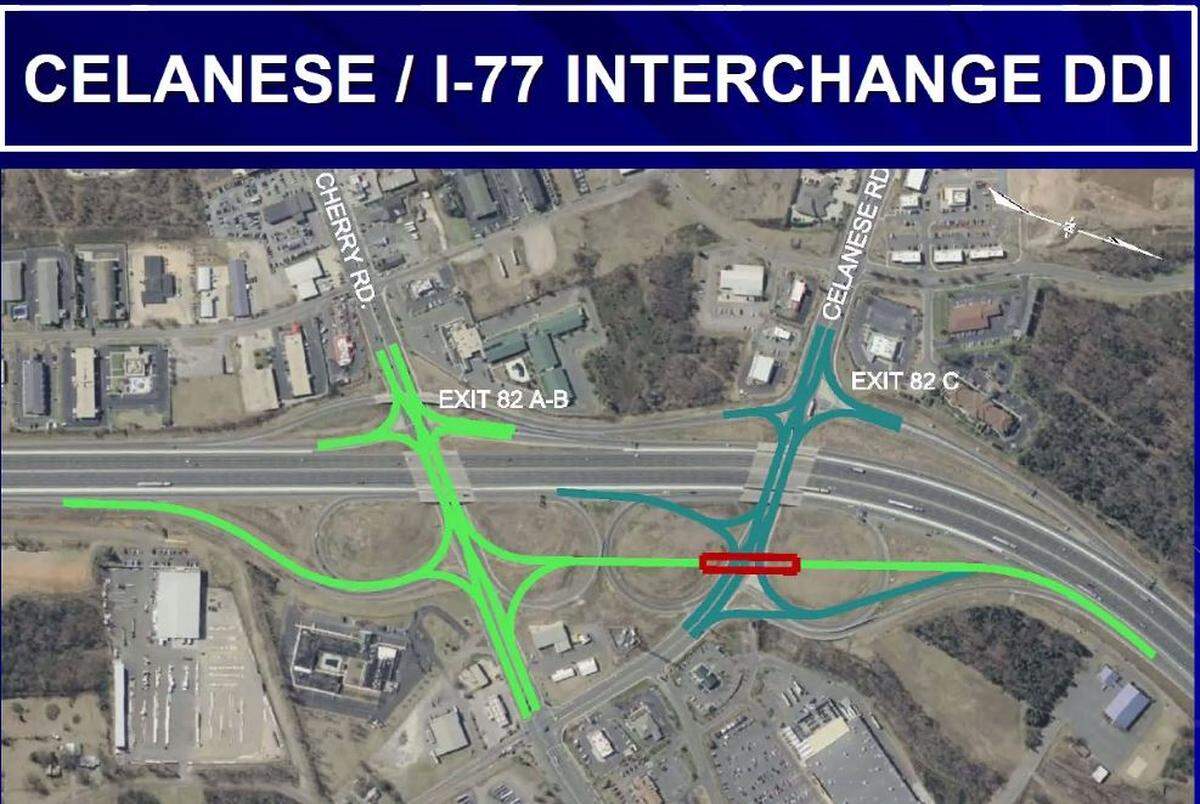
New or improved interchange work on interstates requires federal approval. Since the initial planning for Exit 82 there have been changes that could impact how the site functions.
Exit 85 in Fort Mill had been slated as a diverging diamond, but was expanded to a larger, costlier directional interchange with expansion at Kingsley. The 115,000 vehicles per day at Exit 82 was calculated before news that a new exit will come just south at what will be Exit 81, the Panthers’ practice site.
“That was before the Panthers announcement,” Hooper said.
Federal regulators will have to revisit Exit 82. With new calculations, it’s uncertain whether the double diamond still is the best fit.
“It is a more involved process than it would have originally been,” Hooper said.
Property owner impact
Mayor John Gettys in Rock Hill said his city needs to plan now in case a more expansive fix is needed. There already are industrial, commercial and other sites around Exit 82. There also are development plans, and proposals, throughout the area, especially heading south toward the future Carolina Panthers headquarters.
Developers looking at property near Exit 82, along with city planners and elected officials, need to know more land for roads could be needed, Gettys said.
”The last thing we need to do is approve some plan or rezoning and then make the cost of road improvements go through the roof because we didn’t plan ahead,” he said.
It’s possible a more complicated fix than the double diamond could still be completed in the existing interchange footprint. Hooper said it’s likely the project already has the needed right-of-way. But flyover lanes or similar possibilities could complicate that issue.
“At this point it’s too early to say,” Hooper said.
Mattox said federal decisions are dependent on improved traffic flow. As with the recent decision at Exit 85 at Kingsley and Baxter, regulators won’t approve a smaller or cheaper option if it doesn’t improve traffic flow.
“We can’t spend federal money if it doesn’t fix the problem,” Mattox said.
Improvement cost
RFATS, infrastructure bank and York County funding for Exit 82 now combine for about $44 million. Long-range RFATS planning has more in reserve.
When the Exit 85 interchange in Fort Mill went to a directional setup, the price jumped about $22 million compared to the diverging diamond.
“Things changed over the years with Kingsley,” Mattox said. “The diverging diamond no longer worked like we thought it would.”
Between utility relocation, bridges, rights-of-way and related factors, costs can quickly escalate if it’s determined new ramps are needed. An advantage to the diverging diamond is it often can be completed within the existing road structure. It’s improvement comes from eliminated left turns rather than new lanes.
“Things tend to snowball when we start building new ramps,” Mattox said.
This story was originally published March 29, 2021 at 12:48 PM.