Here’s how far three decades of federal road money for Rock Hill, Fort Mill area goes
There’s a plan in place for how to spend the next three decades worth of federal transportation money in eastern York County.
The Rock Hill-Fort Mill Area Transportation Study recently updated its 2050 long range plan. Included are urbanized areas of eastern York County, from Rock Hill to Fort Mill, Tega Cay and Lake Wylie, plus Indian Land in Lancaster County. The plan covers everything from roads to sidewalks, mass transit and aviation.
By far the most federal money is projected for improvements along the area’s transportation backbone, I-77.
Funding breakdown
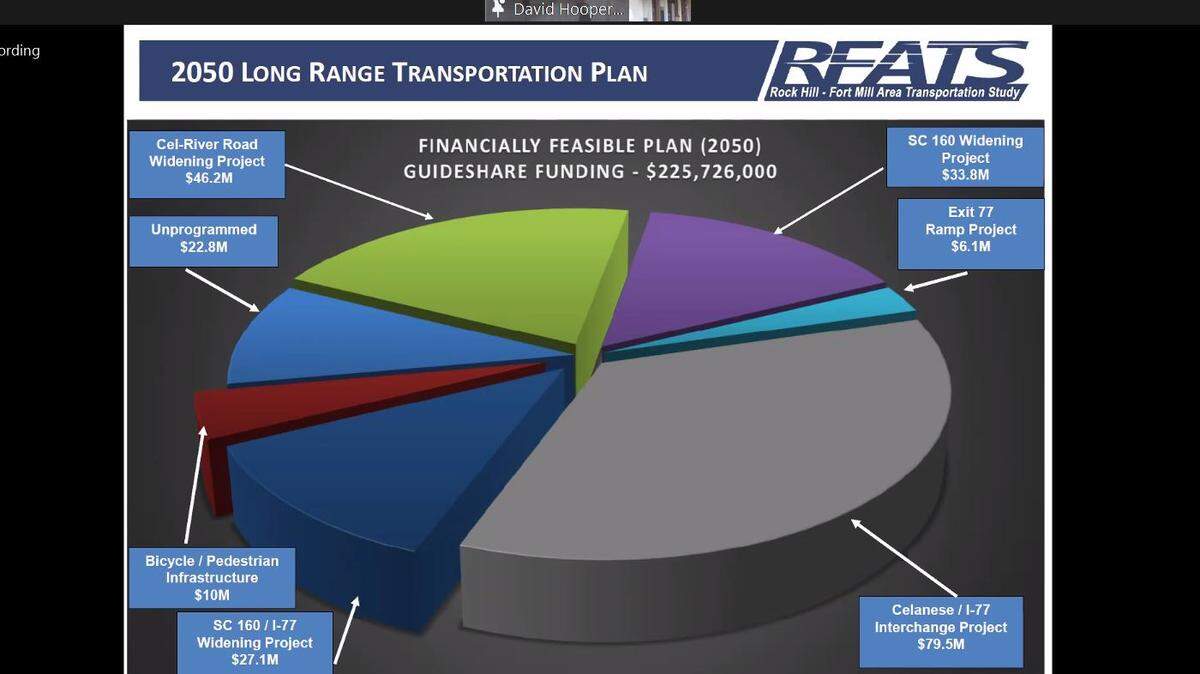
By far the largest federal revenue stream expected is guideshare funding. The South Carolina Department of Transportation allocates a mix of federal highway and state money through guideshares to planning groups like RFATS, who decide how best to spend it. RFATS estimates the area will receive more than $225 million in federal guideshare dollars through 2050. That money can pay for projects on its own or partner with other federal, state and local sources on larger construction. Transit, air quality grant and other federal sources combine for about $130 million.
Improvements at the I-77 and Celanese/Cherry roads interchange in Rock Hill is the biggest guideshare project at $79.5 million. There’s Cel-River Road widening at $46.2 million, S.C. 160 widening at $33.8 million, I-77 and S.C. 160 interchange work at $27.1 million, bicycle and pedestrian improvements at $10 milllion and Exit 77 interchange improvements at $6.1 million.
The plan leaves $22.8 million of guideshare money that isn’t allocated to a project yet.
The larger projects from the guideshare funding list have money from other sources too, from state infrastructure bank funding to Pennies for Progress sales tax money for road widening.
Despite large numbers plugged into the plan, there’s still some uncertainty given the mix of funding sources and years it will take before some projects come up for construction.
Funding variables
Despite best efforts, it’s impossible to outline exactly how decades worth of money will be spent. Too many factors affect those decisions. RFATS administrator David Hooper reminds his policy committee the money shown on graphs is a projection, not money in hand.
“All that money is not available today,” he said.
RFATS gets about $6.1 million per year in its guideshare program, with about a $20 million balance expected in the next couple of years. Funding comes based on population and related factors, which can change. It could be 2025 before there’s definitive data on how the 2020 census impacts funding for coming years.
There also are now unforeseen projects. Just since the last long range plan update in 2017, the transportation landscape changed dramatically.
There’s a new I-77 interchange coming for the Carolina Panthers headquarters, and state infrastructure bank funding for interchanges at S.C. 160 in Fort Mill and Cherry/Celanese roads in Rock Hill. There have been corridor studies for S.C. 49 in Lake Wylie and U.S. 521 in Indian Land, plus multiple large regional transit efforts connecting the Charlotte region. Rock Hill also added the My Ride fixed route bus service.
“That’s a real milestone in the field of transit,” Hooper said.
Some of the long range projects for RFATS could get money from Pennies or a similar sales tax revenue from Lancaster County. RFATS can adjust the long range plan if needed, but wouldn’t do it too quickly since cost overruns are a possibility. Hooper said the ongoing or planned I-77 work at Gold Hill Road, S.C. 160, Cherry/Celanese and the new Panther exit all at the same time is unprecedented.
“We’ve never had that before, and it would not be unreasonable to expect at least one of those projects to have a surprise (cost increase),” he said.
Mass transit, bike lanes
A transportation need that appears in the long range plan but doesn’t have guideshare money put toward it is mass transit. There are multiple ongoing Charlotte regional studies related transit. Corridors through Fort Mill and into Rock Hill have been studied for their potential as bus or some type of rail routes.
Hooper said a mass transit addition in York County would likely reach beyond what guideshare money could fund.
“What is more likely...you’re probably looking at a request to have a multi-jurisdictional transit tax,” he said.
What does appear is $10 million for bicycle and pedestrian improvements. The area may not have to wait long on that spending, either. Rock Hill Mayor John Gettys, a policy committee memeber with RFATS, asked that the $10 million be spent in the coming two years.
“There’s no reason for us to wait on bike/ped,” he said.
Not all needs will be met.
The long-range plan identified about 120 possible improvements. The top seven would cost about $10 million. Still, one group sees progress.
The Bike/Ped Coalition of York County has been vocal on the need for more sidewalks, shared use lanes and safety improvements. New road work in the RFATS area now typically includes sidewalks or shared lanes, up to the coming S.C. 160 interchange work where pedestrian access was the most common concern during the public comment phase.
Coalition co-chair Liz Duda said the money dedicated to pedestrian work in the long range plan is a major step forward.
“I believe that our voices increasingly are being heard,” she said.