‘No. 1 priority’: What SC legislators say they need most from schools in York County
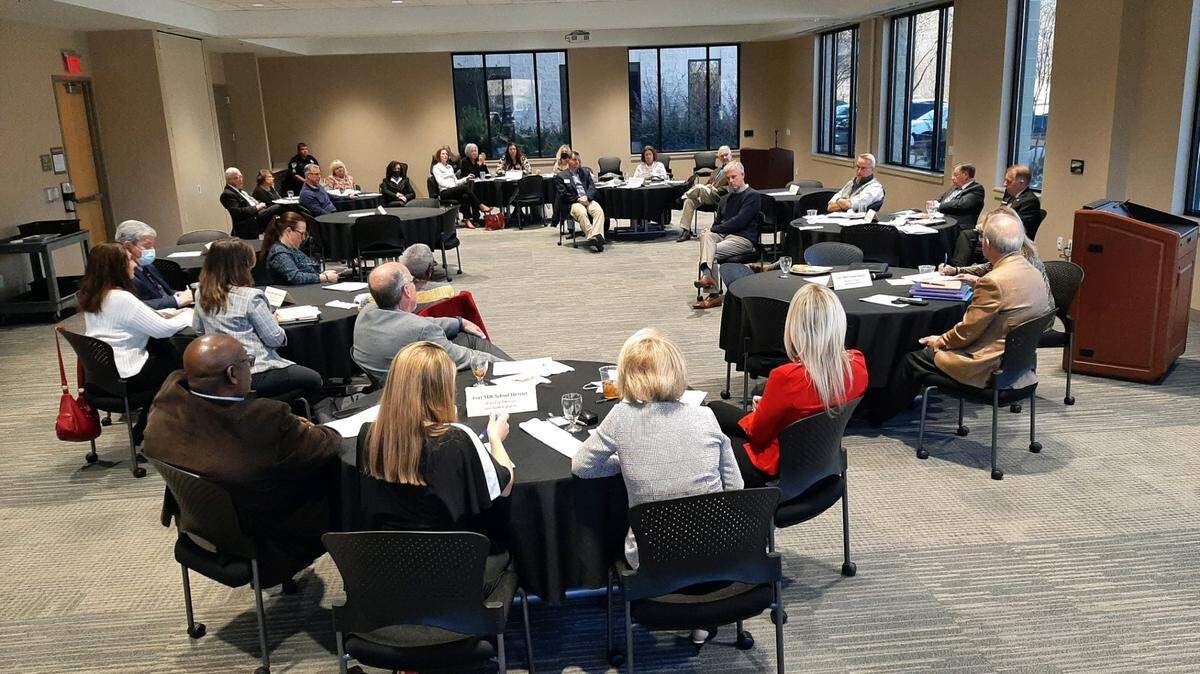
Editor’s note: Superintendents and board members from the York, Clover, Rock Hill and Fort Mill school districts met Jan. 7 in Fort Mill. This is the fourth and final installment in a series of articles from that meeting that explores common issues the districts face, including teacher shortages, COVID funding, state funding and impact fees.
Legislators listened. Members of the York County delegation heard area school districts ask for help with a teacher shortage, impact fee dispute and other key issues.
Legislators also brought their own requests. Mainly, said S.C. Sen. Michael Johnson, keeping students and teachers in classrooms.
“To me that is the No. 1 priority,” he said.
Johnson represents most of Lancaster County, along with much of Fort Mill and Tega Cay. He also spent eight years on the Fort Mill school board, and eight more on York County Council. So at some point he’s represented constituents in all four county school districts.
As a state legislator, his and his colleagues’ decisions take a much broader view. He knows while districts like those in York County went back to in-person learning during the COVID-19 pandemic when the got the opportunity, there were others that took longer or needed much more persuasion.
Johnson said statewide focus has to be on improved formulas for COVID exposures that allow students and teachers to stay at school as much as safely possible.
“We have a pandemic coming of years and years of kids not being in the classroom,” Johnson said.
S.C. Sen. Mike Fanning represents southern York County, up into York. He also represents Chester and Fairfield counties. Fanning also sees in-person education as a critical issue. Both for students and teachers, and students training to become teachers.
“No kid who dreams of being a teacher imagined being on Zoom,” Fanning said.
Area specific problems, legislators say, can be difficult to solve at the state level. State decisions naturally impact a statewide audience.
“We need a magic wand,” said S.C. Rep. Randy Ligon, who represents southern Rock Hill and much of Chester County. “I don’t have it. But I’ll certainly listen.”
Sometimes efforts to fix issues at the state level can bring unintended consequences. Proposed rules can change as legislators from other parts of the state with other constituent concerns debate them.
“We don’t cut with a scalpel,” Johnson said. “We cut with a hatchet.”
Impact fee court case
One area where delegation members say a local fix may be feasible is the question of impact fees. York County asked a court to determine whether Fort Mill can use impact fee revenue to repay bond debt. About $45 million of collected impact fee money for Fort Mill schools sits in escrow awaiting a legal decision.
Fort Mill and Clover districts have impact fees, or charges on new construction designed to help pay for growth. The York district has a study as an initial step toward a fee. Because the legal question isn’t a new law but instead a clarification on the intent of an existing law, Fanning sees an interest in legislators helping.
“You’re asking an easier lift for us,” he said.
The question is, how? A budget proviso would clear up the rule and free up the money in escrow, but wouldn’t set it into law the way a full clarification or amendment would.
“The problem with the proviso is it’s a one-year fix,” said S.C. Rep. and Speaker Pro Tem Tommy Pope, who represents the north and central parts of York County.
While legislators believe the issue can be resolved, Johnson told Fort Mill, Clover and York officials in the near-term they are still better to look at impact fee revenue as a way to pay for new construction rather than bond debt.
“I don’t know if the legislature will fix this in a timely way,” he said.
COVID money
South Carolina has a formula for base student cost, funding that was cut more than a decade ago when recession hit. When the economy improved, the state didn’t raise funding to where it had been. Now with an influx of emergency money from the pandemic, Fanning looks to school officials to focus there.
This year is the one, he said, to demand legislators fund schools at needed levels.
“You’ll never have that money again,” Fanning said.
Fanning advised districts not to get distracted by other issues, but admitted there is a big one up for debate this year. A private school voucher bill would, if passed into law, take money directly away from public districts for use by parents who send their children to private schools, he said.
Though they almost entirely center on money, education decisions at the state level are varied. Legislators say they’ll do their part. Yet on many issues, like decisions that can keep students in classrooms, they need help from districts. Local decisions when made well, legislators say, are preferable to state mandates that limit local control.
“If you can figure it out so your legislature doesn’t have to,” Pope said, “that’s best.”