Their lives changed when Winthrop botched their sex assault claims. Then a floodgate opened
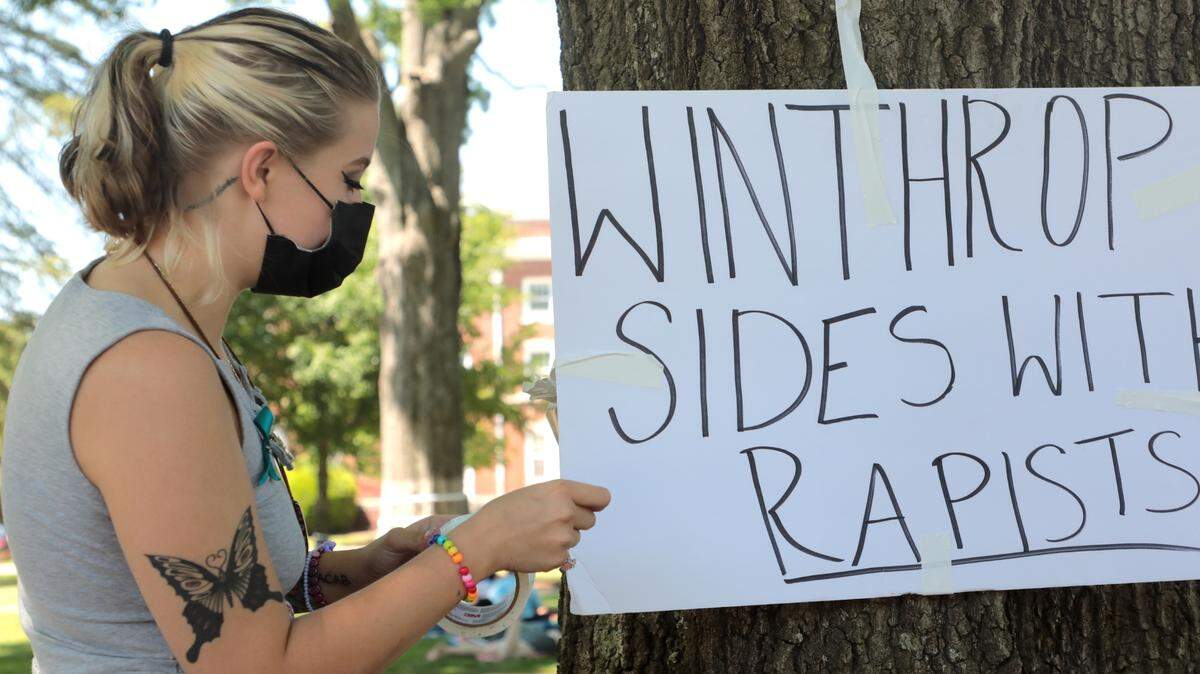
Rhianna Rausch looked over a sea of Winthrop University students, many sitting on blankets or on the warm grass in front of the school’s Byrnes Auditorium. She clutched a megaphone, stood on a low brick wall and shared her story.
“How Winthrop University treats survivors has to be known,” she said. The edge of her black short sleeve shirt slightly covered the tattoo on her right arm that says “No Means No.”
“Yes!” several in the crowd shouted.
“Indifference, interrogation and victim-blaming are just some of the tactics that Winthrop’s administration uses to approach the topic of sexual assault,” Rausch continued. “I am tired of sitting by while Winthrop students continue to get hurt.”
“Boo!” one person clamored.
“Woohoo!” another hollered.
Chants soon rang through the courtyard.
Rausch, with the help of her partner, Milo Wolverton, and several friends, organized the April 2021 protest. First, she started an organization called Winthrop University Students For Change.
The group formed after an article in Winthrop University’s student newspaper, The Johnsonian, reported that two former students, Ellie Marindin and Summer Phillips, had been sexually assaulted and harassed. But when they notified Winthrop officials, the Rock Hill, South Carolina, university took little consequential action.
That hit Rausch particularly hard.
Rausch, as The Herald has reported, said she was assaulted in 2019. For the past three years, she has pursued resolution through police and university investigations and, she said she’s encountered systemic flaws.
But her conviction, at a protest and in her own case, remains unshaken.
“Winthrop has a way of making victims think that they are going to be helped, then turning around and instead breaking them down, confusing them, and telling them that nothing can be done,” Rausch said. “But I have always felt like I need to keep trying and exhaust every option for possible justice.”
She’s worked to shine light on the issue of sexual assault on Winthrop’s campus and to amplify her classmates’ stories.
“It was important to me to try to show my support by speaking out and helping Ellie and Summer and other survivors establish a pattern of Winthrop’s actions,” Rausch said.
The Herald has interviewed four former students — Rausch, Marindin, Phillips and Trinity DeAngelis — who reported instances of sexual assault and harassment to Winthrop officials. They all said the university poorly handled their cases.
The Herald typically does not identify victims of alleged sex crimes. However, the students granted The Herald permission to do so. The Herald has not named the alleged assailants in any of the cases because no one has been convicted, and one case still is pending.
Federal law and school policy prohibit Winthrop officials from discussing individual sexual misconduct cases. But the four students provided The Herald with emails, documents and audio recordings from university officials that support their allegations.
The Herald has requested on four occasions to meet with Winthrop officials and has so far been denied.
“Recently, there have been individual Title IX cases (past and present) that have generated concern about the university’s approach to handling sexual misconduct incidents,” Kevin Sheppard, Winthrop’s Title IX coordinator and ADA compliance officer, said in a statement to The Herald.
“Although in-depth reviews of these Title IX complaints have resulted in the consensus that internal administrative procedures for handling these cases were appropriately followed and were in compliance with laws and policies in place at the time of each incident, we can and must do more to instill trust in our processes,” the statement also said.
Summer Phillips
Phillips said she was a sophomore when she was assaulted. On Feb. 24, 2017, she went to an off-campus bar with a group of friends.
She had been at the bar a few hours when she started chatting outside with three male students, she said. She had a few mutual friends with the three students, who were on one of the university’s athletic teams, and she occasionally saw them around campus.
Phillips soon realized her friends had left the bar, so the athletes offered to drive her home.
“Typically, if you get into a car with four people, it would be like someone driving, someone in the passenger seat and then two in the back,” she said. “But that’s not how they got in the car. It was one person driving and then, I was in the middle in the backseat and two other guys were on either side of me. I didn’t really think anything of it at the time, but now, I’m like, ‘Interesting.’”
During the ride, Phillips said she started to fade in and out of consciousness, but she remembers the athletes did not speak English to each other, and she couldn’t understand the conversation.
Instead of taking Phillips home, she said the athletes took her to their off-campus house.
“Then, I don’t really remember a whole lot else, until I woke up to one of them having vaginal intercourse with me,” she said. “One of them was putting himself in my mouth and then, the other one was sitting up at the top corner of the bed just watching. That was the first time I came to and I just remember being in a ton of pain.”
She said she immediately fell unconscious again.
When Phillips woke up in the morning, her pants were off. She didn’t know where her phone and wallet were. She was wearing only her shirt and socks. She quickly gathered her clothes and ran out the door.
One of the athletes jogged after Phillips, she said.
“The moment I really knew something was wrong was when he was like, ‘We wanted to ask you a question last night, but we didn’t want you to be mad,” she said. “And I was like, ‘OK, we?’ He was like, ‘We wanted to make sure that you were on birth control.’ And I was like, ‘Yeah, I am.’ I just walked off and he went his own way on campus. That was it.”
She said she didn’t go to the hospital, or notify police or university officials. She stayed in bed for several days.
“I don’t want to ever scare anybody, but it was really horrific,” she said. “There was a lot of blood. I was covered in bruises. I couldn’t sit down for a week. I couldn’t pee without being in insane pain. I was really in bad shape.”
On March 1, she decided to tell university officials what happened. At the university’s counseling center, Phillips spoke with a counselor who specialized in sexual trauma.
“My therapist said, ‘Summer, the fact that you’re alive right now is huge,’” Summer said. “Most people who get gang-raped, there’s a high percentage of people who don’t make it.’”
At that point, Phillips wasn’t sure she wanted to pursue a Title IX investigation, but less than 24 hours later, she said she decided to move forward with one. And on March 7, Phillips said she met with the investigators in her case, Assistant Dean of Students Miranda Knight and Renae Myles, who worked in the university’s athletics department.
“It was really all about me, what I drank, how much I consumed, if I was actually drunk,” Phillips said.
Knight asked Phillips to bring her the empty bottle of alcohol she had consumed the night of the assault or to send her a picture of it, according to emails Phillips provided to The Herald.
Phillips went to a nearby gas station and sent Knight a picture of the alcohol.
“I didn’t know any better,” Phillips said. “She was telling me that they were going to have to bring in an alcohol specialist to see, with what I consumed, if I would have been that drunk.”
One of the co-investigators in Phillips’ case was later replaced due to a conflict of interest. In an email to Phillips, Knight explained that, since the three assailants were student athletes, Knight felt it was best to remove Myles, who worked in the athletics department, from the investigation. The university’s Employee Relations Manager LeeAnn Pounds replaced Myles, according to the emails.
Phillips said she also reported the alleged assault to the Rock Hill Police Department, but the three athletes were not charged.
While Phillips waited to hear from Winthrop officials about her case, she continued to see the three athletes on campus. At one point, Phillips said they followed her around at a campus party and tried to take videos of her.
In May, Phillips said she heard back from university officials, but at that point, the semester was almost over.
“They said that it would be really hard for the school to get everyone to come in to testify since school would be out at that point,” Phillips said. “They were like, ‘It’s basically impossible. You can try to get people to come back, but if it’s just three guys and you, that might not go over well.’”
Phillips chose to pursue an alternative resolution, which is generally a way to resolve Title IX cases without going through a formal investigation and hearing process. She said she felt pressured into the option.
“It got to the point where they were just saying it was basically going to be impossible to hold…,” she paused and cried.
“Sorry … to hold a hearing,” she continued. “And I just said, ‘OK then do the worst that you can please and get them in as much trouble as you can.”
She said, had the university’s Title IX officials not discouraged her from holding a hearing, she would have gone forward.
“If they would not have made it sound as horrible as they did ... if they would have been like, ‘Hey, we want to do this with you if this is what you want to do,’ I would have been all in,” she said. “They made it feel like I was going to be completely alone.”
According to Winthrop’s student sexual misconduct policy, an alternative resolution can be pursued when “the reporting party, having been fully informed of all available options, has explicitly made that choice, and if based on the information known about the incident, the investigator or deputy Title IX coordinator believes such a resolution appropriate.”
As part of Phillip’s alternative resolution agreement, the three assailants were required to participate in a local counseling program, she said.
“I don’t know if they ever did it,” Phillips said. “I never got notifications saying it was completed.”
Phillips did not return to Winthrop the following year. She traveled abroad for a few months before she settled on the West Coast. She got married in 2021 and she’s been sharing her experience online in an effort to help other survivors of sexual violence.
“I am livid because I wanted to finish college,” she said. “I wanted so badly to walk across that stage with my friends, and I couldn’t. And it’s not fair because it’s not like, I was like, ‘Oh, college just isn’t for me.’ No — it was stolen from me.”
Ellie Marindin
Marindin, a former Winthrop lacrosse player, said she also was a sophomore when she was assaulted.
In November 2018, Marindin had to regularly visit the team’s doctor after she suffered a concussion in practice. One afternoon, while she waited at Winthrop’s Coliseum for her appointment, she rested on a treatment table in the trainer’s room.
One of the university’s athletic trainers entered and asked if she was OK. She told him she was there for concussion treatment. He offered her a towel to put over her eyes to block the fluorescent lights, which were agitating her injury, she said.
“On his way out he told me to, ‘Get better, gorgeous,’ and gave my upper leg a pat,” Marindin told The Herald.
After her appointment, she left the Coliseum and noticed the same trainer also was leaving. She tried to slowly walk behind him, but he stopped, turned around and waited, she said.
She reluctantly chatted with him as they walked toward the parking lot.
“I went to walk to my car when he pulled me into an awkward hug that seemed to linger longer than it should,” she said.
On Jan. 17, 2019, Marindin went with a friend to the Coliseum for their respective appointments. Marindin finished her session first, so she popped into the room to say goodbye to her friend.
The trainer, who Marindin had tried to avoid, walked toward her.
“Aren’t you going to give me a hug?” he said.
She froze.
“This time, as his hands were on my back, he slid one of them down where he rested it on my butt and gave it two firm pats,” she said. “My skin went hot.”
She backed away and glared at him.
Marindin walked over to her friend and told him what had just happened. He encouraged her to notify university officials, she said.
“I’ve been an athlete my entire life and I’ve seen tons of doctors for injuries ranging from my nose to my feet,” she said. “I know the difference between appropriate and inappropriate behavior and touching.”
Marindin told her assistant coach what happened. Later that day, Winthrop’s Employee Relations Manager, LeeAnn Pounds, who had been an investigator in Phillips’ case, asked to meet with Marindin.
Marindin’s case was investigated by Winthrop’s Office of Human Resources, according to a document she provided to The Herald.
Marindin said she later learned from another athlete that the same trainer had touched a teammate in a similar manner. And on Jan. 28, Marindin said she told Pounds — with her teammate’s permission — about the athletic trainer’s actions.
“I gave her the girl’s cell phone number and said action needed to be taken as clearly he was comfortable enough to touch another athlete five days after my incident,” Marindin said.
Pounds told Marindin that she was continuing to speak to individuals connected to the investigation and would reach out to her teammate, Marindin said.
It’s unclear if Pounds ever spoke to Marindin’s teammate.
After about a month, Marindin said she started to lose hope. At one point, she said she gave Pounds her parents’ contact information.
“It was a lot to handle on my own,” Marindin said. “I didn’t feel full support from the athletic department or my coaches.”
On March 19, Marindin got an email from Pounds that her investigation had been completed. She quickly skimmed the letter.
Her heart sank.
Those involved in Marindin’s investigation determined that, while Marindin was “touched in an undesirable manner” by the athletic trainer, “there was not a preponderance of evidence that the touching was of sexual or intentional nature that violated Winthrop’s policy against sexual harassment,” according to the letter Marindin provided to The Herald.
“Three months of an exhausting back and forth only to claim that although they acknowledged I was touched without consent and of undesired means, this somehow wasn’t a violation of sexual harassment?” Marindin said.
According to Winthrop’s sexual harassment and discrimination policy in place during Marindin’s ordeal, sexual harassment can include “conduct by individuals in positions of authority” that creates “a hostile working or learning environment or unreasonably interferes with the ability of a person to perform his/her employment or academic responsibilities.” This can include “intentional and undesired physical contact”; “repeated, unwelcome sexual advances” and “comments about an individual’s physical appearance.”
In 2021, Winthrop released an interim Title IX sexual harassment policy, and its definition of sexual harassment is less specific.
Marindin wrote about the ordeal on her blog. She didn’t name the athletic trainer. After the investigation ended, she said rumors circulated around campus that she had had sex with the trainer. She continued to see him at the university and as a result, she said she struggled to stay on campus. And her love of lacrosse, which she had played since she was a child, started to disappear.
Marindin graduated from Winthrop in the spring of 2020. She said quarantining in the Outer Banks during COVID-19 — and being off Winthrop’s campus — was a “blessing in disguise.” She went on to finish her lacrosse career at the University of Lynchburg, where she earned a master’s degree in nonprofit leadership studies.
“I didn’t report for him to get fired, although it would have been great to have seen proper disciplinary action,” she said. “I reported for the girls before me, and those who come after me. I did it to set a precedent … It’s my body, what makes you feel as if it’s yours to touch?”
Marindin said she decided not to appeal the decision.
“I was physically and mentally exhausted,” she said. “With the way I was treated, why would I go back for more?”
Trinity DeAngelis
A few weeks before The Johnsonian article came out in March 2021, then-freshman Trinity DeAngelis, who identifies as non-binary — neither exclusively male nor female and uses they/them pronouns to self-identify — decided not to return to Winthrop after trying to report a sexual assault to campus police.
Within a few weeks at Winthrop, DeAngelis made a close group of friends. One friend, who also identifies as non-binary and uses they/them pronouns, confessed romantic feelings for DeAngelis and asked them on a date.
DeAngelis declined and the two agreed to stay friends.
However, the friend, who would become DeAngelis’ alleged assailant, started to make DeAngelis more and more uncomfortable. The alleged assailant made continual sexual comments toward DeAngelis and smacked their butt.
And each time, DeAngelis insisted the behavior stop, but the assailant continued.
On Jan. 19, the behavior went too far. It was the night before President Joe Biden’s inauguration.
DeAngelis was with friends, one of whom was DeAngelis’ best friend. DeAngelis’ alleged assailant was there too.
At one point in the night, DeAngelis’ alleged assailant announced support for former President Donald Trump. DeAngelis tried to change the subject, but DeAngelis said the alleged assailant brought it up again and said: “For one last hooray of Trump being in office, grab her by the p----!” The alleged assailant then reached over and grabbed DeAngelis’ vagina.
DeAngelis tried to ignore what happened.
“I hated it,” DeAngelis said. “But I just kind of laughed it off.”
On Jan. 24, while DeAngelis was at dinner with their best friend and their best friends’ parents, DeAngelis told them what happened. Their friends’ parents urged DeAngelis to notify the police. And after dinner, the group went to Winthrop University Campus Police Department to make a report.
DeAngelis said they explained to the officer that the alleged assailant was non-binary but was assigned female at birth.
“(The officer) was like ‘OK, so it wasn’t a man?’” DeAngelis said. “And I was like, ‘No, but does that matter?’ And he said, ‘With these cases, if it was a man, it would be a different story. It’s harder for us to get reports on women because women don’t usually do this kind of stuff. You can’t really get sexually assaulted by a woman.’”
The officer asked if DeAngelis wanted to press charges.
“He said, ‘If you do, they’re not going to be that much,’” DeAngelis said.
So, DeAngelis decided to wait, but requested that the alleged assailant be moved to a different dorm room.
The following day, DeAngelis decided to press charges. DeAngelis said they did so through the York Police Department.
The York Police Department, the York County Sheriff’s Office and the Rock Hill Police Department do not have records of DeAngelis filing a complaint.
Winthrop’s Assistant Chief of Police Charles Yearta told The Herald DeAngelis came back to campus police the next day and wanted to press charges.
“At that point, we just took their same report that they made the day before, opened it back up and ended up pressing charges,” Yearta said.
DeAngelis’ alleged assailant was arrested by Winthrop police on Jan. 29 and charged with second degree assault and battery, according to court documents. The case is still pending.
Yearta was not the initial officer DeAngelis spoke with, according to the incident report DeAngelis provided to The Herald.
Yearta said he understands that victims can feel uncomfortable by some questions officers must ask when they’re investigating sex crimes.
“They are trained to ask pointed questions, so we can determine which crime has been committed and I understand where that would make someone uncomfortable,” he said.
He explained that in South Carolina, depending on which part of the body the assailant grabs, and whether the victim has clothes on or not, the crimes are different.
He said if the assailant touches the victim’s private areas while the victim is wearing clothes, the crime would fall under second degree assault and battery. However, if the assailant touches the victim’s skin in those areas, that would be considered criminal sexual conduct, he said.
“That’s the reason why they have to ask those pointed questions,” he said.
Yearta said it is customary for an officer to ask the victim and subject’s gender, sex and race.
“That’s more of an identifying factor,” he said. “That doesn’t change the criminal statute.”
On Jan. 27, DeAngelis met with Winthrop’s Interim Dean of Students, Anthony Davis, according to emails provided to The Herald.
During the meeting, DeAngelis said they insisted the alleged assailant be removed from campus.
“I kept repeating myself — ‘I want her off of campus,’” DeAngelis said. “’You have every right. You can take her off campus, and I know you can.’ And he was like, ‘Well this is her first case. I don’t think we should take her off campus for this.’”
And a few days later, DeAngelis said they saw the assailant on campus. As a result, DeAngelis said they didn’t feel comfortable leaving their room after dark.
In February, Davis sent DeAngelis a mutual no contact order between them and the alleged assailant, according to emails provided to The Herald.
“I feel like they are punishing me for something that she did,” DeAngelis said. “I get that a no contact isn’t a punishment, but why should I have to follow the same rules as her?”
DeAngelis said the main reason they chose not to return to Winthrop was the way campus police and other officials handled the sexual assault claim.
Instead, DeAngelis is attending culinary school.
“You don’t have to feel bad for me,” DeAngelis said. “You don’t have to have pity for me, but you do need to change your policy. When somebody tells you something, man, woman, non-binary, I don’t care. When somebody tells you something in confidence that happened to them, your first thought should be, ‘OK I have to look into this right now.’”
Like Rausch, when DeAngelis read The Johnsonian article, they knew they needed to speak out.
“I was so angry,” DeAngelis said.
A few days later, DeAngelis shared details on social media about the ordeal, the aftermath of the reporting process and the reality of sharing a campus with an assailant — like Rausch, Phillips and Marindin had to do.
“I hate to say I was comforted because it’s not the right word, but unfortunately, I was comforted,” DeAngelis said. “I shouldn’t have been. This shouldn’t be happening to multiple people.”
This is the second of a three-part series of the stories on Rhianna Rausch and three other Winthrop student victims of sexual assault. Alex Zietlow contributed to these reports.
This story was originally published June 29, 2022 at 12:00 PM.