High school sports could change across the Rock Hill region. New numbers show how
New student enrollment figures published this week could impact schools across the Rock Hill region, from high school football rivalries to marching band champions to how many kindergarten teachers schools need to hire.
South Carolina schools report enrollment 45, 135 and 180 days into each school year. The 45-day count is used to group schools for competition. It’s also the first snapshot of how schools and districts are changing each year.
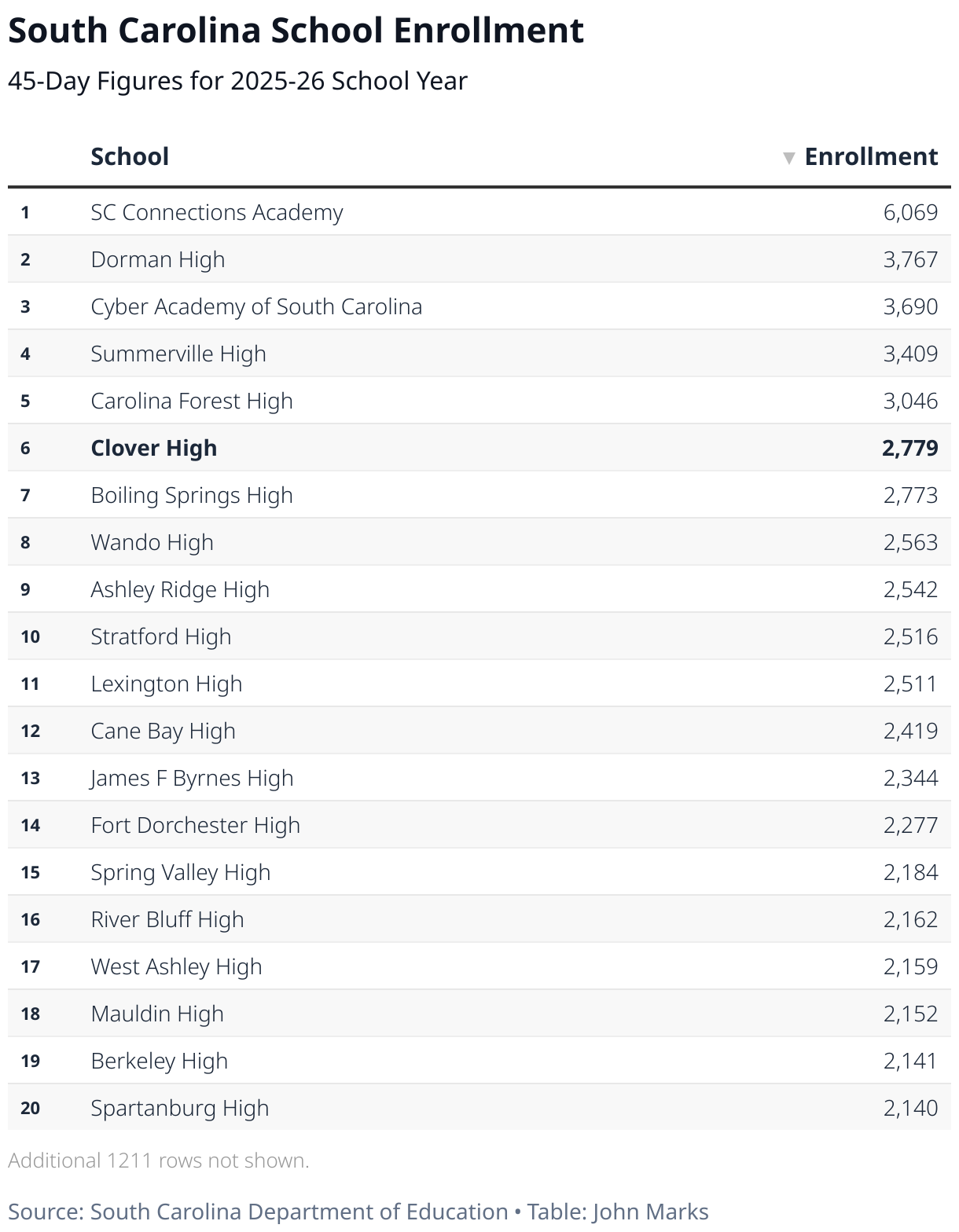
Take a look at the enrollment data from Clover High School at 2,779 students to The Palmetto School in Rock Hill at 71 students. Here are three ways it’ll matter, especially starting next fall:
High school sports classifications
The most visible impact of comparing school sizes comes when they compete against each other. High schools are grouped into classifications of similar-sized schools, then geographic regions within classifications.
The South Carolina High School League will use the new enrollment numbers to set classifications and regions for the next two school years.
“We look at things such as travel, and make sure that we are geographically friendly as much as possible,” said league Commissioner Jerome Singleton. “We don’t have a set number of how many schools will be in what class.”
There will be five classes again, 1A through 5A. A guidelines committee is collecting information from schools now. Singleton wants to put a preliminary realignment plan out before schools take winter break, with a final version expected in late February. There will be time for schools to appeal their classifications or regions.
The high school league used a new formula two years ago that had multipliers, and Singleton expects to use it again this time. Students who attend high schools but live outside the attendance zones for those schools will count as three students.

While many people focus on playoff implications from new classes and divisions, the high school league focuses on regular season play that can involve travel most nights of the school year for more than 20 sports.
“Make sure schools have teams they can play against without having to travel such a long distance or having to be such a big disparity in the population they’ll have in their schools,” Singleton said.
That’s why Catawba Ridge, Clover, Fort Mill, Indian Land, Nation Ford, Northwestern and Rock Hill high schools compete in the same 5A region. Great Falls, Lewisville and Riverwalk Academy, meanwhile, are together in the same 1A region. Those setups could change with new enrollment figures.
A separate committee handles state championship brackets once classifications are set. That group deals with questions like whether 5A football will have two division championships, like they do now, or one.
“The playoffs are just a byproduct at the end because all of the schools are playing regular season,” Singleton said. “A selected few get to play in the playoffs.”
One big change from the enrollment figures is the opening of Lake Wylie High School next year, drawing students from Clover High. The high school league will use Clover School District enrollment estimates for next year to place both schools in classes and regions.
Clover is expected to have about 500 more students next year than Lake Wylie, said district spokeswoman Stephanie Knott. The difference is, Lake Wylie won’t have seniors.
The following year, when both schools have all four grades, Lake Wylie is projected to have about 200 more students that Clover.
The district expects to start with two 4A-sized schools, Knott said, based on pre-reclassification school sizes.
The committees that make classification and playoff decisions are made up of school district administrators, principals, athletic directors and coaches. So the high school league will lean heavily on enrollment numbers, but make decisions that work best for schools.
“It’s a representation of them,” Singleton said.
Marching band classifications
Similar to sports, high school marching bands use their own classification system based on 45-day enrollment numbers. The South Carolina Band Directors Association has reclassified every two years since 2006, and is due for another regrouping for the coming two school years.
The association hasn’t posted plans for that update. The Herald was not able to reach an association official for comment.
If the association reclassifies using its long-time model, it could have significant implications on some of the state’s top marching bands.
Catawba Ridge and Nation Ford, both two-time defending state champions, would be placed in the same 5A classification. Fort Mill, after finishing second to Nation Ford in 5A the past two seasons, would move up to 6A alongside powerhouse bands like Wando and James F. Byrnes.
Those changes aren’t official. They only reflect where bands would fall in the typical classification model, using the latest enrollment figures.
A reshuffling of band classifications also could impact bands like York, a school that finished third in the state this fall in 4A. The new enrollments would shift champion Catawba Ridge out of that classification, but keep York in it.
Then there’s Clover, the third place finisher in the state’s largest classification this fall. The opening of Lake Wylie High School next year will likely put both schools into new classes.
.jpg "BOA FM, CR, NF DMs (1).jpg")
School finances depend on students
Competition is far from the only impact of changing student enrollment.
“On the finance side, enrollment is one of several components the state uses when determining funding,” said Laurabree Monday, spokeswoman for the Rock Hill School District.
Per pupil spending, hiring of teachers, buses and other costs depend on enrollment. There isn’t a straight line amount districts get per student, since factors from poverty in the community to needs for special services play a role. The South Carolina Revenue and Fiscal Affairs Office posts a spending dashboard that breaks down many of those costs.
“There is no simple answer because funding is based on student needs,” Monday said.

Rock Hill has more than 15,000 students. The Fort Mill School District overtook Rock Hill as the region’s largest district five years ago, and now has more than 18,000 students.
Budgeting for the district and school staffing are done based on continual enrollment projections, said district spokesperson Joe Burke. The district then reviews those projections against actual enrollment counts.
“Should a school see a significant increase in student enrollment at the 45-day mark, we would make adjustments to the school funding allocation within the current budget,” Burke said. “If a school were to see a significant enrollment increase at the 45-day mark, the district would assess the need for additional staffing.”
School and district enrollment figures
Use the charts and graphic below for more information on new enrollment data: