
As Ocracoke braces for winter, General Assembly poised to vote on Dorian relief bill
Kelley Shinn sat on the cement in front of the N.C. Legislative Building asking anyone who passed by Wednesday if they would read the letter she and students from Ocracoke School had prepared for the state’s elected officials.
Temperatures were chilly Wednesday morning, but Shinn told one passer-by, “We’re plenty fine. It’s going to be much colder in Ocracoke this winter if we don’t get help.”
Earlier this month, the state House and the Senate each passed disaster relief bills, with the $280 million House proposal including resilience and mitigation funds, along with about $104 million to replenish pots of state money that match disaster relief funds.
The Senate bill, meanwhile, included $102.5 million for those pots of matching funds and $30 million in recovery funds for the N.C. Department of Transportation, omitting the other relief efforts, including those specific to Ocracoke.
On Wednesday afternoon, Rep. Chuck McGrady, a Hendersonville Republican who co-chaired the disaster relief bill’s conference committee, said members were poised to release a conference report largely mirroring the House bill. The total package, McGrady said, would include many of the mitigation efforts and total as much as $241 million, depending on the $30 million for DOT being included in that bill or different legislation.
“The Senate has agreed to a fair amount of the resiliency funds that were in the House bill,” McGrady said.
Resilience provisions in the House proposal, which are expected to be part of the conference report, include $5 million to the N.C. Division of Emergency Management for expanded flood mitigation studies; $4.8 million to Emergency Management to monitor 1,510 high- and intermediate-hazard dams throughout the state; and $5 million to the N.C. Department of Agriculture and Consumer Services for stream debris removal.
In addition to the matching funds and resilience efforts, the conference report was expected to include $1.5 million for the State Emergency Response and Disaster Relief Fund. That money will be used to support the state individual assistance program Gov. Roy Cooper set up after the Federal Emergency Management Agency denied the state’s application for the federal program. The state disaster fund would receive $5 million to replenish it to provide relief during future emergencies.
McGrady also said the conference report would include some Hurricane Dorian-specific provisions, such as $5.2 million to repair damage from the storm at Elizabeth City State University and $1.7 million to repair storm damage at Ocracoke School.
Shinn drove from Ocracoke on Tuesday and was met in front of the General Assembly by about a half-dozen people, most of whom maintain part-time homes on the island, which saw a record storm surge come from the Pamlico Sound during September’s Hurricane Dorian. Hundreds of residents remain displaced, Shinn said, and the long recovery process is beginning to weigh heavy on many.
Children, especially, are feeling the impacts, Shinn added. Repairs continue on the flooded Ocracoke School, but classes have started again, with children spread across three different locations.
Ocracoke School repairs
Last week, Shinn spent time with the sixth- through 12th-graders who are being taught at the N.C. Center for the Advancement of Teaching while repairs continue at Ocracoke School. Rooms in the building are housing four classes, and the noise can be distracting to students, Shinn said.
“It’s like a refugee situation. Our children are afraid,” Shinn said. “I subbed three days last week, and they’re acting out, they’re distraught, they’re begging for affection and tenderness.”
Shinn’s letter to legislators included notes from students, ranging from a senior in high school to a second-grader.
One, a seventh-grader named Gabriel, wrote, “Ocracoke needs money to rebuild after the storm. Lots of people lost their houses, and it is sad. My mom lost her job and she was already working two jobs before. Lots of people lost their jobs.”
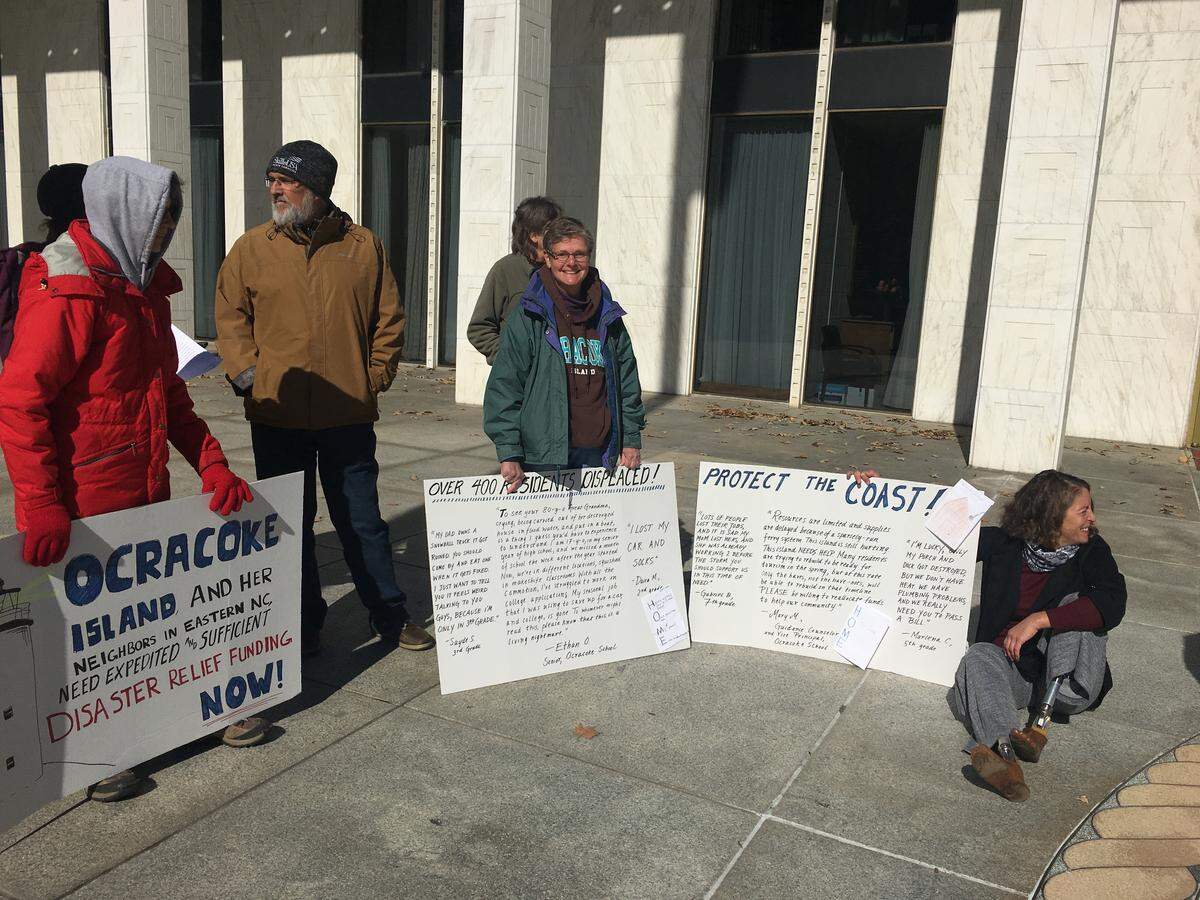
Others on Ocracoke are worried about how they’re going to stay warm once winter arrives. Gary Mitchell, a musician who has lived on the island since 1978, wore a heavy jacket and beanie while standing in front of the Legislative Building.
Mitchell said his house has no heat, and that the gas backup tank to the electric system was washed away by Dorian’s surge. It is hard, he added, to find workers to make the repairs, especially when so many other residents on the island are seeking the same help.
He said he spends many days on the phone trying to make progress with insurance companies or line up workers. And in addition to his home, Mitchell is working to repair the Deepwater Theater, a small local venue that had three feet of water inside during Dorian.
“I don’t think I’ve had anything that’s happened on the schedule I intended it to happen since the storm came, so it requires a lot of flexibility right now,” Mitchell said.
‘Haves’ versus ‘have-nots’
Those who came before the General Assembly Wednesday said there is a sense that Dorian will exacerbate the divide between the “haves” and the “have-nots” on Ocracoke.
The recent announcement that Ocracoke would reopen to visitors Nov. 22, in time for Thanksgiving, is one decision that has drawn criticism. Candice Cobb, a Hillsborough resident who lives on Ocracoke part-time, said she is worried that displaced people who have been living in rental homes while they make repairs could be pushed out so tourists can rent them.
“A lot of people feel it would be better to open probably in the spring,” Cobb said, “but business owners are losing business, so I see both sides.”
The tension between those who have money and those who don’t have as much is subtle, Shinn said, but it is there, especially as the recovery continues to unfold. She gave the example of someone who was born in Ocracoke and whose house was flooded working at a local store, when someone starts talking about making the kind of repairs that the person behind the register can’t even consider.
“Because Ocracoke is loving and kind, it is not like people fighting and nastiness, but it’s very difficult. ... To keep your mouth shut and put on a smile gets very difficult,” Shinn said. “And the colder the winter gets, the harder it’s going to be.”
This story was produced with financial support from Report for America/GroundTruth Project and The North Carolina Local News Lab Fund, a component fund of the North Carolina Community Foundation. The News & Observer maintains full editorial control of the work.
This story was originally published November 13, 2019 at 5:30 PM with the headline "As Ocracoke braces for winter, General Assembly poised to vote on Dorian relief bill."