A country diner and its biscuits provide a reprieve from coronavirus in small-town NC
READ MORE
20 News & Observer stories to read from 2020
A sampling of the News & Observer’s journalism from 2020.
Expand All
Dan Odom sat in his pickup truck in front of the Nashville Diner and waited for the lights to come on. It was a few minutes before 5:30 on Thursday morning, more than an hour before sunrise. In these abnormal times Odom sought normalcy, and a biscuit.
A lifelong resident of Nash County, about 30 miles east of Raleigh, Odom has been coming to the diner for the past 26 years. He’s there just about every morning, usually when it opens. Usually, he’s there with three or four others.
The group likes to sit over breakfast and talk “about everything,” said Odom, 58. “Some of it, you don’t want to know,” he said with a grin. He wore glasses, an old hat and thin mustache. He spoke with a thick Eastern North Carolina accent.
“Well, we just talk about what’s going on in the community a lot of times,” he said.
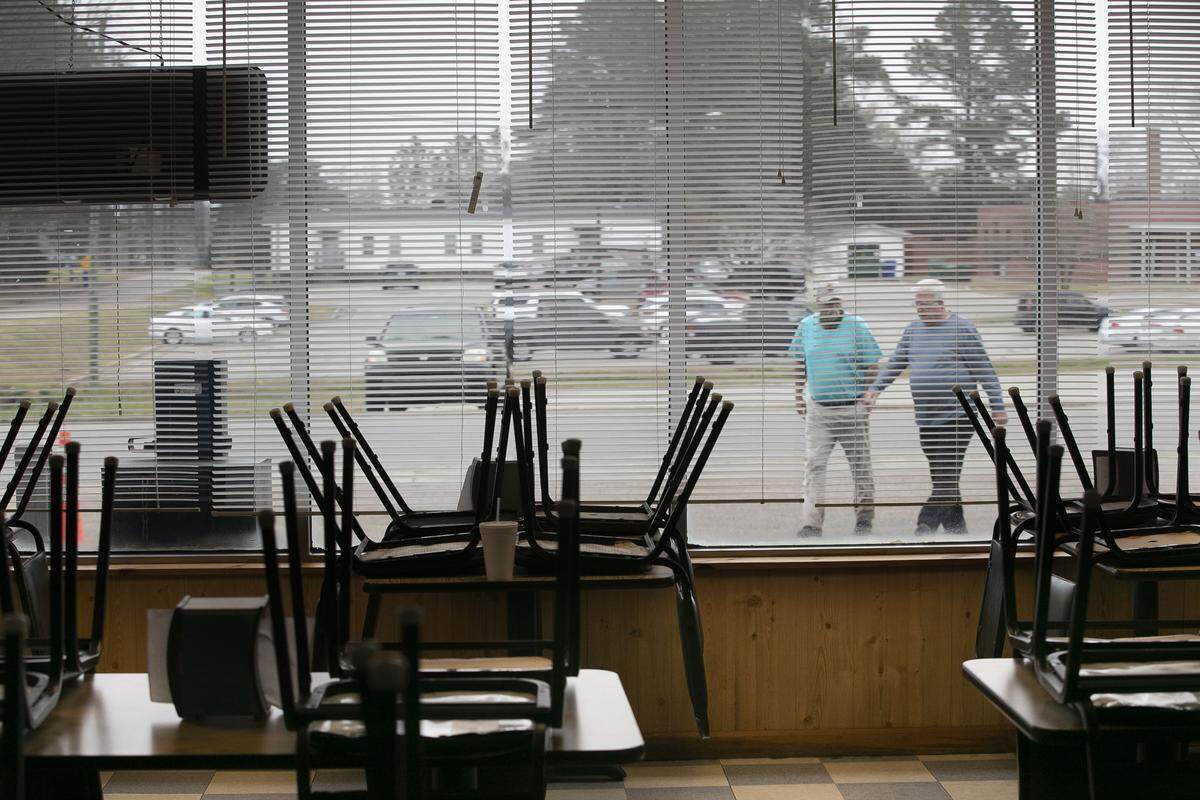
For decades, that has been the routine for Odom and his friends: breakfast before dawn at the Nashville Diner. But now, he said on Thursday, “since this is going on, you can’t sit.” He was alone in his truck. Two others were parked nearby.
A few minutes before 5:30 a.m., the three men gathered outside the diner door. A sign referenced Gov. Roy Cooper’s mandate, issued Tuesday, to close all restaurant dining rooms amid the threat of COVID-19, the coronavirus disease. The Nashville Diner was takeout only.
Now the deadbolt unlocked and the door swung open. Odom was the first to step inside.
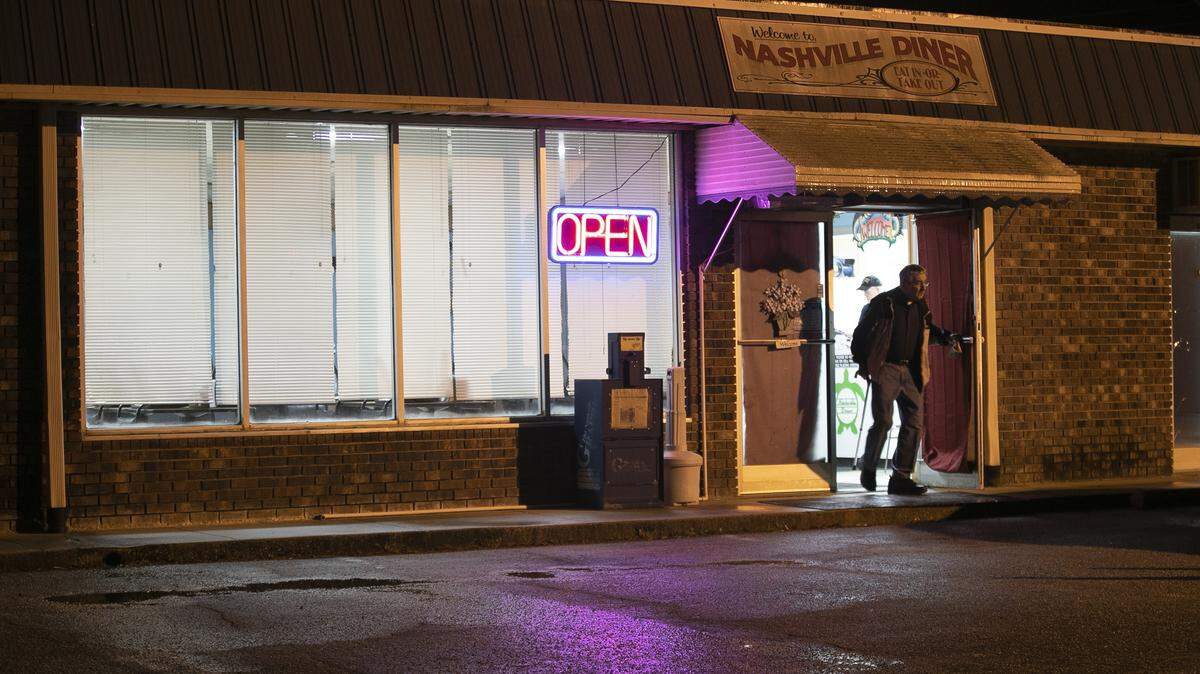
His order already waited at the register: a tenderloin biscuit, packed in a brown paper bag. As he walked in, Bob Davis, who runs the diner with his wife, pulled a cord to turn on the neon sign in the front window. The pink letters shined brightly in the darkness: OPEN.
Trying to keep up the routine
Inside, Tammy Davis and her husband had been working since about 4 a.m. He cooks the bacon, sausage and ham. She usually makes the biscuits. That has been their routine for a long time, and now they were trying to uphold it while routines were becoming more difficult to maintain.
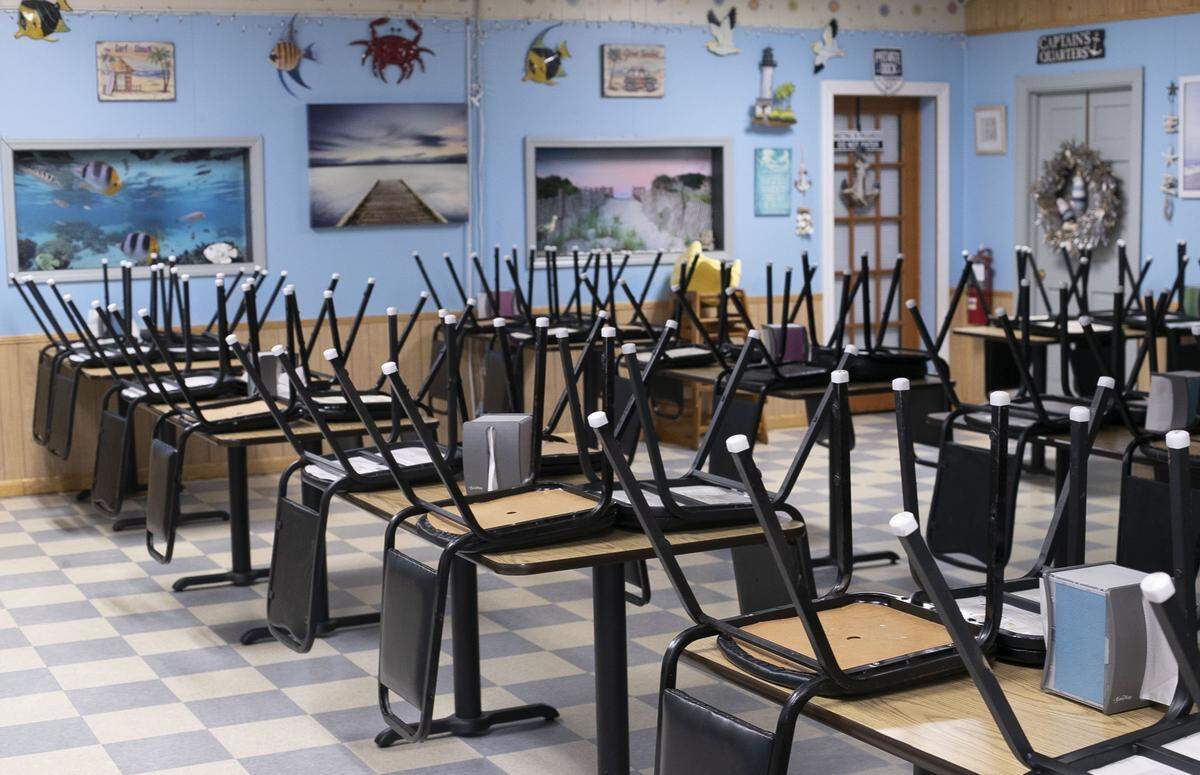
In little towns throughout North Carolina, there are many places like the Nashville Diner — those known as much for their sense of community as for their food. Now, the chairs were upside down on tables, and no one could be sure how long they might stay that way.
“They say two weeks,” said Tammy Davis, 60. She’s a Nash County native with the dialect to match. “I see it longer than two weeks. I’m seeing us going into May. Somewhere into there, to the point of getting a grip on what’s going on.”
Across North Carolina, the threat of disease has brought the state’s largest cities to a halt. Restaurants and bars have shut down indefinitely. Stores have closed. Schools have closed. Businesses sit vacant, employees working from home. Downtown streets are mostly empty.
Smaller towns, like Nashville, have for a long time felt removed from other parts of the state given the widening divide between urban and rural. Now, a week into a growing crisis, Nashville felt even more isolated. Tammy thought about some of her regulars, the older ones in particular.
“I’m sure a lot of them come out to get around people so they’re not by theirself,” she said. “If they can’t come sit and talk, then they’re not going to come.”
One more thing that’s different
The Nashville Diner regulars include farmers and firefighters, retirees and landscapers, county government employees and workers at nearby stores. Odom works just up the road at the NAPA Auto Parts store.
The diner can be a morning refuge, a part of life. Now it’s one more thing that’s different.
Early on Wednesday, a retired couple pulled into the parking lot, like always.
“They came in expecting to sit down and eat like they normally do,” said Bob Davis, who wore a black Wake Forest hat in recognition of his alma mater. “Which I thought was a little surprising, because don’t you think it’s hard to miss this now on the news? Some understand, a lot don’t.”
More than one of the customers who picked up an order on Wednesday morning expressed doubt about the need for all of this — restaurants closing their dining rooms, the mandate for social distancing. One man, who didn’t want to give his name, said “it’s a lot of panic for no reason.”
“Let us know what it is but don’t try to scare us to death where everybody think it’s the end of the world,” he said. He expected things to be back to normal in “probably a good week or so.”
Like fiction, but with real-world consequences
Others were not so sure. Billy Roberson walked in around 7:30 Wednesday morning. He and his son, J.D., come in a few times a week. They work together outside, a tree removal service. The biscuits keep them coming back to Nashville Diner.
A few days ago, Roberson, 66, called his brother and said, “Is this like ‘The Stand,’” referencing the Stephen King novel, “or ‘The Walking Dead?’”
It felt like fiction except with real-world consequences. They circled through Roberson’s mind.
“When people get laid off, and people can’t go to work — that’s going to create a big problem,” he said. “Because a lot of folks live week to week. And when you’re talking about week to week, some folks ain’t going to get paid, because the chairs are up. ...
“I hope Trump do what he says he’s gonna do — is send people money. Send people checks. That’ll help relieve some of the tension. But I hope he’ll go ahead and get a grip on it, and figure out what’s going on.”
Outside, through the window, the signs of the fast-food chains near U.S. 64 shined through the trees. Bojangles’. McDonald’s. Tammy Davis — known as Miss Tammy when she’s working the diner — figured those big chains would make it through OK, regardless of how long this lasted.
What about her place? What about her people?
‘A little bit scary’
Parts of Eastern North Carolina are shrinking fast, the population declines mirroring the loss of economic opportunity. The decline isn’t as pronounced in Nash County, but it’s still there. Between 2010 and 2018, Nash’s population declined by almost 2,000, according to U.S. Census data. Only 12 of the state’s 100 counties lost more people.
Still, there’s pride here. Exit the highway and one of the first things that becomes visible is the sign that welcomes visitors to “the original” Nashville. Up the road a little ways, there’s a new courthouse. A couple new businesses, including a coffee shop, have opened downtown.
A little ways past there, stately, historic homes line either side of the street. A long time ago, people built big houses and settled down here. Now they leave more often than they arrive, and the people who come off of the highway might not make it past the Sheetz, just beyond the first stoplight.
The people who’ve remained have always faced something of a shaky future in recent times and now, like everywhere else, there’s no telling how an extended public health crisis might change people’s lives here. The past two days, reality was just starting to set in.
“I think it’s a little bit scary,” said James Warrick, a landscaper who ordered a tenderloin biscuit, with egg, at the diner. “The little bit scary part is grocery stores. You go in there and everything’s gone and people are trying to grab everything up.”
In Nashville, there aren’t an abundance of options. A Food Lion. A Wal-Mart. A Piggly Wiggly.
Bob Davis made the rounds recently to pick up some bread for the diner and found a shortage of it. He searched for chicken and found none. He figured the supply would come back soon enough. Some of the diner’s customers, meanwhile, worried about how long they might be OK.
“It’s sad,” said Katie Pridgen, 34, who ordered a ham, egg and cheese. “I mean, usually when I come in here, just about the whole dining room is full. And just like I told them, I don’t know what people are going to do as far as jobs and everything like that.
“Luckily, I’ve still got mine.”
She works at a daycare. J.D. Wells, another regular, runs the cabinet shop next door.
He’s been coming to the diner for 40 years, since he was a kid. Different people owned it back then. Now Wells is 50. He said he doesn’t pay much attention to the news, but he saw something on Facebook about the disease, and mass graves, and he wondered if everything he read on there was true.
“I try not to watch much news,” said Wells, a muscular man with a clean-shaven head. “Because I keep my cup half full. You watch that, and you’ll be depressed. And I think that’s a lot of people’s issues. So yeah, you can blow it up with drama real quick, from the press.”
Still, Wells had a feeling people might be underestimating what’s to come.
“They say two weeks,” he said of things being shut down. “I’m guessing the minimum’s a month. I’ve got a feeling it’s going to be probably a month. No doubt. I’d hate to see it stretch out into the summer time. That would be sad. I mean, I can handle my end.
“I can go home and go to work. Long as I can sell cabinets.”
Trying to keep the bills paid
Tammy Davis long ago stopped needing to measure ingredients. When she makes biscuits, which she has done most mornings for the past 21 years, she does it by feel.
“There is a science,” she said. “And if you don’t get it right, your biscuit knows it.”
She knows whether she’s done it right when she finishes mixing the dough. If the consistency feels right, then it is. In recent days, the creation of biscuits — mixing the dough, then arranging it into 12 little piles on a pan — has alleviated stress.
There is a soothing order to the process. And now, outside of that, there is little order.
Inside the diner on Wednesday and Thursday, she and Bob turned on only half of the lights to save on electricity. They prepared only about half of what they normally would. Normally, they’d have had a staff of seven or eight, including several servers. They had a staff of three the past two days.
Gladys Evans, 64, arrived at 4:30 a.m. on Thursday. Another biscuit expert.
“I just don’t let nothing worry me,” she said, and Tammy tried to adopt that approach.
Yet it was more difficult, what with the responsibility of ownership. She’d had a difficult conversation with her staff after restaurants were ordered closed. She promised to give her workers as many hours as she could. She’d rotate them. She promised to help them.
“If you can’t pay a bill, tell me,” she told them. “I will do everything possible to help you pay that bill. Don’t lose everything you’ve got.
“I will help you any way that I can to make sure that your bills are paid.”
Yet she had her own bills, too.
“They’re going to continue to come in,” she said, “when my revenue is cut down to a third. Or even less. It might not be that. I’m hoping at least I’ll stay to half where I’m at, but ...”
“That’s probably optimistic,” said Bob, who studied business at Wake Forest and then taught it at the local community college for more than 30 years.
“Yeah,” Tammy said. “But we’ll do the best that we can.”
Doing it for the people — and the people keep coming
On Wednesday, Tammy made six trays of biscuits — about half of what she’d normally make. She sold all of them, and that was a small victory. Maybe this could work. Usually, about 35% of her business might be takeout. Now it had to be 100%, for who knows how long. On Thursday she and Bob offered lunch, too, including a special of ham hock and spaghetti with potatoes, beans and a choice of dessert.
“And we do have some pound cake, but it’s going quick,” the cashier told a customer on the phone, with a drawl as sweet as country iced tea. The foot traffic was steady, the regulars waiting at 5:30 a.m., followed by mini rushes around 6:30 and 8.
“If I made enough here yesterday to pay the utilities, your gas that you’re running, and the few employees that I had here, I’m very lucky — which I very seriously doubt,” said Tammy, her gray hair pulled back underneath a camoflauge beanie. “But we’re doing it for the people that do want to come in.”
And people did want to come in. They were people like Gilbralter Douglas, 73, a retired welder who usually sits by himself. On Thursday he ordered a sausage and egg biscuit to go. And Billy Roberson and his son, who both came back in for the second consecutive day. And J.D. Wells, who did the same. And a woman who showed up before her shift at Bojangles, in her Bojangles shirt and hat, and ordered a biscuit from the diner.
It was as if that worker from Bojangles had heard Tammy’s pleas to support the mom and pop shops around town. For two days she’d told her customers that she’d walk their meals out to their cars, that she’d deliver breakfast to their neighbors, and especially to the elderly. One retiree had come walking in slowly on Wednesday, using a cane to brace himself.
“This is what you call dedication,” Tammy said to the man, whom she called Mr. Sonny. “Hey, Mr. Sonny —if you call us, we’ll bring it to your car. You do not have to get out.”
“I’m fine, I’m fine,” he said, dismissively.
“Thank you Mr. Sonny. Mr. Sonny, we’ll be here for lunch tomorrow!”
“OK, all right,” he said.
All around Nashville and beyond, life had been thrown into flux amid the specter of disease. The Nashville Diner offered a small reprieve, moments at a time.
When the world turned upside down, leaving her diner chairs the same way, Miss Tammy made biscuits. She showed up in the darkness, like always. She found peace working with the dough in these anxious moments. Soon enough, a few of her regulars were gathered outside, waiting for the OPEN sign to turn on.
This story was originally published March 20, 2020 at 9:57 AM with the headline "A country diner and its biscuits provide a reprieve from coronavirus in small-town NC."


.JPG)
.JPG)