We’ll get a busy hurricane season, NOAA agrees. Here’s what NC & the East Coast might see
While they rarely form a consensus on what path an individual storm will take, forecasters are nearly in agreement that this year’s Atlantic hurricane season is likely to be one of the busiest ever.
The National Oceanic and Atmospheric Administration released its forecast Thursday and it lines up with those other meteorologists have made so far this year. Like others, NOAA forecasters say a La Niña expected to form in the Pacific by August and near-record high water temperatures in the Atlantic are likely to fuel heavy tropical storm activity this summer and fall.
How many storms does NOAA expect this year?
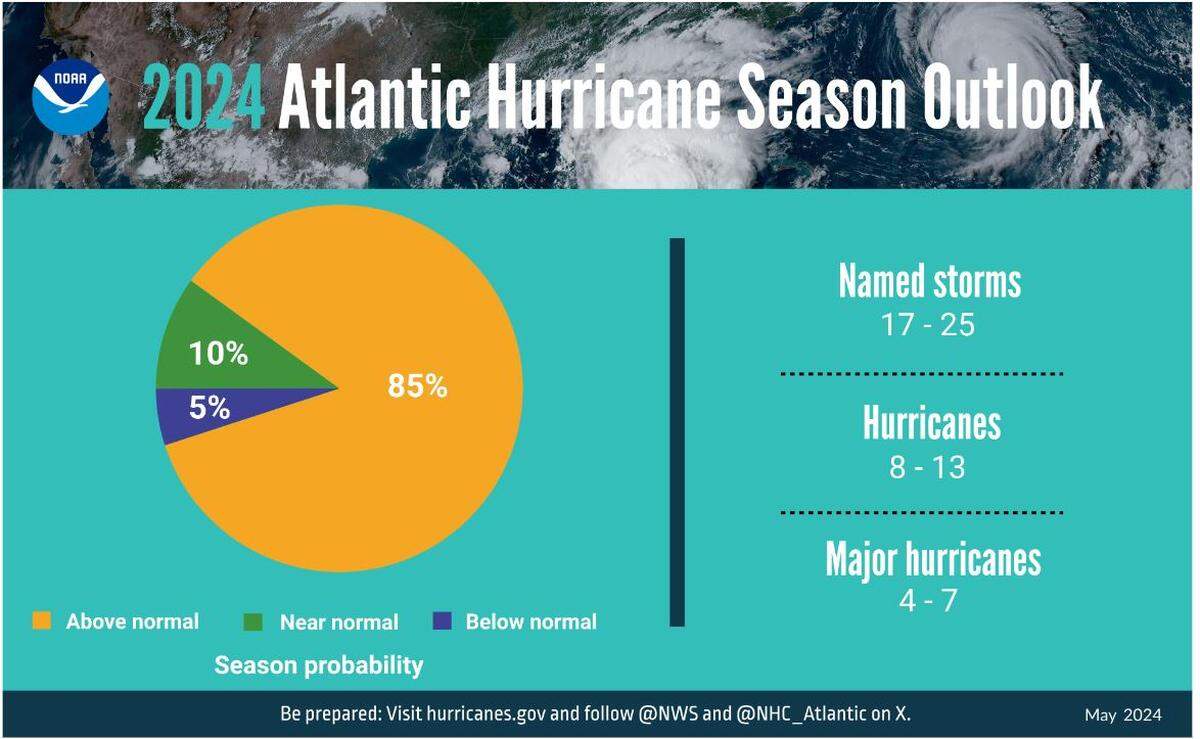
Forecasters at NOAA’s Climate Prediction Center said Thursday there is an 85% chance of an above-normal season and only a 5% chance of a below-normal season.
Specifically, NOAA’s forecasters predict with 70% confidence:
▪ 17 to 25 named storms, meaning those with sustained winds of 39 mph or higher.
▪ Eight to 13 of those will become hurricanes, with winds of 74 mph or higher
▪ Four to seven of the hurricanes will be “major,” meaning they’ll fall into Category 3, 4 or 5, with winds of 111 mph or higher.
In their report released in April forecasters at Colorado State University called for:
▪ 23 named storms
▪ 11 hurricanes
▪ Five major hurricanes
According to NOAA data from 1991 to 2020, an average season has 14 named storms, seven hurricanes and three major hurricanes.
Colorado State researchers’ numbers land within the range of NOAA’s predictions.
How many storms could make landfall on the East Coast?
NOAA does not make predictions about the likelihood of a hurricane making landfall, which Colorado State does.
▪ The university has said its forecasters estimate a 62% chance of a major hurricane making landfall this season somewhere on the entire continental U.S. coast, higher than the 43% chance on average from 1880 to 2020.
▪ Colorado State’s researchers estimate a 34% chance of a major hurricane making landfall somewhere along the East Coast this year. The average probability from 1880 to 2020 was 21%.
What does the La Niña have to do with hurricanes?
After an exceptionally strong El Nino that has been weakening through the spring, NOAA says a La Niña is expected to develop between June and August. Like an El Niño, a La Niña affects the ocean and atmospheric circulation in the tropics, NOAA says, beginning in the Pacific and rippling around the globe.
The agency says that a La Niña generally leads to a more active Atlantic hurricane season because it reduces vertical wind shear over the Atlantic. Wind shear can break a hurricane apart by weakening its circulation and limiting the heat and moisture it can gather. Without wind shear, it’s easier for hurricanes to grow and strengthen.
Why make predictions about the number of hurricanes?
After NOAA shared its hurricane-season forecast on social media, some responses accused the agency of hyping the risk or just trying to scare the public. But the agency says it makes the predictions to remind people that it’s better to consider the possibility of severe weather long before it arrives.
“Severe weather and emergencies can happen at any moment, which is why individuals and communities need to be prepared today,” FEMA Deputy Administrator Erik A. Hooks said in NOAA’s release. “Already, we are seeing storms move across the country that can bring additional hazards like tornadoes, flooding and hail. Taking a proactive approach to our increasingly challenging climate landscape today can make a difference in how people can recover tomorrow.”
How close was NOAA on its forecast last year? Did NC have a hurricane in 2023?
The Atlantic basin saw 20 named storms last year, meaning 2023 had the fourth-most named storms of any year since 1950, NOAA said. Seven storms were hurricanes and three became major hurricanes.
Those totals fell within the agency’s forecast range after it was updated in August. Originally, NOAA expected 2023 to be a near-normal year for hurricanes, but in its August update, it upgraded to a forecast for an above-normal year.
Only one hurricane — Idalia — made landfall in the U.S. last year, when it came ashore in Florida.
Tropical Storm Ophelia made landfall in North Carolina, coming in at Emerald Isle with 70 mph winds and heavy rainfall that caused significant river and storm surge flooding in portions of eastern North Carolina.
What is the Farmers’ Almanac hurricane forecast?
The Farmers’ Almanac predicts several periods of heavy rain and thunderstorms through the Atlantic hurricane season, which runs from June 1 to November 30. It mentions the possibility of a tropical storm or hurricane in the Southeast only three times:
▪ A hurricane threat along the Gulf Coast Aug. 28-31
▪ A hurricane threat along the Eastern Seaboard Sept. 12-15
▪ Heavy tropical rains over Mississippi Sept. 20-23
Finally, from Nov. 28-30, as hurricane season comes to a close, the Almanac says a storm will hug the Atlantic Seaboard, “bringing increasing winds, copious precipitation” for Thanksgiving Day. It doesn’t say whether that’s a tropical storm.
This story was originally published May 24, 2024 at 9:56 AM with the headline "We’ll get a busy hurricane season, NOAA agrees. Here’s what NC & the East Coast might see."