Laws require language support for students. Many SC districts are ‘exploitative’ instead
Dozens of South Carolina school districts provide unequal educational opportunities to students because of where they’re from, a McClatchy review showed.
When answering an unprecedented survey reporters sent to S.C. districts last summer, many openly admitted to using bilingual students as translators instead of hiring professionals to interpret for children whose parents don’t speak English. That’s against the law.
Other districts kept essential academic information away from parents by sending it home or posting it online in a language they couldn’t understand. Without the language support, students interviewed by McClatchy reported being made to feel inferior to their English-speaking classmates.
Many others fall behind in school. Hispanic students across South Carolina drop out at a higher rate than both white and Black students. In some districts, the Hispanic drop out rate is three to five times higher than the average for all students.
“The children are paying the price,” said Deborah Santiago, the co-founder of Excelencia in Education, a national group that advocates for Latino student success in higher education. “The reality is they are not serving this population of folks that need English language support.”
Unequal access to education is hardly a new problem in South Carolina. After a Black student in Clarendon County drowned while trying to cross a reservoir to get to school — Black children in rural Summerton lacked school buses while white ones nearby had plenty — Thurgood Marshall represented 20 Black parents in one of the lawsuits that made up the Brown v. Board of Education case decided by the U.S. Supreme Court. The historic 1954 decision ruled against the “seperate but equal” system that had repressed S.C. Black students for centuries and prompted desegregation.
Those civil rights era reforms increasingly need to protect international children, too. Over the past two decades, the Hispanic population in South Carolina has at times grown faster than anywhere else in the country. The number of children in state schools classified as not yet fluent in English has risen with it. Since 2000, that number has exploded by almost 800%. As a whole, students who speak languages other than English make up nearly 1% of those enrolled. But in districts where the growth is strongest, like Beaufort, there are more Hispanic students in some classrooms than any other racial group.
All districts are required to overcome the language barriers those children or their parents have in order to provide education without discrimination against “race, skin color or national origin.” A family member’s legal documentation status makes no difference, the U.S. Supreme Court decided decades ago. Districts still must identify all individuals in need of language support, provide professional interpreters so parents can communicate with educators, and inform multilingual parents of the same programs English speaking parents would be aware of, the federal guidelines state.
School representatives admitted they commonly struggle to comply, pointing out that neither the state nor the federal government offers much money to help them.
“We can’t even fill regular classroom positions,” said Jack Hutto, the director of communications and grants in Hampton 1, a rural district. “We’re doing the best we can with the resources we have.”
Providing language support is not optional, however, no matter the amount of funding available. Since 2017, the U.S. Justice Department has publicly identified only two large districts in South Carolina — those in Horry and Charleston counties — as being out of compliance.
Now, for the first time, McClatchy is publishing data showing the extent of the problem across South Carolina — and the impact the reporting appears to have already made on government policy.
Widespread “exploitative” use of student translators
Starting in May, The State and The Island Packet newspapers asked each of the 81 school districts then in South Carolina a series of questions regarding the language support they provide to students. Most of the districts responded — 90% of them. Their answers, sent to reporters over email or in response to public records requests, suggest a staggering reality. In small and big ways, school districts of all sizes in South Carolina have been violating the civil rights of their students.
If just one enrolled student or their parent needs a translator, schools are required to make sure they get one. But in 42% of the 43 districts that counted more than 100 Spanish-speaking families among their students, schools did not employ a single full-time or part-time interpreter. Just four of those 43 international-heavy districts had more than five translators on staff to assist with over 100 families’ interpretation needs.
Spanish-speakers make up the largest community of families who need translation in South Carolina. But 21 districts also enroll more than 100 families who speak other languages, like Portuguese, Vietnamese and Mandarin. Only four of those districts said they had dedicated interpreters on staff in languages other than Spanish, the survey answers showed.
To fill those gaps left by educators in charge, more than a dozen rural and metropolitan districts admitted to violating federal guidelines by using bilingual students as translators.
When answering the survey, 19 school districts acknowledged they used children as interpreters, though the guidelines state only trained professionals should be called on to do the job. Another 20 districts did not directly answer the question or said they weren’t sure.
“Basically, they’re not even aware enough of how this is problematic,” remarked Dr. Ben Roth, the interim associate dean for Diversity, Equity and Inclusion and an associate professor at the University of South Carolina.
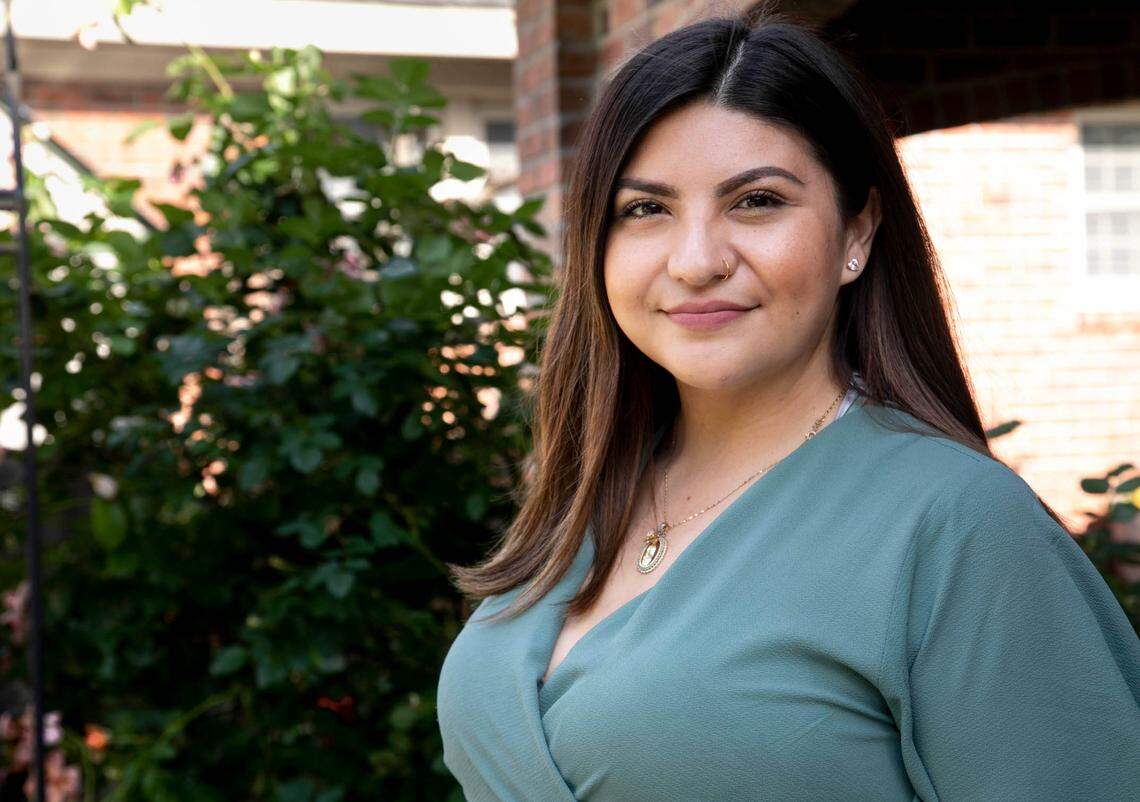
Alejandra Gonzalez-Rizo, now in her mid twenties, remembers how working as an unpaid child translator impacted her learning in Spartanburg. Her Mexican parents were never once provided with a professional interpreter when they needed one, like in parent-teacher conferences, she said. In those kinds of situations, Gonzalez-Rizo was the one who had to step in and do it.
That meant that instead of the educators helping her to succeed, she — the child — was forced to take on their responsibilities.
There was “absolutely no support, nobody helping my parents with translation,” she remembered. “It was all on me to translate to my parents from as early as 5 years old.”
And the handouts teachers gave her to take home were always written in English — never in Spanish, as the federal guidelines require in situations like hers. Her father used to spend hours pouring over the forms, flipping through his Spanish-English dictionary to try to understand them.
Gonzalez-Rizo bore the consequences in the classroom. Her mother never knew how to participate in the parent teacher organization or when snacks were supposed to be brought to school — things the other moms seemed to understand. She remembers “a constant sense of being inferior.”
![Gonzalez-Rizo, pictured here in a Spartanburg pre-school photo, said her parents always felt removed from her life at school, “because [they] were the Hispanic family.”](https://www.thestate.com/public/latest-news/jlcuk/picture259651475/alternates/FREE_1140/IMG_9709.JPG "IMG_9709.JPG")
Jackie Mayorga, a young adult raised in Columbia who attended schools in Richland Districts 1 and 2, also recalled children were used as translators there. But they went even further than in Spartanburg, she noted. Bilingual students were asked to translate not just for their own parents, but for the Spanish-speaking parents of other students, too. When asked in the survey last year whether they still used bilingual students as translators today, neither Richland district answered the question directly.
“It’s exploitative,” said Mayorga, whose parents speak Spanish and Otomi, an indigenous Mexican language. “Instead of hiring somebody, they used other students.”
Students translating on behalf of schools is “definitely not allowed,” said Dr. Julie Sugarman, senior policy analyst for PreK-12 Education at the Migration Policy Institute, a think tank based in Washington, D.C.
“It’s a terrible idea on many levels. It’s pulling them out of education to do a job, and they’re not getting paid for it,” Sugarman said. “But they’re also not qualified.”
When asked to interpret for the parents of others, it’s even worse, the analyst added, because the second student’s privacy might also be violated.
Six of seven international students interviewed by reporters who attended public schools in the Lowcountry, the Midlands and the Upstate said their non-English speaking parents frequently had no access to professional translators or translated school paperwork. All reported struggling academically because of it.
Some school districts defended their use of student translators, saying the practice is difficult to avoid.
Hutto said his rural district would love to provide professional interpreters for the multilingual students that need them in Hampton, but with current teacher shortages, qualified personnel can be nearly impossible to hire.
“We try our best to recruit but there are lots of struggles to recruiting people to rural districts,” he said. “We just don’t have the funds.”
If there’s a breakdown in communication when a child is translating, the school will try to find someone else who can help — sometimes another parent and sometimes someone who isn’t a certified teacher, he explained. Though larger schools tend to have much more people and finances to draw from, he pointed out, Hampton has to follow the same federal guidelines.
Despite their additional size and resources, however, larger districts said something similar.
In many schools like those in her district, it’s routine for a bilingual child to step in and start explaining school-related issues to a parent who doesn’t understand them, said Melissa Robinette, a spokesperson for Spartanburg District 5. A professional might be called later to offer help.
But representatives from the South Carolina Department of Education confirmed using children as translators at any point is illegal and should not be happening.
“It’s important to note that per the Civil Rights Act of 1964, local school districts are obligated to provide language access regardless of whether or not they receive federal funds,” said Derek Phillips, the agency’s director of communications.
“It’s not the responsibility of that student or the family to provide translation services,” added Zach Taylor, who leads the agency’s diversity team and is involved with the state’s accountability office. “It’s a civil right of that family to receive, free of charge, interpretation and translation.”
Experts like Sugarman say that if districts clearly understand what the law prohibits in regards to language access — and have a plan in place for how to respond appropriately to the needs of multilingual learners — situations that veer into violations of the federal guidelines can be prevented.
But the majority of districts in South Carolina appear to have nothing of the sort.
In many SC districts, bare translation minimum not met
Only a quarter of South Carolinian school districts that responded to the McClatchy survey — 17 across the state — produced a form that showed how they planned to provide the legally-required interpretation and translation services for students.
In one district, Beaufort County, representatives told reporters they would draft a plan only after they were asked for the document. Others made only vague reference to the fact that the services were required by law. Still worse, others pointed reporters to state-level documents that did not specify how their district planned to adopt them or provided reporters with policies that never mentioned interpretation services and the laws that require them.
“That information is not currently in policy,” responded a representative from Orangeburg.
“The plan is currently being developed,” said Charleston.
Just a few districts, including Dillon 4 and Lexington 1, showed in the documents that they understood the federal rules and had interpreters available.
That lack of planning for language access may have led districts to resort to measures experts regard as insufficient. Most districts surveyed shared that they contracted with telephone-based interpretation services.
But using a remote service to translate instead of asking someone to do it in person is often not good enough, explained Roth, the USC professor. Communicating through a bilingual educator is almost always a better option for families that don’t speak English, he added, since it establishes trust with parents and allows them to build a relationship with at least one educator who speaks their language.
“It’s like a stop gap of sorts but it does not address equality concerns,” he said about remote translation.
Immigrant parents looking for information online are also often left without much help when trying to obtain critical information from their children’s school websites, a review of the online sites showed.
The majority of public school systems in South Carolina enable their websites to be translated through a service like Google Translate that allows the information to appear in other languages. Still, in most of those cases, the tab parents would need to click to translate the content is often difficult to find. Sixty websites only mark it in English. Others bury it at the bottom of the page.
That’s not the only issue with the sites.
Content translated by Google into another language can be riddled with errors. Many professional website creation services that offer the Google feature, like Wix, require clients to disclaim that “translations may be flawed or inaccurate.” But in South Carolina schools, just one district warns parents that the computerized translations can’t always be trusted. Only Richland 2 cautions visitors that “computerized translations are only an approximation of the website’s original content.”
Any translation online is still far better than none. That’s the dire situation for seven South Carolina school districts, including Dillon 3 and Florence 4’s school systems. None of those districts had any kind of translation feature to make their website content accessible for families that don’t speak English.
When schools fail to ensure their information can be read by multilingual parents, their already-vulnerable children can fall behind in countless ways, Roth pointed out. Without knowing it, parents can miss critical deadlines for things like signing their children up for summer school, he said. Santiago, the national expert, added that parents can be unaware their children could obtain even essential services provided in school free of charge, like speech therapy.
Roth was sympathetic about how difficult it can be for South Carolina schools to afford translation services on their tight budgets. But the law makes it clear, he said. Educators have to find a way to support multilingual families — as some rule-following schools in the state already do.
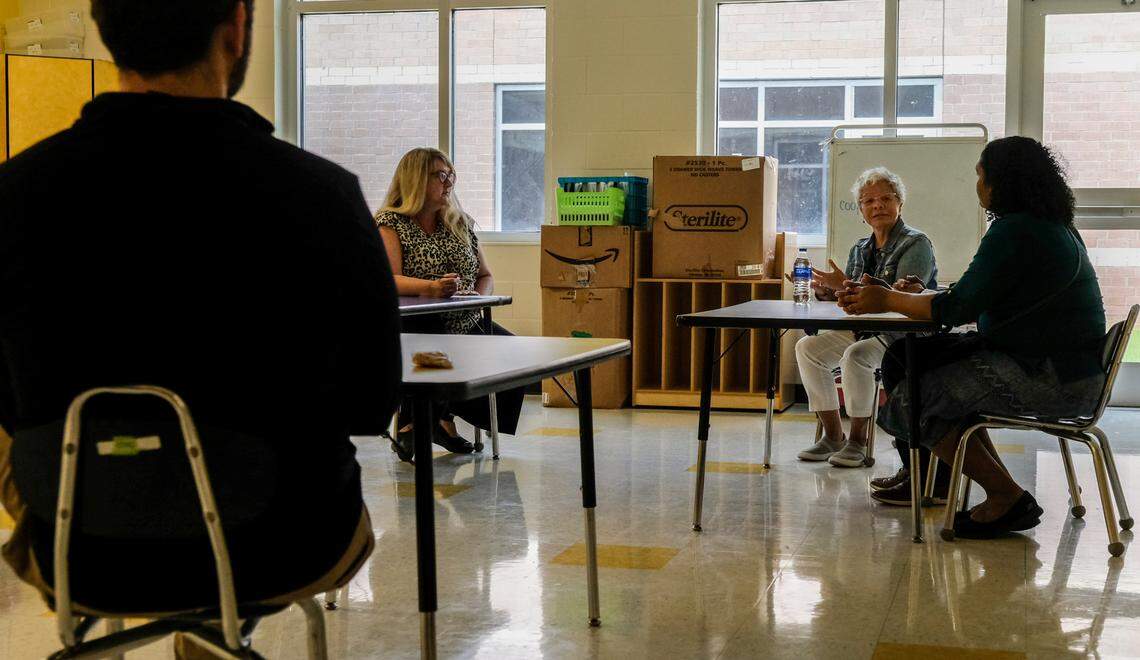
He suggested a few steps South Carolina districts can take to do better by their students.
“You start by who you hire; this is not rocket science,” Roth said. “We need to be intentionally recruiting and training bilingual, bi-cultural professionals.” (This deceptively simple solution is made more difficult owing to the fact that South Carolina still prohibits often bilingual “Dreamers” from obtaining state licenses, a topic The State investigated in 2021.)
Beyond that, schools should prioritize the voices of families at the margins, he said. They can do that by forming partnerships with local nonprofits familiar with the Hispanic community, as some in Greenville have done. Or they can find the employees in their district that are already forming trust with multilingual families and build on their momentum. Or they can learn from schools in other states that went through this decades ago, like those in North Carolina and Georgia. Or they can think of creative ways to engage multilingual parents, like offering childcare at events or meetings in the evenings instead of during the day, when immigrant parents might be working.
And if the school districts still find themselves without the ability to comply for lack of money, the professor believes the government should step in to change that.
“The state ought to provide some options for them. There should be collective resources for districts that are feeling stuck,” Roth said. “At some point someone needs to take responsibility and say, ‘This is a problem and we’re going to solve it.’”
Representatives from the S.C. Department of Education told reporters they currently give districts informational assistance. They suggest how to comply with federal guidelines, identify vendors for translation services and monitor schools for compliance on a five-year basis, they said. They do not, however, provide the financial resources that districts indicated to reporters would help them support students
But after learning of the results of the McClatchy survey, which officials said were “very helpful,” the agency did make some improvements. By the start of the upcoming 2022-23 school year and for each year afterwards, the agency told reporters in March, as part of their enrollment paperwork, all districts will have to include a questionnaire identifying students in need of language support. The new process also allows families to be notified from the beginning of their right to obtain translation and interpretation services.
Whether the moves will be enough to prevent children from continuing to pay the price for their schools’ inaction remains to be seen. Many still remember the experience with bitterness.
“It was hard on me as a student,” said Gonzalez-Rizo, the Spartanburg graduate. “I had to put my learning second.”
This article was translated into Spanish by Noticias Nuestro Estado, a local Spanish language outlet. It can also be read on their website.
This story was originally published April 4, 2022 at 8:00 AM with the headline "Laws require language support for students. Many SC districts are ‘exploitative’ instead."